Brass bands, the backwoods and bugle boys.

I grew up in a pint-sized town where we had one of everything: one post office, one school, one grocery store and a helluva lot of one-dimensional thinking.
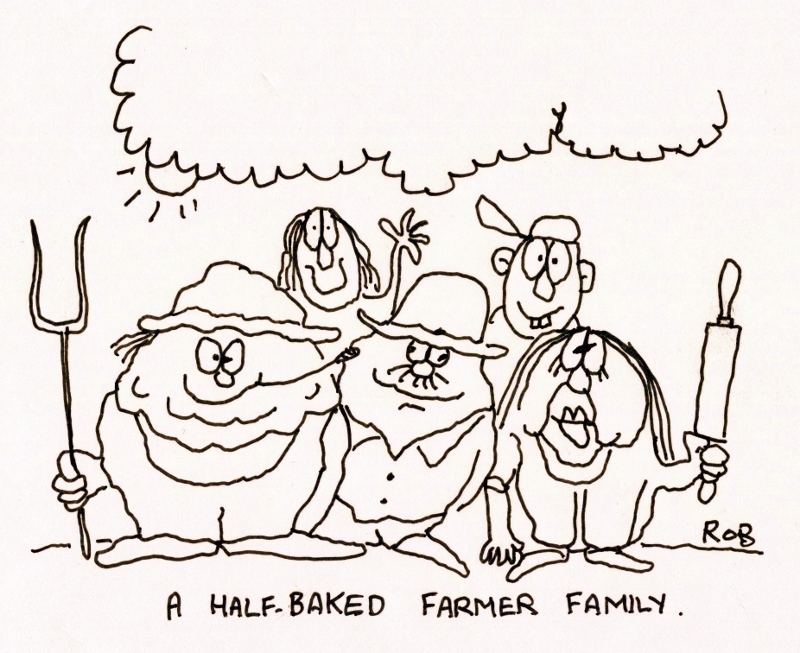
Half-baked (800x653)

It’s not that I criticize the folks from my childhood home, because this was normal to me. We were a half-baked bunch of farmers and families with an unsevered umbilical cord that received a good, solid yank from the motherlands of northern Europe on a regular basis. Accents still sprouted through the soil even through years of plowing the old languages asunder. And my reference to half-baked couldn’t be truer, in that anyone who has spent some measurable amount of time in the upper parts of the Midwest will agree that the sun’s grace and efficacy was short-lived and insufficient. It usually left many of us looking like pallid, stodgy bakery goods with no leavening agent.

Accents (800x711)

It was a safe and dependable place to grow up. The cows were content, the back roads straight and you could set your watch after waving to Mr. Sobieski as he headed out in the morning to go fishing and came back in for meals. Betty’s Café always served pie, the Miller’s butcher shop had the best big pickles in a barrel, and the lake was either covered by ice or algae, but sometimes both—depending upon the season.

There was another thing that happened like clockwork in our village, and that was the annual Memorial Day parade. As a scabby-kneed kid, all I cared about was being close enough to the curb to scoop up a Tootsie-Roll or two as the 4-H float came rolling by, its riders tossing candy into the crowds. And maybe I wanted to catch a glimpse of the oldest Gold Star Mother as she was transported down Main street, likely wishing she was being honored for anything else other than having lived longer than every other mother in our town who lost a son or daughter in dedication to our country’s service.

Goldstarmum (800x584)

When I was old enough to ride the 4-H float myself, I only hoped my aim was sure and that I wouldn’t blind some poor elderly woman who was probably only there to show strong moral support to her Gold Star Mother best friend on the float behind me, and who was now weeping openly at having caught a Tootsie-Roll in the eye.

When I was a teenager, my main focus was finding some way to gain membership to the high school marching band. Since I played the oboe, my instrumental participation was nixed. My suggestion of having an oral surgeon striding in scrubs a foot behind me was a solution no one agreed with, as it would mess with our formation and color coordination, That meant I could twirl flags or rifles. Since the flags were three times the size of the rifles and much easier to spot if you screwed up on the routine, it was a no brainer. I learned how to snap, twist and hurl a chunk of wood. It was incredibly impressive. And incredibly loud if it fell. Which was often.
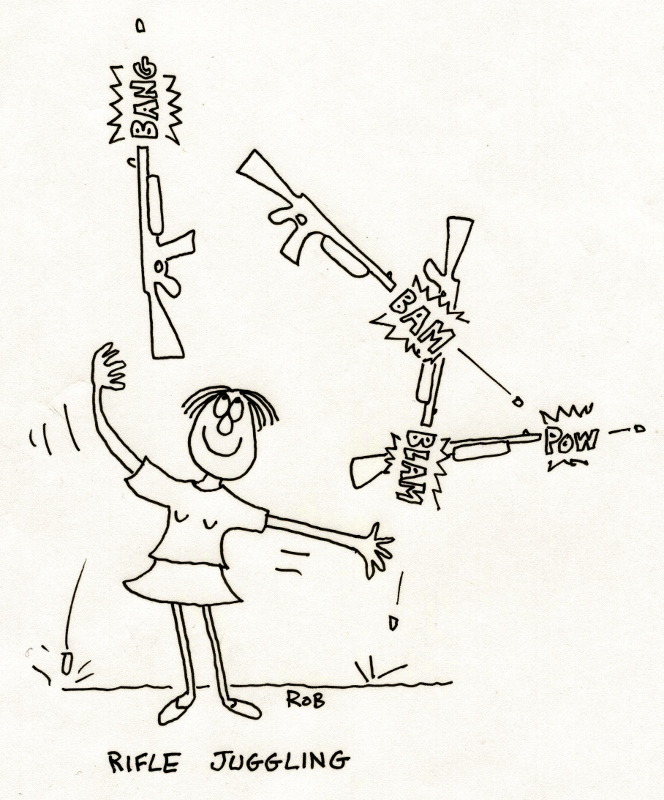
Riflejuggling (664x800)

The coolest thing about the marching band—and in particular the flag and rifle corps—was that we were outfitted in full Scottish regalia. It was also the hottest thing about the marching band. Covered head to toe in folds, layers and bolts of heavy, tartan wool, we prayed it never rained during the parade, causing us to smell like fetid farm animals and creating a cavernous gap between us and the floats before or after the band. And we kept our fingers crossed it never got above fifty-two degrees, at which point you were beyond sweltering and marchers would start dropping like flies. As long as we could contain most of the drum section, folks didn’t seem to care. It wasn’t like we were throwing out candy or anything.

The parade lasted all of about five minutes, there being only the two floats and the marching band, but once you knew it was over, the whole town would follow behind and bring up the rear, walking in time to the remaining drummers until we reached our little town park and the local swimming hole, which was no bigger than a large rainwater puddle. Here, everyone would gather round the flagpole, listen to Pastor Anderson give his memorial sermon, see the wreath dedicated to our fallen soldiers be placed in position, hear the three or four men representing the American Legionnaires fire their arms in salute, and lastly, listen for the bugle player from the marching band—hidden somewhere distant in the woods—follow the gunfire with Taps. Our fingers were always crossed in hopes that he was not one of the members lost along the parade route. Our fingers were also crossed in hopes that he remembered to practice the night before.
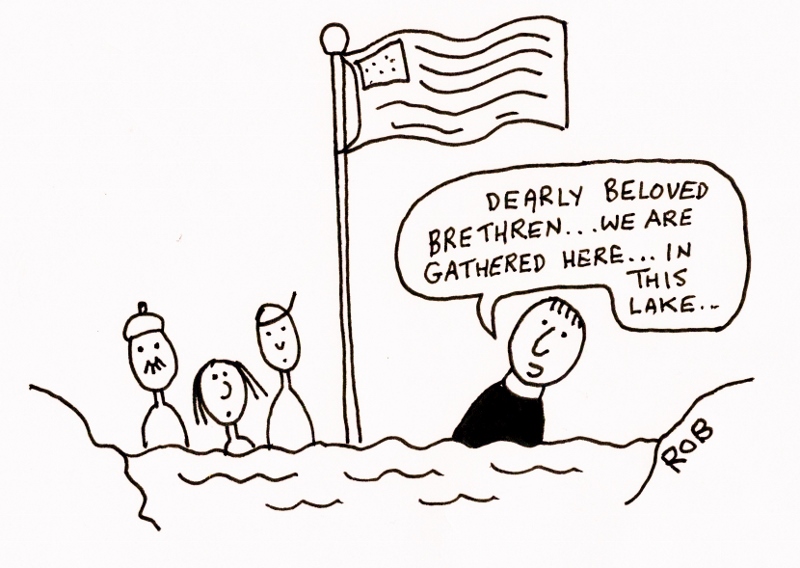
Lakesermon (800x568)

No matter how old I was, what part I played, or what accents murmured around me, I understood the message: This was important.

More important than fishing, pie or pickles.

This was freedom.

English: Members of the 86th Airlift Wing base...

My country, ‘tis of thee, sweet land of liberty, of thee I sing; land where my fathers died, land of the pilgrims’ pride, from every mountainside let freedom ring!

~Shelley

Don’t forget to check out what we’re cookin’ in the Scullery (here) and what we all talked about down in the pub (here). And to see more of Robin Gott’s humor–all from the only pen carved from a human funny bone–click here.

Related Articles

Don’t kill a mockingbird.

My grandmother once said to me, “A girl should be like a diamond. The more facets she has about her, the more appealing she becomes.”

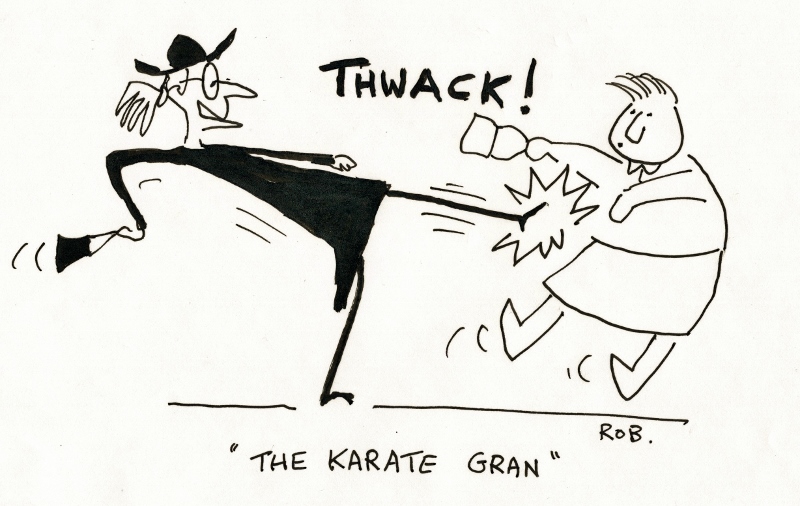
This came from a woman who had to leave high school to work the family farm, and then went to night school to get her GED so she could work her way through the accounting department at JCPenney’s. She was a whiz at math and took exceptional pride in the opportunity to beat any cash register when pitted against it. She owned a grocery store, was a caterer, spoke three languages, played a wicked golf game, took karate lessons and lastly, took a course in How to Build Your Own Bomb Shelter.

Karategran (800x506)

She was not your average mother’s mother.

I tell you this because lately, as I’ve been hunched over the ever-spreading, perpetually-broadening mass of weeds that infest my garden floors, I am accompanied by the cheer-infusing, thought-provoking song of a mockingbird.

This warbling, mimicking, capricious minstrel strikes me as one who’s still searching for just the right fit, testing the waters by dipping a toe into many a pool to satiate the desire for true fulfillment. He wears an array of caps, and within a minute or two, cycles through a search for the answer to, “Am I a blue jay? How ‘bout a cricket? Now I’m a blackbird. Let’s try a hawk.” Continually learning new songs and sounds to imitate, he is the quintessential skill builder.

Cockatoo (800x573)

History has taught us that typically, we had precious little time to attempt adding anything more to our daily calendar than hunting, gathering, breeding and fighting. Include all the hours we spent building alters and purification fires, creating feasts and paying homage to our many gods, and it’s easy to see how your whole day is shot. Worship is a full time job.

The Industrial Revolution altered our schedules, along with our standards of living, nutrition, life expectancy and for some, the ability to now get a table at trendy restaurants. Everything depended upon which rung of the social ladder your foot rested on.

But coal mining and factory work wasn’t for everyone. Especially, those who didn’t want to face a piece of equipment that made their prior skills irrelevant. It’s easy to see how a person who studied the fine art of lacework for the bulk of their life could be persuaded to join the League of Luddites and go all “John Henry” on a piece of machinery.

English: Frame-breakers, or Luddites, smashing...

English: Frame-breakers, or Luddites, smashing a loom. Machine-breaking was criminalized by the Parliament of the United Kingdom as early as 1721. (Photo credit: Wikipedia)

And then came the growth of mass education–reading in particular. At first, it was largely influenced by religion because holy books weren’t just there to make the coffee table in the parlor pretty and Books on Tape hadn’t had a chance to record that big guy yet, nor make the tape they’d eventually use for the project. So literacy was key. And now that we could read, we were given access into other people’s thoughts, opinions and experiences. Roughly speaking, it expanded our circle of campfire stories exponentially. The act of taking in new information usually has some measurable impact on the average Joe. It often shows up in the form of thinking. Thinking can lead to action, action could lead to dancing, and as some religious leaders of the world believe, it’s usually all downhill from there.

Slipperyslope (800x762)

But in a few other parts of the world, thinking led to the awareness of dissatisfaction. And that led to big action.

War.

Cue women to join us onstage in the giant chorus of the workforce. You know what happened then, don’t you? It was a tiny little thing, but it had a big impact on career aspiration. THE PILL.

Yep. Now women were growing bolder with the knowledge that they had choice in deciding when to have a family, if at all. Finding a vocation suddenly became a word dripping with possibility.

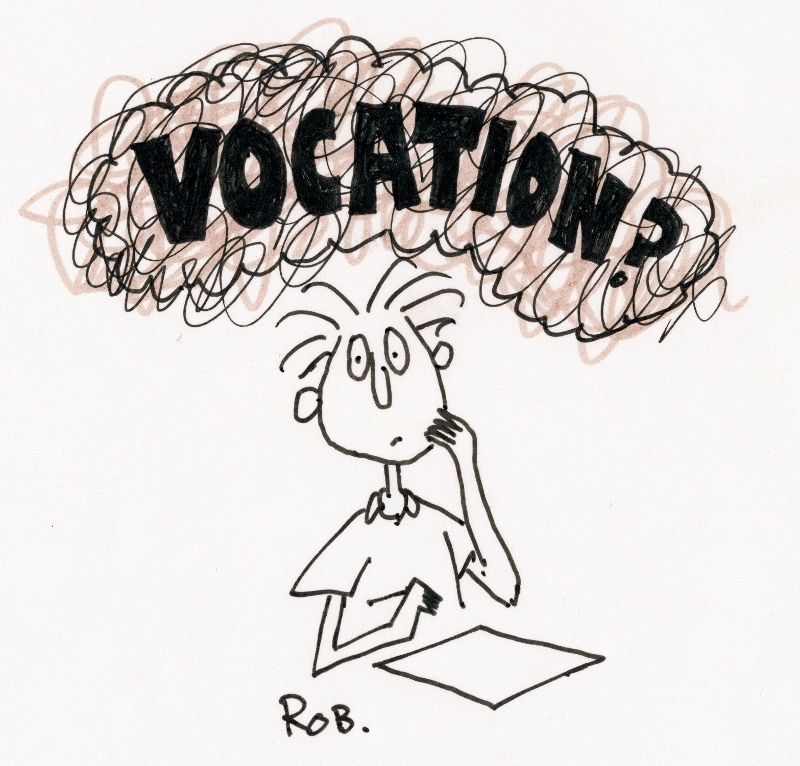
Sadly, many of us are encouraged to make those occupational picks at much too early an age. Facing a guidance counselor, who spreads out a dozen career pamphlets in front of you, or visiting a high school college fair often leads to hasty decisions. Now you find yourself propelled onto an ill-suited professional track from the idiotic act of putting your name down on a clipboard simply because they had a bowl of brightly-colored candy sitting beside it.

Vocation (800x766)

As a parent attempting to guide my firstborn through the highly stressful process of college searching, the one piece of advice I find myself repeating is this: Don’t specialize.

Over the last several years, hearing my children (okay, and let’s face it, a great chunk of children going through our current educational system) utter the words, “I’m never going to use this,” when referring to homework from a subject they detest, puts my mouth into automatic gear.

“That’s not the point,” I lecture. “The point is you are learning how to learn.” And until we modernize our schooling ideas, this is the best rationalization I can come up with.

I don’t think it’s a bad one.

It’s a critical process that will ultimately help each one of us attempt something new, or challenging, or death-defying. Who says we have to stick to only one career, one calling, one song? I admire my grandmother for her desire to not only plow the fields of her farm, but those of her heart’s ambition. And maybe that mockingbird is my grandmother reminding me, as I clear away the weeds, not to neglect planting a variety of seeds in their place.

English: The Strawn-Wagner Diamond, the only p...

So I say grow a little. Stretch out of that comfort zone. Whistle a new tune. Chip away at something new and hard. Be like a diamond.

Sparkle.

~Shelley

Don’t forget to check out what we’re cookin’ in the Scullery (here) and what we all talked about down in the pub (here). And to see more of Robin Gott’s humor–all from the only pen carved from a human funny bone–click here.

Call Me Scent O’ Mental

Five Senses

Five Senses (Photo credit: TheNickster)

If you had to give up one of your five senses, which would you choose?

I’m speaking of the traditional five we humans possess with some (but in some cases no) degree of functionality. Which one would you find most difficult to part with?

Your sense of taste? Sight? Smell? Touch? Hearing?

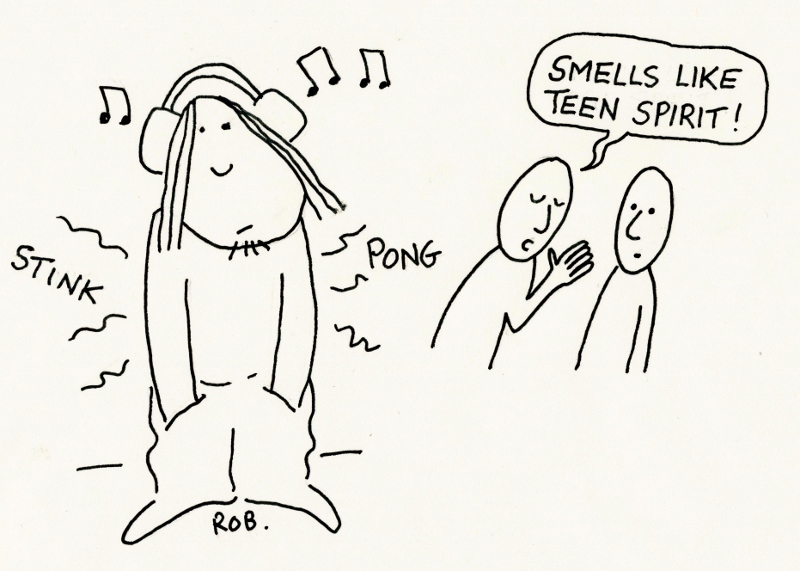
Many of you may already know the answer to this. Maybe you would relish the chance to never again force down Auntie Mabel’s mock meatloaf soufflé. Perhaps one more hour of listening to Junior practice Bach’s Fugue in F flarp is more than you can stand. And your world might be slightly more bearable if, when you opened the door to your teenage daughter’s bedroom, you were not greeted with a view of everything it contained strewn about her bed, the lampshades and every square inch of the expensive plush carpeting you were coerced into believing she desperately needed to fulfill her ideal living conditions, capable of propelling her academic aptitude through the roof as she judiciously studied upon it.

Teenspirit (800x571)

For me the answer is simple: I would give up everything else as long as I could keep my sense of smell.

Although nothing remarkable to behold—no profoundly protuberant schnoz of Groucho Marx status, no perky, upturned Tinkerbelle snippet cutely pinched in the middle of my face–it is by far my favorite bodily feature.

Our sense of smell is particularly mysterious. And as I’ve come to find out, an action that still continues to befuddle some scientists. I’ll do my best to explain—in crude fashion—why this is so.

There is more than one belief as to how we perceive smell. A widely accepted theory is that floating molecules are brought into direct contact with olfactory receptors (a postage stamp sized patch of neurons way in the back where your nose and throat meet), and those receptors decode the combination of molecules by SHAPE and supply your brain with an answer that suggests the name of whatever substance you inhaled. (Put six carbon, ten hydrogen and one oxygen atoms together— cis-3-hexenal—and the light bulb in your brain sends up a flare shouting, “Fresh cut grass!”)Oldfactory (800x649)

Imagine closing your eyes and being handed a banana. Likely you’d identify the fruit simply by its shape and feel—the smooth skin, the slight pliancy, its curvature, the dry, sharp stem—rather than having to peel it, sniff it, view it, or taste it for further confirmation. The architecture is a specifically designed puzzle piece that fits into one particular enzyme receptor. Every molecule has a distinctive combination of bumps, grooves, ruts or ridges, and its partner, the enzyme receptor, identifies it exactly. It’s a shape code.

A not as widely accepted hypothesis (and one that is scoffed at in some labs) is that smell is not shape, but SOUND. Molecules quiver with vibration and, in a sense, sing. A rather hefty and unwieldy scientific instrument known as a spectroscope is capable of identifying those notes and will easily recognize each molecule by its tune, which brings us to the uncomfortable conclusion that we all have our very own spectroscope jammed up inside our noses.

I told you my explanations would be inept, but I thought it necessary to take a crack at it.

Fascinating science aside, and the argument which names you as either a “shapist” or a “vibrationist,” the nose is wholly remarkable in that it can communicate vital information, allow deeply imbedded memories to resurface and, propel us into every emotional state known to human beings. With just a simple sniff.

Shapist (800x672)

Bring a ripened wedge of brie to your nose and you are transported back to your youthful summers working on a dairy farm when you were desperate to save up enough money for a new bicycle.

Walk into your basement and recognize the whiff of sulfurous “rotten egg” and you’ll flip a U-ey, head outdoors and toward the nearest phone to call your gas company regarding a dangerous leak.

Accidentally burn the sugar you’re caramelizing on the stovetop and you’re awash with memories of summer camp, log fires and gooey s’mores.DSC07974 (800x450)

The jury is still out regarding whether or not our human noses can detect pheromones and the messages attached to them, but scent psychologists suggest it would certainly explain a lot of eyebrow raising relationships that befuddle common sense.

To be fair, your sense of smell is intricately tied to your ability to taste. Place a bowl of jelly beans before you and pinch your nose shut.

Jelly Belly jelly beans.

Jelly Belly jelly beans. (Photo credit: Wikipedia)

Select a bean without peeking at its color. Place it in your mouth and begin to chew. I challenge you to identify its flavor. It’s sweet. There’s texture. But until you release the hold on your nose and breathe in and out, you’ve got bubkes. Nothing.

Imagine walking into a kitchen on a crisp, fall day and missing the cloud of cinnamon and butter over a newly emerging sizzling apple pie from the oven.

Picture yourself pulling open the door of the local mudhouse and never again embracing the dark, chocolaty scent of deeply roasted coffee beans.

Envision a trip to the seaside and not finding your head filled with a wind that carries the salt-crusted briny ocean and the clean fragrance of deep sea creatures.

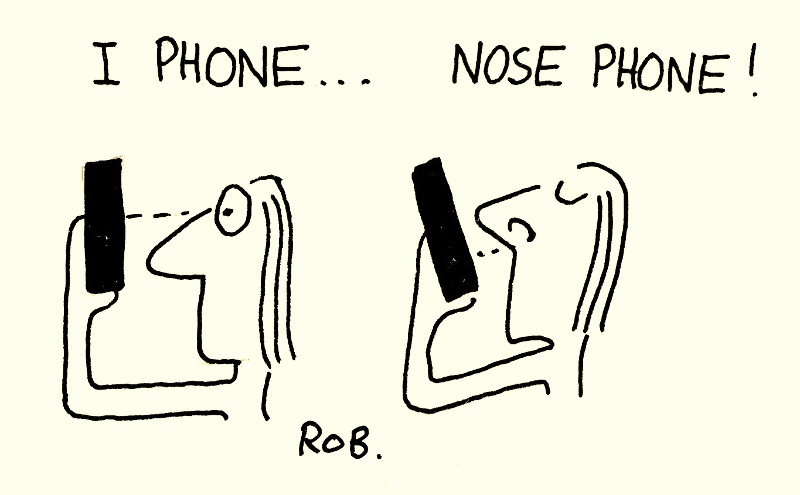
Did you know that your nose is capable of recognizing around 10,000 odor molecules?

Nosephone (800x495)

When I think about how many sounds my ears can pick up, it usually varies between those of hungry animals or grousing teenagers. Everything else gets washed out. When I take my eyes off of my computer screen and look around, I see mainly hungry animals or grousing teenagers. I’m fairly certain that if all this keeps up, I will shortly be snapping with sharpened fangs at said animals or teenagers and will therefore be able to tick off one more sensory experience.

Regardless of my written musings, the question always makes me pause for thought. Which sense would you cling to most?

Of course, there’s one other sense I could not bear to part with …

my sense of humor.

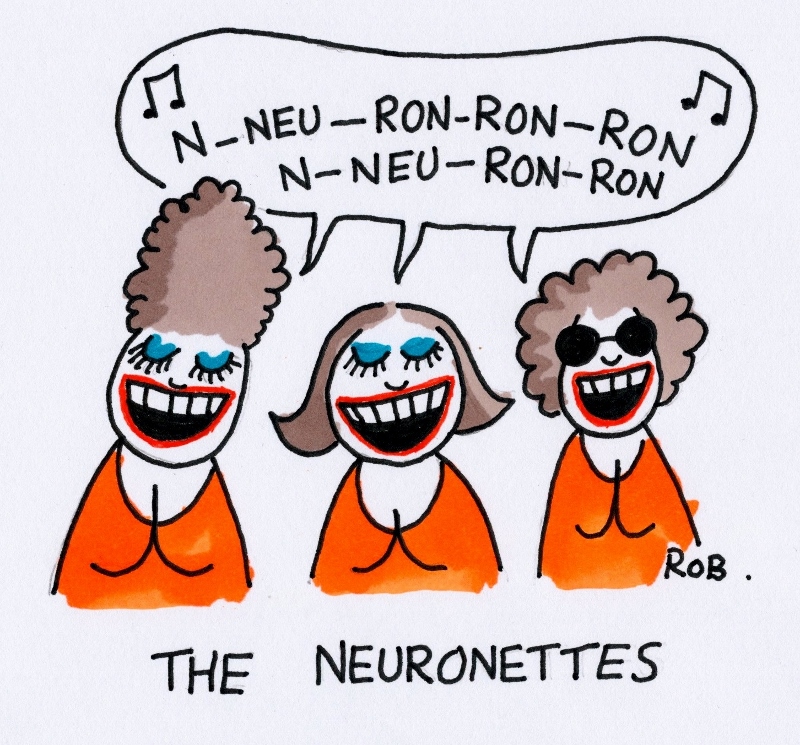
Neuronettes (800x745)

Not too sure I’d want to part with Rob’s either.

~Shelley

Don’t forget to check out what we’re cookin’ in the Scullery (here) and what we all talked about down in the pub (here). And to see more of Robin Gott’s humor–all from the only pen carved from a human funny bone–click here.

Mister Rogers, Mae West & Mexicans; a beautiful blend of bedfellows.

File:Fred Rogers.jpgHow does one define a neighbor?

If you’re Mister Rogers from the thirty year hit children’s television show Mister Rogers’ Neighborhood, it’s everyone watching on the other side of the camera. Granted, that audience was mainly comprised of three to six-year olds who were simply in search of a thirty minute eye-glazing nap, but we were present nonetheless. The fact that he called both me and Julie Ziggler his neighbor—and we were pen pals in separate states—made the term confusing and spurned a few poorly written crayon arguments between us as to where the good man truly lived, but that’s neither here nor there anymore.

When I was a couple years older, “neighbor” meant the elderly folks who were the recipients of our May Day baskets on the first of that month. Stuffed with flowers, and maybe a sweet or two, the tiny wicker bins were dropped off on our neighbor’s front porch before we rang their doorbells and dashed away. The dashing part was easy, as the rule was if you were caught by the recipient of the basket, they had kissing rights. Eeyuck.

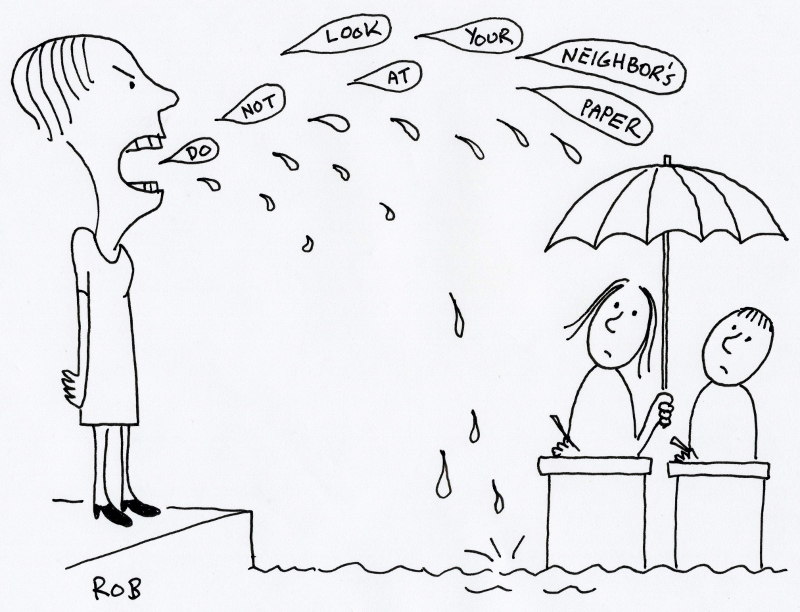
Then there was the constantly drilled in phrase, “DO NOT LOOK AT YOUR NEIGHBOR’S PAPER,” articulated with a spray of spittle that easily reached across a classroom of nervous test takers. And this, of course, intoned not only fear of one’s classmate, but suspicion as well. Again, I think the word suffered.

Spraysay (800x612)

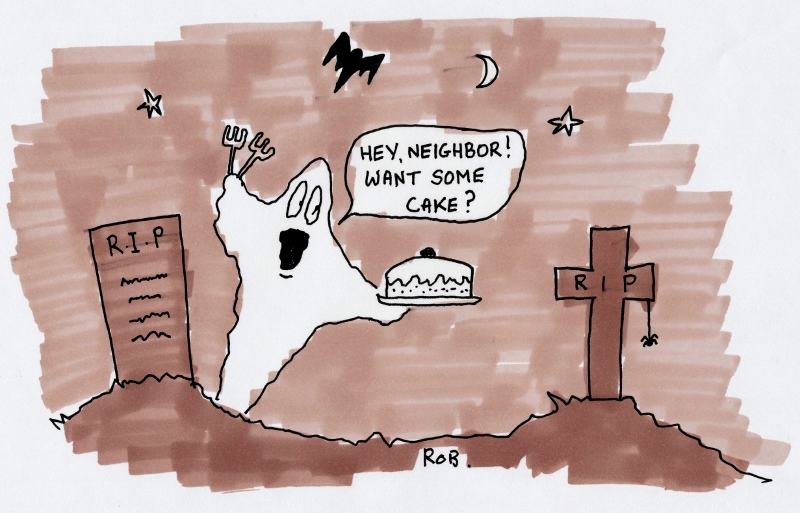
Just last week, I received an inbox full of reminders to participate in Neighborday (April 27, 2013 for all 50 states and growing globally), where folks were encouraged to do more than attempt to make eye contact with the person in apartment 3B with whom you’ve shared an elevator ride with for the last year and a half. Elevator (800x772)Paste up flyers, set up a grill and have a block party, or make a cake, bring two forks and ring the doorbell of the guy who lives next door, or coordinate a “Thanksgiving in spring” dinner at your local park, or run around your block singing John Jacob Jinglheimer Schmidt while bashing cymbals together and see if you can get everyone to join in the parade. Be creative, they said. Try not to get arrested, I add.

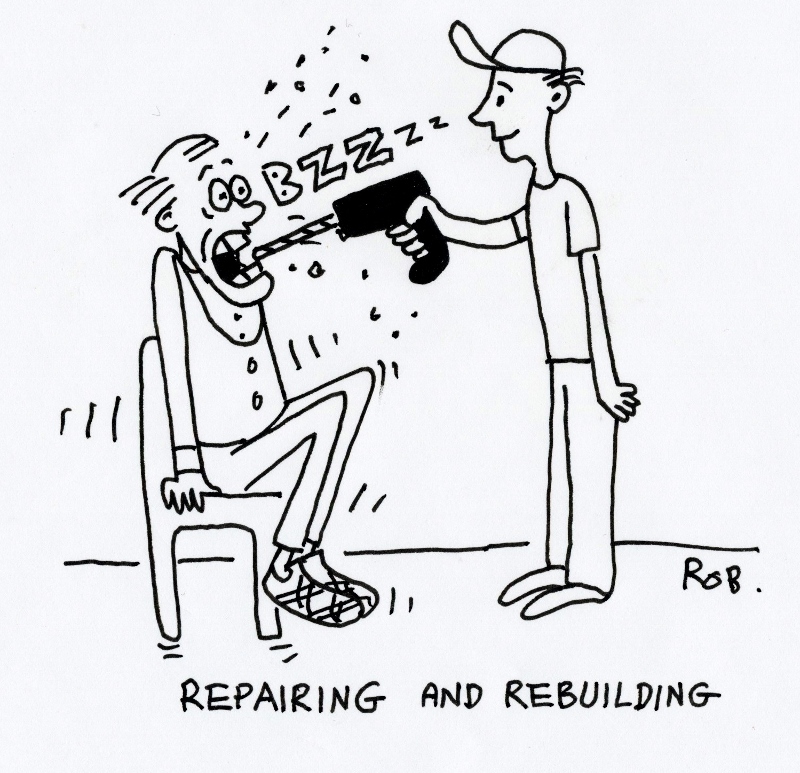
This April, my son had an opportunity (read had no choice) to spend a week working with his classmates, repairing, rebuilding and reviving structures needed by folks living in a much more impoverished area of our nation. What he came away realizing was that whether because of a natural disaster or naturally bad luck, when trouble comes a callin’, you pray your neighbor answers the phone.Teethrapair (800x773)

I think what moved those teenagers in such a monumental way was the understanding that all it really takes to make a difference is a drop of desire to do so. One pair of hands is a blessing to most folks, but one hundred pairs are enough to bring you to your knees.

That truly takes the definition of neighborly to heavenly heights.Monsterhands (800x737)

Today, many people in both America and Mexico will celebrate Cinco de Mayo; a momentous day in history (May 5th, 1862) when a meager and poorly outfitted Mexican army overcame the leading and most powerful militia of the time, a case of David beating Goliath, a day where the notions of freedom, democracy, unity and national pride are passionately cheered for until the margaritas take over and make everything worthy of raising a glass in toast. And since it would be churlish not to acknowledge our neighbors to the south and offer them our sincerest words of congratulations regarding such a feat, I’d encourage you to haul out the bar blender and find that old lime rolling about in the back of the fridge’s fruit bin.

Graveyardcake (800x513)So whether or not you decide to make that cake, ring and run with a basket, or extend your hand, I encourage you to give a thought to Fred Rogers’ beloved song, and in particular, my favorite part:

So let’s make the most of this beautiful day,
Since we’re together, we might as well say,
Would you be mine? Could you be mine?
Won’t you be my neighbor?

Screenshot of Mae West from the trailer for th...

Lastly, I leave you with a quote from Mae West (who falls about as far from the position on the personality spectrum as Mister Rogers, but I wanted to be fair in my research):  Love thy neighbor – and if he happens to be tall, debonair and devastating, it will be that much easier.

~Shelley

Don’t forget to check out what we’re cookin’ in the Scullery (here) and what we all talked about down in the pub (here). And to see more of Robin Gott’s humor–all from the only pen carved from a human funny bone–click here.