Rabbit Holes: Some Call it Daydreaming, Writers Call it Work

Aristotle argued that all objects craved their “natural place,”—the geocentric center of the universe. That would be Earth. Okay, well at the time Aristotle was sucking in air Earth was considered the be all end all.

And maybe yes, there exist a few folks who still believe this and are lagging a bit behind with their history homework, not having quite caught up to where the rest of us live—aka more than two thousand years in the future. And within the world of fairly trustworthy science.

Although, to be fair, the science we all believed one hundred—or even one thousand years ago was believed to be trustworthy too.

Until it wasn’t.

Regardless, it was explained to me that ‘Aristotle believed that a dropped rock fell to the earth because rocks belonged on earth and wanted to be there.’

This is from a book currently resting on my bedside table: But What If We’re Wrong? By Chuck Klosterman.

Often, I liken myself to Aristotle’s rock. I belong at my desk, in front of my screen, with my hands hovering over my keyboard, and my eyes effortfully scanning words across a page.

Except thankfully, there are other forces of nature at play (read friends and family) that repeatedly fight Aristotle’s idea of gravity where I am concerned, shoving me out into the world where people and ideas are in mix and at play.

I am not at all a fan of going places where you have to make eye contact with others, or exchange words that add up to more than those in a haiku, or share the same oxygen molecules. This behavior comes about just before birth when whichever deity is creating your personality profile decides you’ll be a professional recluse and switches on the genetic codes for artless, awkward, blundering bore.

But ultimately these opportunities are the catalyst that make the question WHAT IF burble up from the basement of my brain. And that is not an altogether unpleasant feeling.

It starts like indigestion but then belches out with measurable relief.

Yes, regularly I collect data to support the theory that I should simply stay home and away from crowds (read anyplace another person is already occupying), but more often than not, I am wide-eyed with surprise to discover the hidden gems of history, or art, or that people have moved on from wearing elastic waist pants and eyeglass ropes.

Except no. Turtlenecks are here to stay, dammit. (And the earth is the center of the universe … Yeah, yeah, I hear you.)

The WHAT IF question is one I have pinned up on my computer screen. It is the foundation for creative thinking. And creative thinking is the foundation for creative writing. And creative writing is the foundation for paying my bills—as people will not buy books that scream, “I’m exactly like that story you just read yesterday only my characters are Latvian!”

Yeah, not gonna fly.

But how many of us practice asking WHAT IF (insert head scratching query here) in real life? Chuck Klosterman did because he had to write a book where he asked a pile of crackerjack thinkers questions about their level of confidence on subjects like physics, and time, and whether AOL would ever come back into fashion.

And I do it because the thought of copying someone else’s ideas and simply giving them a limp and an accent is about as creatively appealing to my brain as separating all of the lint from my dryer into individual color piles.

Also because I enjoy electricity and food. Again … near carbon copies of other people’s tales do not equate to financial security. And more often than not a lawsuit.

But in real life? I’m not terribly sure I engage in this examination. Not nearly often enough anyway.

And maybe not at all ever—but that would be wholly embarrassing to admit on a public platform so let’s all pretend I didn’t, okey dokey?

This is not some sort of mid-life crisis desperate attempt to fill ever widening, fathomless gaps in my life, but rather just an everyday exercise of whim and whimsy. And okay, maybe a touch of the age thing, but hush—just follow me here.

It’s a fairly effortless task in my working realm, as the sky is the limit ergo, nothing is absurd. I can confidently lean back in my chair and ponder the impossible:

WHAT IF my main character quit his job, won the lottery, or discovered he had cancer?

WHAT IF my guy slowly starts to disappear, or can now communicate with polar bears, or wakes up with knees that can bend fully backward?

WHAT IF he can think himself anywhere, or program the earth to stop spinning, or activate himself to become any element in the periodic table?

WHAT IF every fictional character ever written about comes alive? WHAT IF we discover that our laws of physics only work this way on earth because we’re stuck on some default setting of one on a scale of ten and the answer has been printed on the last page of every IKEA instruction booklet?

Yeah … rabbit holes.

But I rarely spend time going into that warren when I and my life are the subjects for consideration. And it might be fun—if not a little necessary at times.

We’re all full of certitudes in life. We’re sure our political view is wide enough, confident we think with deep consideration, positive we’re slightly above average—at least in comparison to the other yahoos we find ourselves surrounded by.

But what if we’re wrong?

What if I’m not really meant to be Aristotle’s rock?

What if I’m meant to be Aristotle?

If we’re all going to be proven wrong one hundred or one thousand years from now, where’s the risk, right?

Think the absurd. Be the absurd. Do the absurd. Accomplish the unthinkable.

Physician, heal thyself? How about writer, imagine thyself.

~Shelley


For the time being, the blog is closed to comments, but if you enjoyed it, maybe pass it on to someone else. Email it, Facebook it, or print it out and make new wallpaper for the bathroom. If it moves you, show it some love and share. Cheers!

Don’t forget to check out what’s cookin’ in the Scullery and what we all gossiped about down in the pub. Or check out last month’s post and catch up.

The Grave Danger of Being Silent

“Okay, you’ve got to choose one word. And one word only that will describe you and a representation of your life to be carved on your tombstone.”

I was at a writer’s meeting. And this was one of those wretchedly “fun” exercises we did to stimulate creativity, or imagination, or brain damage.

It was my turn. Everyone looked at me.

“Umm … whisky?

NO! was the general shout from all corners of the circle. Most of these people knew me well enough.

The host looked at me with a full measure of pity. A little bit like how I look at the dog after he’s eaten an entire stolen loaf of bread and he’s all swollen and gassy but still looking for more: pathetically.

“No, not whisky,” the host said in patient tones. “Whisky is something more of your life preference rather than your life portrayal, Shelley.”

Yup. Same look.

“Okay,” I said, determined to get this one right. “Then I choose voice.”

That answer got a woefully polite round of applause.

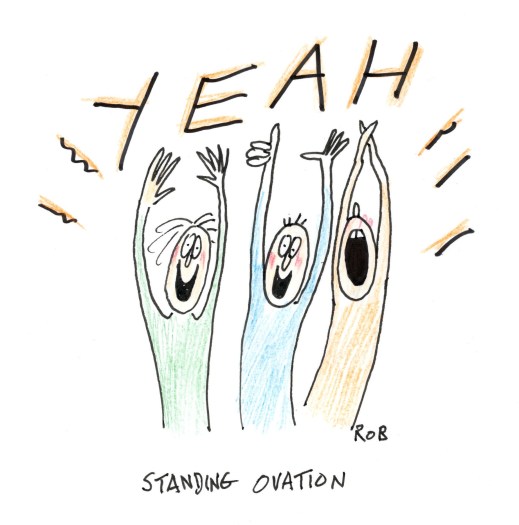
But the more I thought about it, the more I grew certain that it should have received a standing ovation. Because, in essence, it really has been the central theme threaded throughout my entire life—and every day, it grows more paramount.

In about two weeks, my next book will be published. (The Freemason’s Daughter) (disclaimer: Publicists and marketing departments get super cranky if you do not provide easy links to readers or refuse to say the phrase, “In my new book, The Freemason’s Daughter” as the start to every conversation. And let me tell you, it was a monumental challenge to work that one in with my seventy-four-year-old garbage man whilst handing him one more bag full of cat poop from the litter box.

“There are men in it,” I said lamely. Yeah, he was going to love my young adult novel about a sixteen-year-old Scottish girl.)

Anyway, again, in about two weeks, my next book will be published. I can hear all of you muttering the word finally.

And although this book has all the crucial motifs that appear in every coming of age story—the challenges of youth, friendship, love, relationships with six burly smuggling Scotsmen—the keynote theme that rose above all others was this: Where the hell do I fit in?

Now, granted, the voice that uttered this query at least one time in every chapter classed it up a bit with a lilting, girlish British accent, but it is, beyond a doubt, a central examination that needs answering by the end of the book.

And maybe it does get answered and maybe it doesn’t. I ain’t gonna spoil it for all of you. Especially ol’ Cooter Covington who promised he’d buy the book as long as I somehow managed to have the cat experience a fatal accident before he came back next week. But to find out … (The Freemason’s Daughter).

Funny enough, that question was present in my middle grade contemporary novel, DEAR OPL (Dear Opl – You’re welcome), about a thirteen-year-old American girl suffering from prediabetes and obesity who struggles with loss everywhere in her life except on her body.

Before that, I voiced that question as I made the transition from mandatory mother to partially needed parent to occasionally sought guidance counselor who receives messages like, “I’d like to schedule a major meltdown on Thursday evening after my class on linear algebra. Could you clear your schedule and send me a bucket of chocolate so I can have it there while you talk and I cry?”

My job status was shifting. And I needed to redefine some new position I could find fulfillment within.

And, quirkily enough, before all of that, my actual voice was the focus of my entire life. I got paid to sing. Once or twice I got paid not to sing.

The point is, “voice” has been stamped all over my forty-seven years of life.

Which brings us up to the present and the future—to my love for soothsayers and crystal ball gazers.

Because now, in recent months, voice has become a ubiquitous word. Rare is it a solitary strain, buried beneath the weight of larger, louder bodies that attempt to silence it. Rather now, it is a growing collection, a chorus, a rising refrain.

It is the sound of town hall meetings, the chant of protests, the carefully crafted question in a press corps meeting. It is the debate across the aisle, the conversations in the coffee shop, and the gossip over the garden fence posts.

It is the struggle to parse fact from fiction as myriad voices crow with what they believe to be true—or what they want you to believe as true. It is the concerted effort to eliminate the noise, to brush away the flashy and distracting so that you can uncover the naked, unvarnished reality.

Yes, it does exist.

And when we are able to do that—when we are finally able to hear inside our own heads, we will hear that sound that many of us have spent a lifetime ignoring. Our inner voice. The one that never lies to you. The one that says, Do not go out wearing those pants under any circumstances.

Yeah, that one.

The amazing thing is, is that all of those voices are asking the very same question—that one about inclusivity. Where the hell do I fit in?

We all want our voices to be heard, our words to matter, our existence to count. Whether we’re a president determined to believe we are the greatest, largest, tallest, (insert-superlative-here) guy to draw breath. Or we are the lowly chap who’s still trying to muster up the energy to clap as loudly for that president as we watch him wave from one of his golf courses and we finish the leftovers from last night’s TV dinner.

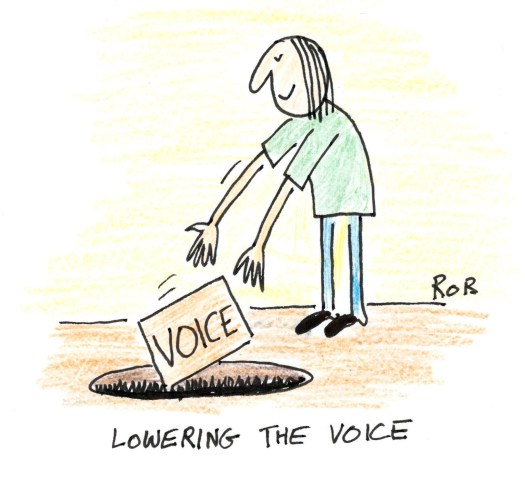
Forecasting the future is dicey work. Asking the hard questions about that future needs to be done—despite the unwelcoming off the cuff response of an extra tiny pointy finger barking at you to “Be quiet!”

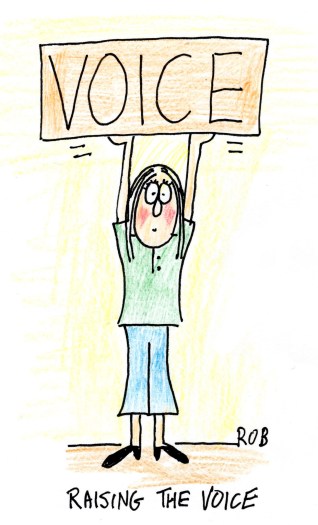
Don’t. Don’t be quiet. Find your voice. Raise it. And use it.

Because I’ve kind of grown fond of the idea of having voice on my tombstone. Otherwise, I will have to resort back to the original epitaph of whisky. Although maybe I’ll spiff it up a tiny bit with that lilting, girlish British accent.

She saw the beauty and necessity of hard liquor.

~Shelley

For the time being, our blog is closed to comments, but if you enjoyed it, maybe pass it on to someone else. Email it, Facebook it, or print it out and make new wallpaper for the bathroom. If it moves you, show it some love and share. Cheers!

Don’t forget to check out what we’re cookin’ in the Scullery and what we all talked about down in the pub. Plus, you can see more of Robin Gott‘s humor (NOW FOR HIRE- so do go check out his gallery!)–all from the only pen carved from a human funny bone.

In Good Spirits

I needed help.

Professional help.

It’s a phrase I utter at least a dozen times a day it seems, and not every episode is referring to the fact that shock therapy might be just the thing.

271116shock02

This time I was searching for answers to questions that did not reveal the meaning of life, or my purpose in the universe, or even advice on how to handle the creepy guy at the grocery store who is always asking if he can hold my melons while I search for apples.

Ah … Security??

No, this time I needed help with my new book. The writing “fiction” part is always so much fun. But the “researching the fiction I just wrote and discovered wouldn’t even be remotely believable” part is always a little hard to choke down.

Best to do them in tandem.

And as my new book takes place in a distillery, and there’s one nearly spitting distance from my house, it would be foolish of me not to immediately take advantage of the expertise within grasp.

So I pleaded my case, called the joint, and set up an interview to make sure that my new manuscript wasn’t going to entirely fit into the genre of fantasy.

Or an oval shaped file under my agent’s desk.

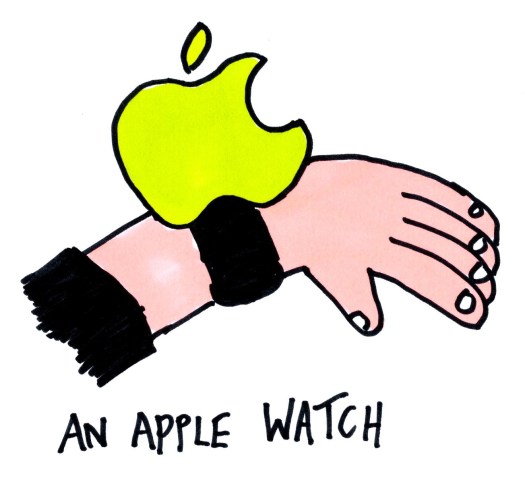
At first I thought Ian Thomas, the new director of operations at the Virginia Distillery Company, was worried about the time—because he was always checking his watch.

271116ian02

And then I thought for a second that maybe the fellow I was standing across was fairly new to the concept of wristwatches, as when he did look down at it, he stared at it with intense focus for at least four or five seconds.

And then I realized that I was the actual idiot.

Ah. An Apple watch.

271116apple02

Ian was getting about as many requests for attention as if he’d had a tiny toddler tugging at his pant leg—which, coincidentally, he’ll have in a few short weeks as he’s expecting his first child.

271116expectant02

So perhaps coaxing a fledgling whisky distillery through its beginning years full of growing pains is exactly the kind of training a soon-to-be dad should be having.

If nothing more than to reinforce recognizing the blissful joy of losing consciousness for more than ten minutes in a row.

That, and maybe to discover what a bazillion new parents come to realize during the agonizing teething phase of their tiny tot: whisky can act as a damn fine benumbing agent …

For the parents, of course.

And this man is sitting on a gold mine.

The questions I needed answering were specifically related to the running and operating of a single malt distillery:

How much does each ingredient contribute to the overall end product flavor profile?

How much does the temperature and humidity in your warehouses play a part in the maturation process?

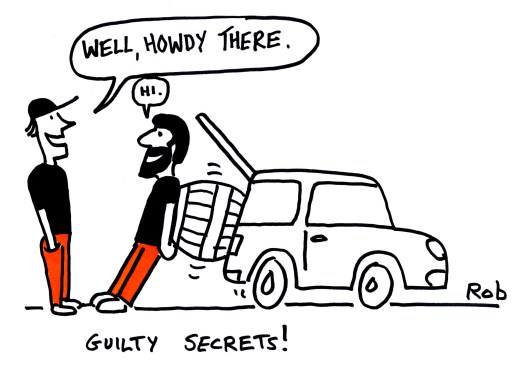
How many times have you tried to roll a full wooden cask of spirit into the back of your car to sneak home and feigned surprise when one of your coworkers discovered you struggling with the back hatch of the trunk?

271116barrelo2

Yup. All relevant.

We spent hours walking through the facility, and Ian patiently explained every piece of equipment and component involved in the operation: the gristmill, the mashtuns, the washbacks, and stills. The miles of plumbing, the resourceful recycling, the freshly plowed and planted barley fields, and the mile-long list of government officials he had to converse with on a daily basis in order to make this American malt find its way from barley to bottle—or grain to glass—or field to finally in my hot little hands.

At one point, while talking in the warehouse that securely housed the seven hundred wooden casks snugly hugging their aging spirit, Ian received the equivalent of another toddler tug that needed attention and stepped out of the warehouse while I ecstatically and repeatedly filled both my lungs with as much of the intoxicating, spirit-drenched air as they could hold. And then, profoundly lightheaded from hyperventilating, I suddenly worried that I had inhaled enough of the whisky-dense atmosphere to register as too intoxicated to drive home.

Maybe Ian’s watch would keep him busy whilst I slept off the fumes and stretched out across a few ex-bourbon barrels.

I thought about the last jaunt I’d undertaken researching a book—an afternoon spent questioning an internist about all the effective emetics available in the 18th century. There were no heady, soothing scents of toffee and brown sugar, butterscotch and bananas encapsulating me like a giant embrace from the ancient gods of magical elixirs. Just half a dozen homeopathic textbooks opened to pictures of poisonous plants that could make you puke.

Yeah, this one was turning out to be a lot more fun.

We finished the day with Ian allowing me to further question him in hopes that he could provide answers for the stickiest parts of the book—things I was struggling with and that were critical to the book’s authenticity and success: the biology, the chemistry, the plot.

His answers were enlightening. And clarified that there were actually a solid handful of hugely capable, talented, and ingenious people who worked alongside him to craft this outstanding spirit that holds so much promise.

And surprisingly, if not somewhat disappointingly, not one of them were alchemists or felt the need to invoke a series of sorcerous spells to turn this water into wine—er … whisky.

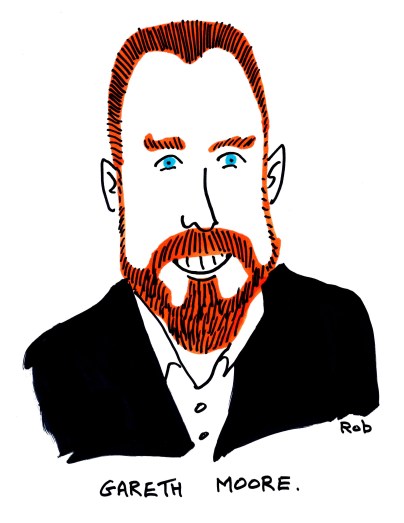
Apparently Gareth Moore,

271116gareth02

Chairman and CEO of Virginia’s newest spiritus frumenti emporium, really knows how to hire his nine-to-fivers and reviews of their work are about as glowing as the cheeks of those who imbibe in their product.

“Okay,” I said to Ian back in his office, “just in case this post goes viral and the only way you can fend off the sudden surge of paparazzi at the distillery is by locking yourself in the waste management warehouse and hiding behind a tank full of lye and caustic soda, is there anything else the world should know about Ian Thomas, young whisky maker hailing from Tennessee?”

“Ah,” he said, glancing at his wrist again and staring at it intensely for about four seconds, “Well,” he chuckled self-consciously. “I like casual strolls along the beach, I’m a good husband, I love my family and Virginia … and I’m working hard to make a world class whisky.”

I don’t doubt for one second all these things are true. Ian is a busy guy with a full life that’s only going to get fuller in two shakes of a lamb’s tail. A new dad. A new home. A new job. Yeah, he’s got his fingers in a lot of pots.

Copper ones to be precise.

And I think the world of ‘world class whiskies” is lucky to have it so.

~Shelley

HEADS UP Y’ALL: Robin has his annual calendar of curiously clever cartoons for sale starting now. If you’re hoping to take a peek a tiny bit farther into his unfathomable brain, then I suggest you head on over and order yours tout de suite! They won’t last!  Robingott.com

For the time being, our blog is closed to comments, but if you enjoyed it, maybe pass it on to someone else. Email it, Facebook it, or print it out and make new wallpaper for the bathroom. If it moves you, show it some love and share. Cheers!

Don’t forget to check out what we’re cookin’ in the Scullery and what we all talked about down in the pub. Plus, you can see more of Robin Gott‘s humor–all from the only pen carved from a human funny bone.

Publishing; It Takes a Village (and some groveling)

Recently I had to write an acknowledgment page for one of my books.

You know what they are, right? They’re usually found at the back of the opus—the part so many folks gloss right over as the writing is mostly filled with names and one line quips about what these names did to contribute to the publishing process, and how life, the universe, and all of mankind could not have been birthed and evolved into what it is today without these sage and wondrous mortals.

Not terribly interesting for the average Joe—unless, of course, you happen to be one of those sage and wondrous mortals.

But in writing my page of “thanks yous,” I can easily see just how out of hand one of these notes of gratitude can become.

It’s critical that one includes the upper echelon of those who ultimately gave your book bound words a chance to be seen.

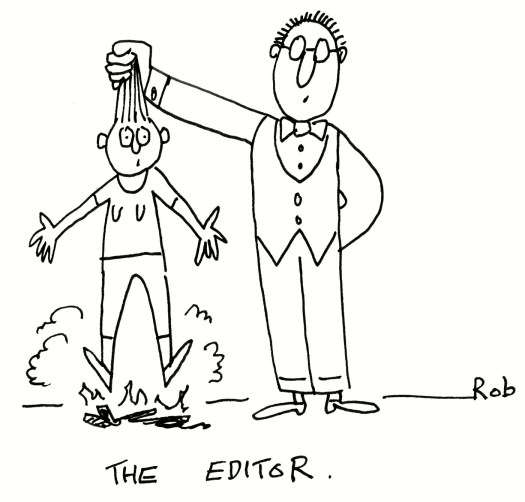
For instance, you must absolutely never forget to flatten yourself to the floor with a giant thanks to your editor—el supremo persona, le meilleur, un eroe—whatever language you choose to describe one of the most erudite, patient, resourceful, and good looking people you’ve ever met. Even if you’ve never “met”.

210816Editor01

Without your editor you are toast.

Maybe less than toast.

You’re just one slice of bland bread among dozens stacked in front and behind you and all the way down the shelf from side to side.

Your editor lifts you out of the endless mass and puts a fire beneath your feet—or whatever body part is molded to the anchor that’s producing your fairly vapid, stale, lifeless literary efforts. They then carefully tease out the aromatic notes, the visually enticing imagery, and the tantalizing flavors of your story while expertly identifying the exact dressing you need, applying a perfect layer of topping that will make the meat of you shine.

Yes, one must thank one’s editor profusely, and all your lucky stars if you have a truly divine one. And then eat, because just writing about editors and their skills makes one unreasonably hungry.

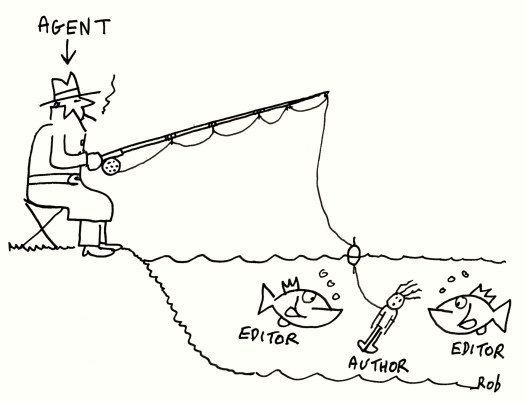
Your agent—should you have one of those as well—is also on the list for high-priority praise. They are the sleuth who, when first presented with your writing, siphoned out the thread of ability that wove itself in and out of the tapestry of clunky words you put down on paper. They are the individual who gets a first look glance at your work before bravely putting their name to an email that is then cast widely out into the pool of editors who are fishing for something new the public is hungry to bite on.

210816Agent01

Or they are the one who picks up the tab at a gulp and go lunch where they pitch your work to those same bleary-eyed editors in hopes of convincing them to take on the task of giving up another night’s sleep in favor of reading one hundred thousand of your best and shiniest words.

Don’t forget the copy editors. These folks examine your one hundred thousand words, parse them, and then reconstruct them into more appropriate linguistic elements that will have true value to the reader. They will leave you dumbstruck with awe to realize that there are individuals out there in the world who truly understand all the principles and rudiments of grammar. They should be given many basketfuls of cookies for their efforts and patience.

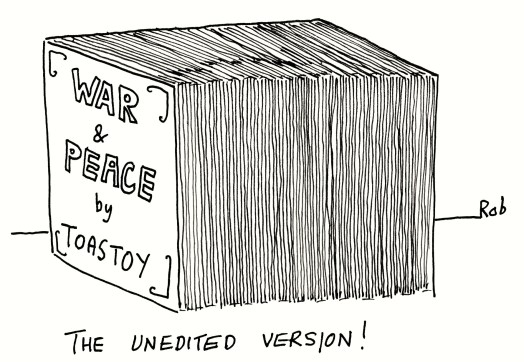
210816Toastoy01

The marketing department, the art department, the line editors, the assistant editors, and publicists—where does one begin? Each of them, inundated with so much work and so little recognition, really should have a small shrine erected in their names.

So I have.

I’ve built a large altar in a separate room in my house—a temple where I’ve placed magic stones, a dozen candles, tiny false gods, myriad pagan symbols, and any other sorcerous talisman I can collect for my ritualistic moments of devotion and homage. It is a room filled with smoky incense and funneled in melodramatic and lamenting bagpipe music. It is the best I can come up with to replace what I believe they all probably truly deserve over my feeble prostrations: a cruise.

210816Thanks01

I just don’t make enough money to make that happen. Sorry.

But you really should see the altar I’ve set up for you guys. It’s amazing.

And scares the hell out of the cat.

And lastly are the people who truly know you. Like—know you know you. The ones who had to read all those diabolically dreadful first drafts. The folks who see you drinking three-day old coffee and eating mac and cheese that you made for an end of school potluck last month. The family members who have had to learn to wash their own laundry, make their own lunches, write their own college essays, and attend their own parent-teacher conferences because you were “just finishing that last sentence,” or “editing that final paragraph,” or passed out on your keyboard.

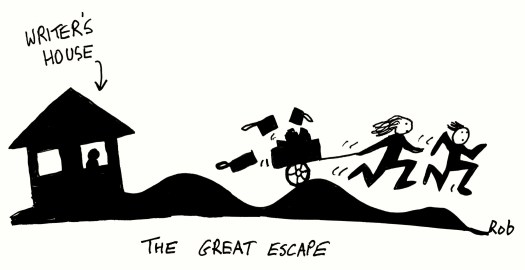
Speaking on behalf of many writers, we know who you all are, and are so incredibly surprised to look up and discover that not only are you not in the house where we were certain we last spotted you, but are now living in another, entirely different city from us and have taken all of our pots and pans with you.

210816Escape01

We thank you too. Except for the theft of our housewares.

Lastly, as the orchestra music swells over our words, we thank our fifth-grade teachers, or librarians, or fairy godmothers. It’s that one individual who told us we had promise, we had potential, we had possibility.

It’s that one special person who started this whole domino effect of thanks and recognition: the one who gave us that first nod of acknowledgment.

So to all those sage and wondrous mortals—whether they see you as a product or a parent, family or a friend—the thanks are endless and the gratitude unfathomable.

Now it’s probably time to acknowledge the fact that there is no food in the house and the cat litter seriously needs to be addressed. Life goes on—even after The End.

210816End01

~Shelley

For the time being, our blog is closed to comments, but if you enjoyed it, maybe pass it on to someone else. Email it, Facebook it, or print it out and make new wallpaper for the bathroom. If it moves you, show it some love and share. Cheers!

Don’t forget to check out what we’re cookin’ in the Scullery and what we all talked about down in the pub. Plus, you can see more of Robin Gott‘s humor–all from the only pen carved from a human funny bone.

The Foot-Slogged Journey from Zero to Hero

According to Google, the definition of the word hero is:

A person, typically a man, who is admired or idealized for courage, outstanding achievements, or noble qualities. A warrior, a knight, a lionheart.

Or we could go with Google’s second definition:

Another term for a submarine sandwich.

I am surrounded 24/7 by heroes. Their voices ring in my ears in pitches that reveal their age and dialects that unmask their country of origin. Occasionally, their speech is so foreign to my mind, I find I must consult etymological dictionaries to make sense of what they say.

Most of these heroes I conjure up myself.

It’s a writer’s process that involves a mixed bag of tools: a few shovels and brushes for the archeological dig to uncover the bones, or a hammer and chisel to chip away at “whatever isn’t the angel,” or, my favorite, the ability to sit with a mental stereogram—where you purposefully lose the eye’s traditional and automatic ability to focus—and then suddenly, mind-blowingly, find a new depth of perspective.

Something magical emerges from something quite ordinary.

I’m used to following these heroes through some journey.

We meet the hero. Something happens to him that forces him to change—despite the fact that he is resistant to change. He’s drawn into some crisis. Things go to hell in a handbasket for a brief period of time. Some metamorphosis occurs, impacting our guy and allows him to respond to the call. And then …

BANG!

He saves the day.

Amen.

I am drawn to these people like a needle pointing north and with the same urgency as when anyone cracks open the door of an oven filled with chocolate chip cookies.

My above definition is a super-simplified explanation of a complex, universal storytelling form called …

The Hero’s Journey.

(Please note: In my head, anytime this phrase is said aloud, its audio quality is enhanced by some impressively epic reverb.)

According to many who’ve studied the great stories of mythology and the broad swath of tales that fit beneath the umbrella of the monomyth, there are a few things necessary in each of these sagas:

A situation, a protagonist, an objective, conflict and disaster, and very important—an opponent.

Hero02

My list is by no means complete, but just an “around about” example to further my unfolding tale.

But the hero I’m going to tell you about is not one of mythology or conjured up by my writerly imagination. She is a regular Joe. A flesh and blood body. A mortal, a maiden, and amusingly, mine.

Okay, that last part may no longer really be true, as she leapt from the nest two years ago, but the ownership part isn’t the important bit. It’s the journey. It’s one I was given the privilege to watch close up and from all angles.

You know those first words we record as proud parents in the biblical baby books of unprecedented infant achievement? This is found in hers:

Airpane.

Yeah, not a typo.

One tiny fist with one tiny finger extended upward and continuously, unrelentingly, irritatingly pointed toward the sky. One tiny mouth was forever uttering what two tiny eyes could see and two tiny ears could hear.

Airpane.

Airpane02

Rare was the day when I had the time to track each one of her identifications—and I certainly did not possess the keen eyesight and impressive auditory range that she seemed to have been born with—but I breezily verified each one of her chirps with some form of response like,

“Wow, good for you, Toots. Keep your eye out for more.” Or,

“Clever girl. How many is that this morning? One hundred? One thousand? I’ve lost count.” Or,

“Okay, I get it. You were a pilot in a previous life. I’ve got to fold laundry.”

When my daughter was about five, two common career themes emerged and spilled out into her everyday life. She was heavily into deciding between becoming a ballerina or an astronaut.

Ballerina02.

One day, I scheduled a doctor’s appointment for her. She was going to have a few follow-up booster shots for some prior vaccinations. Knowing her intense hatred and fear of needles, I tried to plan something fun to follow that doctor’s appointment that would keep her mind off of the wretched shots:

We were going to have lunch … WITH AN ASTRONAUT IN TRAINING!

A family friend was delighted to hear of my daughter’s early interest in space and eager to encourage her tiny spurts of enthusiasm. It was exactly what we needed to follow that pediatrician’s appointment—which was …

Awful.

She hid, she screamed, she threw tongue depressors at the man as if she was barricading herself inside an ice cream truck with nothing but popsicles to use as weapons. She told him she was going to hunt him down in the middle of the night.

Yeah, it was appalling.

Anyway, back at lunch, our astronaut friend began to fill my daughter’s head with all the details involved in becoming “an astronaut,” and at one point launched into the myriad medical tests and examinations one must undergo in order to determine if one is even physically fit enough for space.

My daughter inquired about inoculations.

“Yep,” he said. “Plenty of needles.”

She then turned to me and asked, “Do ballerinas need shots?”

Well, I thought we were finished with our miniature hero’s journey into space and that life would finally return back to normal. I would no longer have to feign interest in her long conversations about the complex water systems aboard the International Space Station which provided astronauts drinking water made from a filtered mixture of recycled shower water, old astronaut sweat … and pee.

Except I was wrong.

Because every day that space interest grew. Whether she was curious about rocket fuel, or space shuttle tiles, or the physics of learning how to fly.

At one point, she said to me she would happily accept a one-way ticket to Mars if it was available and she qualified, and then gave me permission to give away everything in her bedroom to Goodwill.

“What?” I said. “You’re still interested in space?”

Apparently, this was the equivalent of asking, “What? You’re still interested in breathing air?

She struggled with physics like it was some Minotaur she’d regularly sword fight with each night before bed.

Minotaur02

She spent countless, frustrating hours with her teachers in order to understand—not memorize—the facts in front of her.

One of her teachers—a Japanese physicist, whom I swear was the prototype for Mr. Miyagi from The Karate Kid—threw countless roadblocks in her way.

“Why waste your time with space?” he’d ask her. “Space is for boys. Dolls are for girls.”

She would march from his classroom and turn to face him just before leaving and flip him the bird.

He, on the other hand, would smile with smug contentment after she left, knowing he’d lit a fire beneath someone’s nettled knickers.

Word had it, that this man had come to America with the impassioned notion that the world needed more girls in math.

But apparently, he didn’t want ones that crumpled when facing adversity.

Walking into her bedroom was a bit like being a detective who opened the door belonging to a guy whose crazed neural network encompassed all four walls of the freakishly alarming one room apartment he lived in. Where equations were sprawled across every square inch of space, and yarn connected one spot to another, making the entire room feel like it was a massive, but not yet completed, macramé pot holder.

Understanding that this was a language I would never have the codes to decipher, I’d offer up encouragement from the safest quarters of my own comfort zones—stories.

Seeing her bleary eyes each morning, and the small, but growing bald spot patches where she would regularly grasp at fistfuls of hair—I first assumed out of frustration, but after taking into account the amount of information she was trying to consume, I came to believe it was in an effort to expand skull space—I would offer up my suggestions. I didn’t want her to give up.

“Why don’t we head to the library and check out some super stories about space adventure? Stories like Aliens Love Underpants, or The Martian Chronicles, or Ender’s Game, or (most important) The Hitchhiker’s Guide to the Galaxy?

But with each book I brought home and encouraged her to read, they ended up buried beneath printed out specs of some new rocket booster. Or NASA flight mission reports. Or CDs that declared, you can learn how to speak Russian and Chinese in under ten minutes a day!

She didn’t want to read a space story.

She wanted to be a space story.

Countless times in this child’s life, I’ve stepped back and looked at the path she was traveling. It’s been riddled with potholes, roadblocks, detours, and burnt bridges. But it has also been abundantly sprinkled with mentors: sensei sword masters, Yodas, Gandalfs, and Dumbledores. Guides who have handed her a sword, a light saber, a wand.

Repeatedly realizing how out of depth I was, the best I could hope to do was step out of her way. I was not going to be the antagonist in my very own child’s heroic journey. I did not want to be her conflict, her disaster, her apocalyptic Death Star.

But I could keep her sword shiny, her lightsaber full of batteries, and her wand connected to Wi-Fi at night whilst she slept.

I looked for the places I belonged in her story. Many times I found it was on the sidelines taking notes. It’s what we writers do to nudge a story into place. It’s what we cheerleaders do to rally our heroes. It’s what we parents do to encourage our children.

Today, this child of mine studies aerospace engineering at MIT and is in the middle of her first summer internship with NASA.

It is a beautiful thing to realize that Thank God, you did not get in the way of someone else’s dream and hopefully, instead, pruned back the prickly path a tiny bit to make the journey a little bit easier.

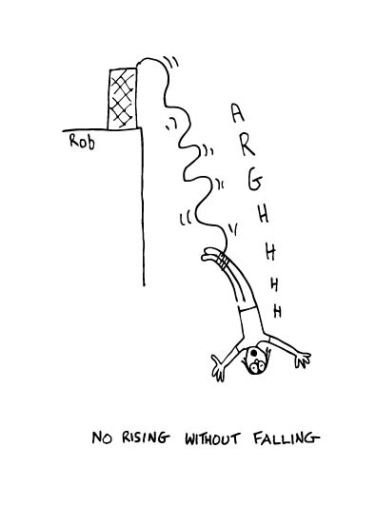
I celebrate both of my children’s achievements as they come, and tell them about the importance of embracing each one of their failures along the way as well. There is no rising without falling.

Bungee02

Today we celebrate. Tomorrow we may bring back the bandages and antibiotic ointments that come with life’s splashdowns and spills. It is all part of the hero’s journey and there are no shortcuts around facing your dragons.

Today I am so happy for this child I find myself nearly bursting with joy. I seriously just want to take a bite out of her.

I’m guessing she will taste something like a submarine sandwich.

~Shelley

For the time being, our blog is closed to comments, but if you enjoyed it, maybe pass it on to someone else. Email it, Facebook it, or print it out and make new wallpaper for the bathroom. If it moves you, show it some love and share. Cheers!

Don’t forget to check out what we’re cookin’ in the Scullery and what we all talked about down in the pub. Plus, you can see more of Robin Gott‘s humor–all from the only pen carved from a human funny bone.