Know your Cupid, Stupid!

English: THE TREATY BETWEEN THE SHEEP AND THE ...

Last night, as I was finishing mucking out the sheep barn, I paused mid-muck, and shivered at a sound that pierced the silence of this early February evening.

Coyotes: Virginia’s scraggly version of a sheep’s Freddy Kreuger and capable of causing such nightmares, no amount of counting themselves aid in a good night’s rest.

The sound of their yipping and howling was so primal, it brought images of ancient scenes: priests, rings of fire, sacrifices and savage rituals. And it’s merely a hop from all that to Lupercalia—perhaps the forerunner of our modern Valentine’s Day.

A lot of folks would have you believe our currently appointed Day of Love

Cupid and Psyche

developed from one of three sainted men possessing the surname Valentine, and that through his deeds of medical miracles/imprisonment and/or writing love letters sprouted a holiday simultaneously celebrated and feared by men and women around the globe today. Maybe it’s true. Maybe it’s hogwash.

But long before these fellas were martyred and thrown on to the Pope’s big calendar of feasts celebrating someone’s demise, another ritual existed. Lupercalia was one of those totally raucous fiestas that nobody in Rome pretends to remember—unless you’re a Wiccan, in which case, nobody pretends to notice.

Curious to get to the real meat of the history, I was surprised to discover the uncanny similarities between the old Roman shindig held February 13th -15th and our fresh take on love, sponsored by Hallmark, held on February 14th.

See if you can follow along.

Lupa capitolina al Campidoglio. Ne esiste una ...

The Romans: Two teams of Luperci (upper crust youths from Roman society) run a footrace around the Palatine Hill and end at the entrance to a cave—supposedly where Romulus (founder of Rome) and twin brother Remus were nursed by Lupa, the she-wolf. Please note that in some texts, Lupa is interpreted as another slang term for prostitute.

Us: Men, no longer in teams but rather solo, run through any series of mazes, hoops, fire and monetary ruin in order to arrive first at the front door of their “prize” for the evening. I doubt many of the women offer professional services, but wouldn’t be surprised to see them bear wolf-like fangs if the man is late.

The Romans: Now in the cave and upon a shrine, priests sacrifice a couple of goats and throw in a dog for good luck, then mix the blood and smear it on the foreheads of those quick-footed lads.

Us: Now at dinner—be it house or restaurant—some sort of meat is slaughtered and whatever wine is paired with the meal is often smudged on the tie of our skittish young stud.

The Romans: The blood is now wiped away with whatever is on hand, usually some milk sodden wool, and everyone has a hearty chuckle at the good-natured prank. You’re asking me why they laughed at this. I shrug; maybe it was akin to blacking out a tooth.

Us: The waiter comes running with a fresh napkin soaked with club soda and everyone inwardly rolls their eyes at the inelegant act of folly. It seems we’ve outgrown the hilarity of the wine on the tie routine, too.

Flagellants practiced self-flogging at the tim...

The Romans: The sacrificed goat’s skin was then divided and handed over to the youths to both wear as loincloths and make into hairy whips for later on.

Us: Upon leaving the table, many men forget they’ve tucked their napkin into the top of their pants and depart from the restaurant with their own special loincloth.

The Romans: Now the youths get to run through the city streets flogging semi-naked woman (requested to be so by their Roman priests) with those bloody, hairy, goat hide whips, all under the guise that by purposefully getting in the way of the thongs the women will gain newfound fertility.

Us: At last, dinner done, our young man has great hope and expectation to see at least one woman expose herself in some manner or form, although this is where the traditions divide. Nowadays, it is the woman who does the whipping at the end of the evening, usually in the form of self-flagellation rapidly followed by self-loathing. Of course the end result is oftentimes the same as those of the Roman women. Newfound fertility.

To wrap things up, it’s easy to see we’ve not changed much. Apparently, getting to thwack a girl on the backside with some shredded bits of goat is still a winning Valentine’s Day plan for most guys.

A 2 month old goat kid in a field of capeweed

So no kidding, Happy Lupercalia.

~Shelley

Don’t forget to check out what’s cookin’ in the Scullery this week (here) and what we’re all talkin’ about down in the pub (here).


The Long, Eternal, Relentless, Never-ending, Unremitting Year

If pressed one day to reveal my dream tattoo, its explanation would arise as a result of watching far too many Monty Python skits.

Group shot of the Monty Python crew in 1969

the men who raised me

More than likely I’d need to find a space massive enough to accommodate this:

All right, but apart from the sanitation, medicine, education, wine, public order, irrigation, roads, the fresh water system and public health, what have the Romans ever done for us? 

The one thing missing, I would hazard to say, is the calendar we depend upon today.

Imagine this– you are a farmer, tied to the land and your animals, agrarian in every sense of the word, and counseled beneath the Roman emperor Numa Pompilius’ calendar.

Numa Pompilius consulting Egeria.

Lunar to begin with, it consisted of a mere ten months—March through December. Now as much as many folk would wish to be rid of January and February, Numa spit in the eye of his subjects’ greatest fears and threw two months into the beginning of the year, officially recognizing the missing sixty days of terror, when unmentionable fiendish ghouls ruled the streets. Yes, you could still walk around covered in ash and leap through the flaming pyres of purification meant to ward off those who shall not be named, but now you’d be able to pencil in on which day you’d prefer to have a chalky complexion and ones where you’d singe your coattails.

Fast forward around six hundred years. Same ancient farmer—well preserved from a fine diet off the land—and same ancient calendar: lunar and totally bungled. Sure, Numa threw in a few extra days here and there to appease those around him with better mathematical skills. But complaints were rife. A 355 day year falls a little short for the agricultural savviness of most farmers, and after a decade or so, they’re getting reminders from Outlook to start planting seeds around December 23rd. Houston? We have a problem.

Русский: Бюст Юлия Цезаря, Летний сад, Санкт-П...

Cue Julius Caesar. Even though the guy had a lot on his plate: a budget crisis, political corruption, throwing a few dinner parties complete with gladiators and lions, he apparently got tired of showing up way too late for the Vernal Equinox Festival each year. Things had gotten so out of whack while Rome was busy conquering the world, nobody noticed—unless you were friends with a farmer—that the first day of Spring was scheduled for somewhere in June, just after school let out. Something had to be done.

Since he had friends in high places, Caesar sought the help of someone whose influence was of the highest order, astronomically speaking.

Sosigenes, an Alexandrian greatly envied for the size of his telescope, er … astrolabe, was beckoned forth and instructed to untangle the calendrical conundrum. Pronto.

Up for the challenge, Sosigenes took out his freshly cleaned slate and chalk, came up with a slick marketing plan and presented the new Julian Calendar, complete with slides. The only glitch was that before implementing the shiny new calendar, they had to set straight the old one.

Thinking no one would mind—or even notice—Sosigenes threw a few missing days into the current year. Sixty-seven to be precise. Thirty days were added in between February 2nd and 3rd and thirty-five snuck in just after the last day of November and the first of December. The other two might have been tossed in as a couple of three day weekends.

Still, no matter how much publicity sparkle the PR department tried to spin it with, the Romans became a cranky bunch. And who could blame them?

English: A girl's wish list for Santa Claus.

February now seemed like an unending Lent, and Sosigenes was getting hate mail from kids who were expected to be ultra patient for the start of the Christmas season. People were going to have to wait an ungodly amount of time see if Caesar would put a menorah on the front lawn of the Basilica. Sadly, they’d never know.

Regardless, there are a couple of things we can take from the lesson of what soon became coined as The Long Year. Firstly, Rome realized their kids were falling way behind in math and sciences and that the Chinese were catching up. Secondly, Romans back then were older than what their driver’s licenses said. And lastly, we’ve got little to complain about when every four years we tack on an extra day in February, because seriously, look what the Romans did for us. If you can’t remember, I’ll show you my tattoo.

Don’t forget to check out what’s cookin’ in the Scullery this week (here) and what we’re all talkin’ about down in the pub (here).


Pipers On Sale, Aisle Three

When you think about giving someone a gift, I’d bet most of you don’t entertain the idea of gifting a person. It seems a rather archaic bestowal, one reserved for a plantation owner increasing his human workforce, or a recently deceased pharaoh to accompany him into the world to come, except when you consider who is bestowing the gift. My English husband, Sir Sackier, considers himself—if the fates cooperate—the future royalty of reclaimed land (that would be America). Therefore, granting a human endowment would not make him pause, believing the token curious, or even illegal.

English: Don Quixote is knighted by the inn-ke...

Nonetheless, one of the nicest things he ever did for me happened on the day we’d moved into our newly built house on top of this mountain, a damp, misty December morning. Both my folks had come to help unpack boxes and direct a crew of moving men. Shortly after the moving crew left, I moved to the kitchen, burying myself in a box of newspaper wrapped crockery. Suddenly, I thought I’d heard somebody shout. I pulled my head out of the four foot deep box, hoping someone had finally discovered my favorite white platter that had gone missing two moves ago.

Sir Sackier hollered from outside, and my mom rushed into the kitchen, all a twitter, saying I’d better high tail it out to where he was. I expected the worst. Surely the man had fallen into an undiscovered well, or maybe he’d come upon a prickle of porcupines, a gang of angry elk or a cackle of hyenas. My mind whirled with all the unusual suspects when it came to the sceptred isle native.

I stepped onto the deck off the kitchen. Sir Sackier stood there with a ridiculous grin spread across his face. He looked like he was eight and had found his first frog.

“Do you hear something?” he asked, cocking an ear toward the mountains.

I leaned forward and scanned the horizon. What should I be listening for? The scream of a bobcat? The cry of an eagle? The sound of a bullfrog being squished behind his back?

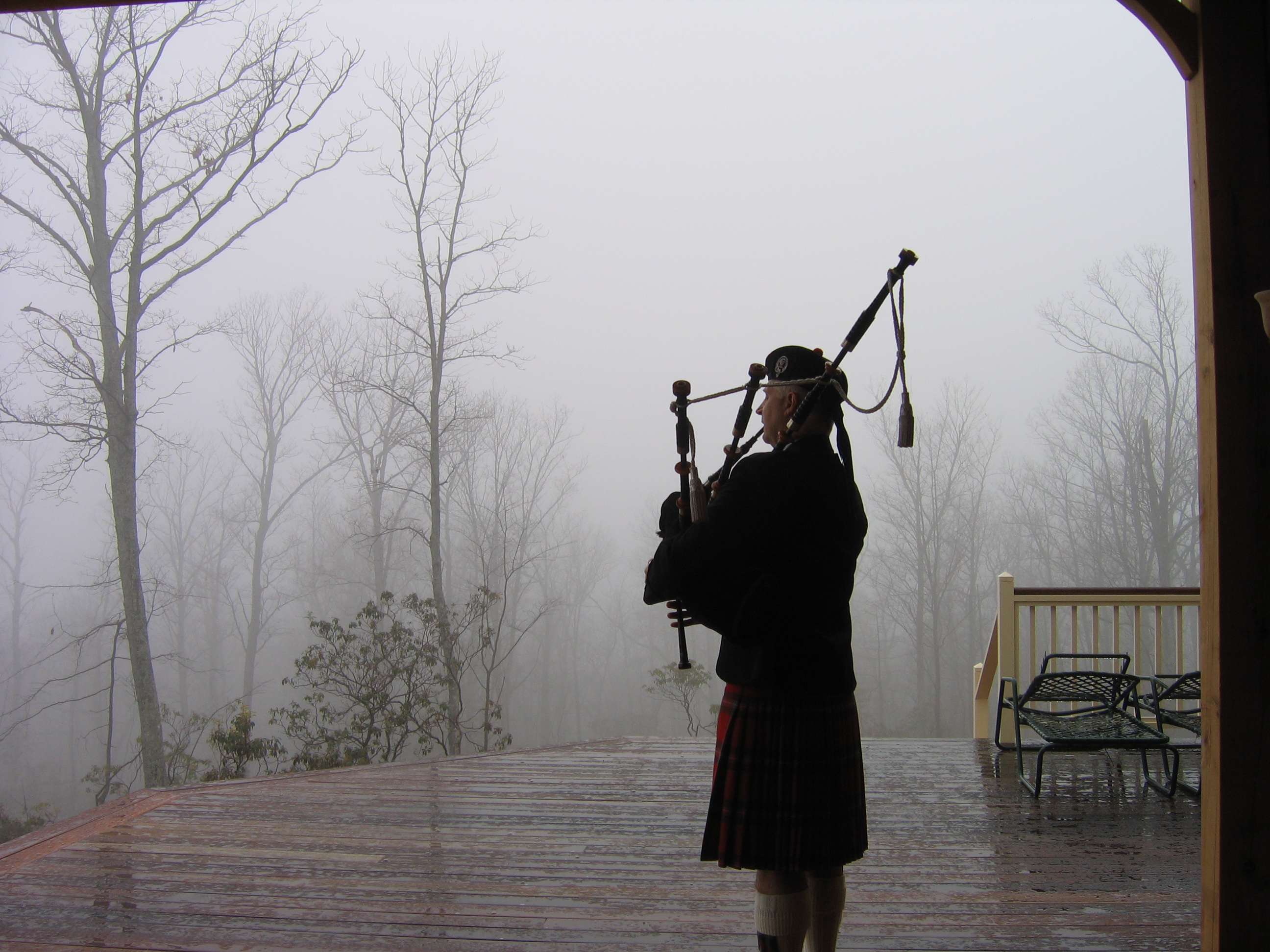
“No,” I said, and then stopped. Because just then I did. I heard the magical sound my heart had suctioned itself to, years earlier when I first went to Scotland.

English: Piper James Geddes plays the most rec...

Bagpipes.

I looked out into the mid-day gloom, across the tree-covered slopes of the mountains, wondering how in the world I’d gotten so lucky as to pick a plot of land that was within earshot of a practicing piper. And then I saw him coming up our driveway.

Wheezing up our driveway.

Our driveway, which is one mile long and one thousand feet straight up.

“What do you think?” Sir Sackier asked me as both my parents joined us on the porch, a video camera in his hands and pointed at my face.

“Oh my God, the poor man!” I shouted, positive the piper was going to have a cardiac arrest before he made it to the top. “Did you do this?” I pointed at the asthmatic geezer in full Gaelic getup.

That eight year old face beamed and nodded. “Yep. Happy moving in day, Shell!”

I looked back toward the kitchen boxes. “Where is the carton that has our first aid kit? I need to see if we have a defibrillator in it.” I bit my lip wondering if there was going to be an eventual lawsuit, but hearing that beautiful sound in the most perfect setting made tears come to my eyes. A piper! To christen our new home.

After fifteen more blissful and painful minutes, the piper finally came through the front door without pausing for breath, and into the hallway—where I thought he’d surely collapse. Instead, he stood bellowing in the hollowed out foyer, perfectly centered beneath a space that rose a full forty feet above him. The blast of the pipes exploded through the house, puncturing the walls and paralyzing my parents. This is oftentimes the sneaky tactics of a military piper, who then signals the rest of the highlanders to sneak up behind their stunned victims and slice off their heads with a clean sweep of their broadswords. Although this probably wasn’t intended, loss of voluntary movement was a by-product of my husband’s housewarming gift.

Even if my folks were too polite—or too stupefied to put their fingers in their ears—I stood there, rooted to the ground, thrilled with the razor sharp melody piercing my bones. It was then Sir Sackier informed me that he felt we needed a house piper and this man was my gift. He could play at whatever events we hosted up here on the mountain. How could I say no? But it was necessary to make a clear distinction. I felt we owed the poor man as he nearly did himself in climbing the mountain to get here, not owned the poor man because he was idiotic enough to pick up the phone when harkened by this aspiring new monarch. I doubt Sir Sackier heard what I said. He had his fingers in his ears.

Don’t forget to check out what’s cookin’ in the Scullery this week (here) and what we’re all talkin’ about down in the pub (here).


Lads & Lassies, Pipers & Poets

English: Robert Burns Source: Image:Robert bur...

January 25th marks the birth of Robert Burns. The Ploughman Poet. The Bard of Ayrshire. Scotland’s favorite son. Sadly, most people only admit knowledge of the catchy tune he penned that they drunkenly mumble along to come New Year’s Eve at midnight: Auld Land Syne.

He wrote poems and lyrics, collected and improved folk songs and fathered as many children with as many women who would have him. No wonder so many people claim him as their ancestor. The guy was a rogue—and a quick one too. He died at age thirty seven, making a remarkable attempt to populate half of Scotland.

Regardless, numerous individuals, whether of Scottish decent, whisky aficionados, or enthusiasts of poetry, annually plan to commemorate this man’s existence and accomplishments (both bardic and bedroom) with an evening of debauchery and boredom.

Scotish dirk

The whisky I love, but somewhere during the third hour of poetry, I’m looking to impale myself on the first dirk  I can slip from any man’s stocking. Consequently, I appreciate the whisky with more enthusiasm than I probably should. Of course, this is what everyone else is doing and why they believe they’re channeling Laurence Olivier.

A typical Burns Night, or Burns Supper, as it is both commonly known, used to be (and I’m sure remains in some stuffy circles) a “boys only” getup held on the anniversary of Rabbie’s birth. Gathering that Burns himself likely preferred the company of women and wouldn’t have missed the chance to gaze upon the legs of a lovely lassie, a few welcome mats have been placed at the feet of the fairer sex. It seems to have spiced up the evening for many a current soirée and is gaining popularity, as more women begin to view whisky as something more pleasurable than a root canal.

The supper components make or break any Burns celebration. More often than not, you’ll find most of the guests sleeping with their eyes open at the table, making frequent lavatory trips, or curled up in a fetal position in the cloak room, arms cradling a depleted Lagavulin bottle.

Assembling your own Burns supper should not be undertaken lightly; get it wrong and you will find attendees plotting your grisly death and funeral. One must consider the key factors needed: the proper guests, the right food, the liquor and the entertainment.

The guest list is crucial. Have a gathering of wallflowers or self-indulgent bores and your evening feels like watching the weekly defrag session of your computer: it will never end. That’s when I find myself making crosshatch paper cuts on the inside of my wrist with the edge of the menu in an effort to locate a vein that may end it all.

If you find the menu is reminiscent of something even Fido would shake his head at, do not blame it on the Scots. Just because these folk were once scrap cloth clad savages does not mean they couldn’t wield a torch with just enough finesse in order to perfectly caramelize the tops of their Crème Brule.

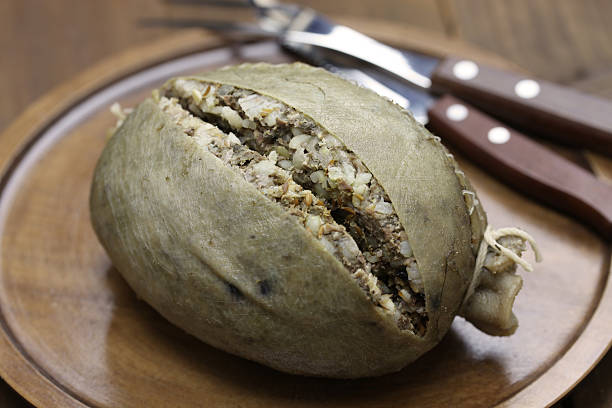
homemade haggis, scotland food stock photo


The main course, haggis, (aka sheep pluck), is a dish whose preparation and success requires deft skill in the kitchen. Try to find a large animal vet who moonlights as a Michelin rated chef to construct yours. Avoid the kind sold in a tin can.

The liquor is simple. Only the best. Famous Grouse need not apply.

When it comes to entertainment, if there isn’t a piper you might as well call it a nice little dinner party because without Mungo MacBugle blowing the cobwebs out your ears, it’s just going to be a slightly Celtic book club meeting with weird snacks.

The Scottish Piper - Victorian print vector art illustration

I have attended other peoples’ Burns Supper and I have thrown a couple of my own. Let me be honest. It is much easier to have a “babysitting emergency” in the midst of someone else’s grand Gaelic failure than in your own living room, among fifty hungry guests, who can clearly see your children alive and well, and currently working as unpaid wait staff.

My suggestions for you? Start small.

Gather your children, your parents and spouse—or anyone you trust not to blog about you the next day, and ask them to come to dinner prepared to recite a short poem, quote or bawdy limerick.

Check out a couple of the easier recipes offered by the BBC (click here).

Then head on over to the nearest (and reputable) liquor store and purchase yourself a good bottle of uisge bathea. Do not skimp and buy something that can double as mouthwash or battlefield disinfectant. If you’re new to whisky, look for a spirit that isn’t heavy with peat or smoke.

Finally, toast with abandonment. The more frequently you do, the quicker everyone becomes pithy, handsome and hungry enough to eat sheep pluck.

Slàinte!

~Shelley

Don’t forget to check out what’s cookin’ in the Scullery this week (here) and what we’re all talkin’ about down in the pub (here).


The waterworks. Except it doesn’t.

Sherpas in Nepal

Just about everybody who’s visited our house remembers at least three things:

#1. Book a Sherpa if they plan to return. Yes, it’s a little pricey, but GPS will land you at Huckabee Goober’s Moonshine Mill and Pit Bull Factory. Plus the Sherpas really need the work out here in the Blue Ridge. Most hikers are way too self-reliant these days.

#2. If you mention anyone in the public domain, alive or recently deceased, you will discover Sir Sackier (aka English hubby) has either gone to school with them, or shared a meal in a pub. It is amazing how many people in the world have gone to the City of London. Seriously. Google everyone.

#3. A plumber was buried beneath our house. Dead first, of course, or certainly soon thereafter. No one can last … what … six years since we moved in? Yeah, surely he’s dead now.

Phil the Plumber

Phil the Plumber (Photo credit: Badly Drawn Dad)

All right, we don’t exactly have proof.

Yet.

But if it is true, then chances are the guy came to an early demise and is now taking his wrath out on the lowly inhabitants of his prior workplace. Not one month passes without the excitement of some type of waterworks calamity. Pipes burst, the well runs dry, the water turns to sludge and comes out of the faucets reeking of the sulphuric gasses of hell. It’s quite possible we’ve built our home on top of a volcano. Or the house of Beelzebub. And he wants his front door back. Since neither fully explains our problems, we’re back to square one with the dead plumber.

It used to be, in times of yore, that a human was sacrificed in the construction phase of a building. They were meant to be the future guardians, the spiritual sentinels of the structure. Criminals placed in every posthole, drunkards dumped in boundary ditches, unlucky short straws clutched between phallangeal bones boxed in beneath door frames. Sadly, more often than not, this human was a child.

Knowing this, Sir Sackier and I have developed two theories. He thinks somewhere between framing and dry walling, some unlucky bloke, up to his chin in the miles of pipe length laid for this house, lost his balance, thunked his head and passed out. Noted as missing from his bar stool that night, he was sadly plastered up and around without discovery the next day.

I don’t buy it. Understanding Sir Sackier’s fondness for his history in Albion,  and desiring to bring some of the more purposeful of ancient rites here to the Old Dominion—in particular one that will protect his fortress, my theory makes much more sense.

I believe as the framing was in its final stages, Sir Sackier was having a congenial chat with some of the fellas during a lunch break and maybe passed on the old tales of foundation sacrifices. Of course they were threaded lyrically between lectures of how America doesn’t know how to build houses, “because only when you can see houses that are considered young at 400 years are you going to find solid craftsmanship!”

English: A crumbling farm building in Watlington.

This aside, maybe one of the workman took him seriously—as if interpreting some sort of “wink, wink, nudge, nudge” message. The only other problem was the other interpreting necessary when speaking with him. Sir Sackier doesn’t speak English. He speaks proper English. And not too many people are still familiar with that kind of lingo any longer.

Quite possibly, he might have thrown out a, “So if we’re going to do this thing by the book, we’ll need to find someone who still rides a toy motor scooter,” NOT someone who works for Rotor Rooter.

Not too difficult if you’re reading it, but full of potential trip ups if you’re hearing it and you’ve not taken any community college course credits for Proper English as a Second Language. It’s a bit like the old verse, “You say tomato, I say tomato …” It doesn’t make much sense when you’re reading it. His dilemma was the reverse.

And there you have it. I think it was accidentallydone on purpose. And now we’re cursed.

The Wicked Witch of the East as pictured in Th...

The only other small factor refusing to be overlooked is that it’s not just this house that has been plagued by plumbing potholes. It’s been all of them. Which means somewhere during the last twenty years of moving houses, a plumber died in the basement and was packed up by a moving company and we’ve been carrying around dead plumber bones for the last two decades.

Bones

I wouldn’t be surprised. And I wouldn’t be surprised to find out he’d gone to the City of London.

~Shelley

Don’t forget to check out what’s cookin’ in the Scullery this week (here) and what we’re all talkin’ about down in the pub (here).