Why We Need to Acquire a Taste for Flavor

As a writer, there is nothing I love more than putting on my Alice in Wonderland frock and purposefully tumbling down the rabbit hole of research.

With the exception of getting published, of course.

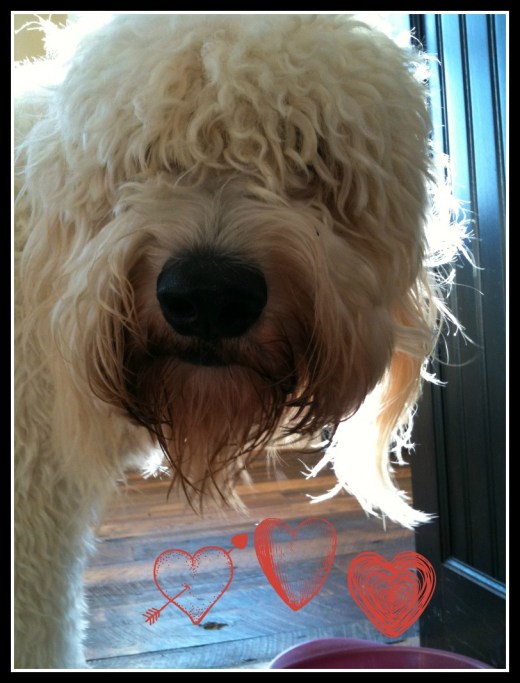
And seeing my hound gaze sincerely into my eyes over breakfast to convey that I’ve never looked more well-rested and attractive, and would I mind passing him three strips of bacon?

But the research part of necessary investigative sleuth work is wholly engrossing and powerfully magnetic.

It also turns me into an insufferable enthusiast—a gasbag of chatter with the sole purpose of spreading knowledge that may be of no interest to any other human.

I tend to forget this bit in between my research projects where I launch headlong into overzealous lectures about poisonous plants that can make you puke, or the new studies supporting the worthiness of fecal transplants to support flailing microbiomes, or the debate as to whether cereal is actually soup.

Currently, I am reviewing countless books, scientific journals, and ongoing analysis all relating to the topic of flavor. And thus far, I have been tentatively directing all conversations I have with breathing humans toward this subject.

Good morning, this is Betty from Allstate insurance. How may I direct your call?

“Hiya, Betty! I’ve got a quick question about my homeowner’s policy, but first, can I ask you how it is that you’d define the vague and rudimentary term we call ‘flavor?’”

Or …

Ma’am? This fish in your grocery cart might not be as fresh as we’d want to sell you. How about I get a stock boy to switch it out for you?

“You betcha. And it appears your orthonasal olfaction skills are exceptional, whereas I probably wouldn’t have caught anything off until I was neck deep in the whole retronasal olfaction process—one occurring during sniffing and the other only when eating and drinking.”

Or …

“Hello, Chloe, this is your mom calling. I know you’re busy, but I was just wondering if you happen to know how many different odor compounds there are in the world?”

I don’t care.

Clearly, I could use an audience who chooses to be there with me, or maybe just a therapist who listens because I pay him.

Either way, it is impossible to simply let such riveting information go unshared. Who wouldn’t want to know that circumstances affect our flavor perceptions—such as the discovery that fans attending hockey games and involved in a study, determined that ice cream tasted sweeter after their team won and more sour after they lost?

Or why hold back that researchers are collecting impressive data that shows babies have an affinity for foods if their mothers eat it while they are pregnant with said baby. Hoping your tiny tyke will be asking for seconds on that bowlful of mustard greens? Start gestationally shoveling it in, Popeye.

And by no means could I refuse to relay the critical science utilized by the food and healthcare industries where phantom aromas are helping to control high blood pressure. Has your doctor diagnosed you with hypertension and mandated you to a low sodium diet? Food industry scientists are your new superheroes, having discovered that by adding phantom aromas of ham into certain foods, your brain will believe it’s still indulging in that five-pound salt lick your tongue so badly craves.

Super interesting info, right?

You’re welcome.

One of the reasons I’m so engaged in this particular research currently is that we, as human beings, have a frustratingly underdeveloped ability to articulate concepts related to flavor. As flavor is an umbrella term that houses both taste and aroma—taste having far more descriptive language than smell—it repeatedly highlights how we struggle with a narrative for our experiences.

How do you profile the unique difference between cheddar cheese and aged Gouda? One’s cheesier than the other? What words describe these cheeses?

What is the flavor of red snapper? It’s not fishy. And stating it is of firm texture does not illustrate flavor.

Flavor is more than a sensory experience as well, as it turns on the light in our brain’s limbic system and rummages around to immediately connect that taste and smell to an emotion and memory.

Why is that when a plate of beautifully sautéed halibut is placed beneath your nose, you’re immediately flooded with the desperate optimism of a marriage proposal?

I’ll tell you why. Because you, like me, used to come home after school and whip up a batch of Gorton’s Fish Sticks and watch an episode of Gilligan’s Island where your only wish was for the professor to finally ask Mary Ann to marry him so they could make perky, adorable, and intelligent babies to populate the island they’d be stuck on forever.

No? Was it just me? Well, still it proves my point. And as an aside, I learned more about GDP, the spectrum of human usefulness, and estate planning from this sitcom than I did from Econ 101.

The scents and tastes we experience are intricately interconnected to a vast array of our bodies’ systems, and we’re too intelligent a species to answer the question – how does it taste? – with an answer like: pretty good or it doesn’t suck.

So come on, people, let’s ban together and lend a helping hand to further science. Take a swig of some Drink Me potion and start fishing around for some helpful language.

Articulation is key.

I’ve told my dog that a thousand times and refuse to pass the bacon until he can “use his words.”
~Shelley

For the time being, the blog is closed to comments, but if you enjoyed it, maybe pass it on to someone else. Email it, Facebook it, or print it out and make new wallpaper for the bathroom. If it moves you, show it some love and share. Cheers!

Don’t forget to check out what’s cookin’ in the Scullery and what we all gossiped about down in the pub. Or check out last month’s post and catch up.

Hatching Happiness through Husbandry

When I was a kid, the word stress had a few specific meanings:

  • “Please stress the notes in your right hand, as there you’ll find the melody.” (I played the piano.)
  • “Hey! Get off the tire swing, dummy. Dad said it can’t hold two people cuz it’ll stress the branch and make it snap!” (I played with my brother.)
  • “I cannot stress enough how you must never eat any mushroom on the forest floor that looks like it is cherry flavored.” (I played being a Pioneer Princess when going for woodland walks with an elderly neighbor.)

As an adult, the word stress emits a different tone. It effectively and uncomfortably punctuates the feelings of anxiety, burden, anguish, and fatigue.

The CDC stresses the importance of social distancing and face masks for the safety of you and your neighbor.

The long-ignored stresses of systemic racism are experiencing a resurgence of interest and commitment from more than just those who experience it.

The constraints of quarantine have placed an abundance of stress upon the economy where many manufacturers may never find recovery. The toilet paper industry, however, is finding their lack of stress is primarily experienced by grocery shore shelves meant to hold their product.

The fact remains, we are inundated with strain and tension, and must find new ways to counteract the effects of them.

It reminds me of a story I once heard when attending a synagogue service long ago. The rabbi—an elderly man who missed his calling on the stage—delivered his sermon with this dramatic narrative.


Once upon a time, there lived a Jewish man—miserable in his existence and driven to alter it. He traveled to his village rabbi, and once seated face to face, began to unload the cause of his unhappiness.

“You wouldn’t believe the tumult, Rabbi. My wife, she heckles me all day long. My daughters bicker between themselves. I cannot find a moment’s peace. I need your advice. What should I do?”

The rabbi nodded sagely, and looking him straight in the eye, said, “Do you have a cow?”

“Yes,” said the miserable man.

“Then go home. Bring that cow into your house and come back to see me in the morning.”

The miserable man was confused, but did not resist, and carried out the rabbi’s advice. The next morning, the miserable man returned to the rabbi, looking woeful and confused.

“Rabbi, I think there must be some mistake. I took your advice, brought the cow into the house, and had the worst night ever. My wife still heckled, my daughters still bickered, and now as well, the cow has made a mess all over the floor and the whole house stinks. I’m very unhappy. What do I do?”

The rabbi nodded sagely, looked him straight in the eye, and said, “It’s as I thought. Do you have chickens?”

“‘Yes,” said the miserable man.

“Then go home. Bring those chickens into your house with the cow and come back to see me in the morning.”

The miserable man, again confused, carried out the rabbi’s advice. The next morning, he returned to the rabbi, dismal and depressed.

“Rabbi, again, I feel there must be an error, as I took your advice with the chickens, and last night was even worse than I could have imagined. My wife with her heckling, my daughters—such bickering, the cow and her mess, and the chickens—well, the chickens clucked and crowed all night. There are feathers everywhere, and I have been pecked more times than I’ve had hot dinners. I’m terribly unhappy. What do I do?”

The rabbi placed his hand upon the miserable man’s clasped grip. “Do you have any sheep?”

The man nodded, hope filling his face.

“Bring the sheep in with the cow and the chickens and see me in the morning.”

The following morning, the man returned, beleaguered, exhausted, and bleak. “Rabbi, the heckling, bickering, cow’s mess, and chicken clucking had the added awfulness of a night filled with unending bleating. No one can sleep, there is no room, and the place is in shambles!”

The rabbi walked the miserable man to the door, his arm around his shoulder. “There is one last thing you must do. Have you any pigs?”

The miserable man reeled back, his faith in the rabbi’s wisdom beginning to wane on his face. But he did as was advised and returned again the next day.

The man slumped into a chair across from the rabbi, put his head on the table, and announced his defeat. “It was worse than worse. More horrid than anyone could imagine, Rabbi. The heckling, bickering, cow’s mess, clucking, and bleating was joined by a ruckus so unbelievable. The pigs ran amuck of everything—toppling furniture, eating our food, bringing in flies. I cannot stand it anymore. I give up.”

The rabbi put his hands on the miserable man’s shoulders and said, “Go home. Remove all the animals from your house and give it a good cleaning. Come to me tomorrow.”

The following morning, the miserable man appeared at the rabbi’s door looking … happy.

“I don’t know what you did, Rabbi, but I feel wonderful! My wife is so pleased with our house free of animals. My daughters smiled gayly at breakfast. And I slept peacefully, at last. I cannot thank you enough.”

The rabbi walked the contented man to the door and smiled broadly as he said, “There is nothing so simple as to live through misfortune to illuminate one’s blessings. The real point is to not lose sight of them from the beginning.”


And I think it’s easy to state unequivocally, that life at the moment feels like we’re living within chaos. But, as has been asserted by the greatest of philosophers, from within crises we experience fog, upheaval, turmoil, and finally clarity.

The stresses we put on systems are often purposeful and meant to reveal where we should place our greatest attention and energy.

I think with dedication, sacrifice, and perseverance, we will increase that which is right at our fingertips and has been the entire time … peace.

~Shelley

For the time being, the blog is closed to comments, but if you enjoyed it, maybe pass it on to someone else. Email it, Facebook it, or print it out and make new wallpaper for the bathroom. If it moves you, show it some love and share. Cheers!

Don’t forget to check out what’s cookin’ in the Scullery and what we all gossiped about down in the pub. Or check out last month’s post and catch up.
The Meticulously Precise and Non-Magical Way to make Whiskey

I’m nearly finished writing another book.

This one won’t be published for the public though. It’s a technical manual.

I’d never done a technical manual before; therefore, this genre has been entirely new to me.

I was at one point reminded, Technically speaking, technical manuals do not fall into a “genre,” Shelley.

Disappointing news.

I was also at one point informed that my other skills of fiction writing were, although appreciated, inapplicable with this work.

“What do you mean?” I’d asked, halfway through the job.

Please do not allow the machinery to have any “dialogue.”

Hugely disappointing news.

In my mind, everything is conversing with anything beside it. Refrigerators hum, clocks tic, boats roar, trees creek, tea kettles whistle, grills hiss, frying pans spit, drains gurgle—I could go on.

There is conversation with their purpose, with their function, and it is our choice to tune in to hear it if we choose to do so—or maybe it’s just a special type of non-worrisome derangement those of us who practice anthropomorphizing inanimate objects experience every day.

So, okay, the mash tuns, the fermenters, the stills, and bottling equipment will not be engaged with any discourse. Fine.

Also, no need to “set the scene.”

Wait. What? No “Once upon a time”? No “In a galaxy far, far away”?

No.

No “Imagine if you can, a farm field in Virginia filled with rows of waving grain. Corn so tall, so yellow, so sweet. Wheat so soft, so feathery, so—”

No. Also, just list the manufacturer of each piece of equipment. No need to give colorful backstory that creates a uh … biography for them.

Damn.

But the still is an old copper Armagnac pot which surely, if you’d allow me to research, has the most fascinating history, connecting it to a village in Gascony, and likely to some illicit brandy making where people’s lives were at risk for defying the king’s orders and skirting around the excise men, right?

No. Louis XVI died in 1793. The still was made in 2006. Write that down.

No excise men?

*insert cold stare here

Fine. Hard facts only. It has been an arduous road to travel. It has been serial numbers, maintenance schedules, standard operating procedures, operator responsibilities, quality controls, ingredient specification sheets, safety protocol, system malfunction detection. It has been measurements, sampling data, testing methods, recording methodology, and out of the realm of tolerance identification.

No language describing the invention of any equipment, the trials and tribulations of the inventor, the recognition, the accolades, the race between rivals to patent first, to reach the market, to make a name and reap rewards.

No timeline of history, the tales of great machinery malfunction and mishaps that caused strife, or injury, or daresay … death.

Nope. Just operator files.

It’s ‘if blank, do blank.’ Or ‘when this, then this.’ It’s ‘measure now, record here.’

There’s no beginning, middle, or end.

It is not a story, not a narrative, no plot.

None of the machinery barely scrapes by, screeches to a halt, or belches out for attention.

The manual is meant to be informative. Concise. Crystal clear. It is meant to provide a “just in case” scenario for an event like a catastrophic pandemic wiping out all previous operators’ ability to fight through throngs of apocalyptic zombies to appear at the facility, allowing any stranger to eventually walk in off the street, discover the book and easily, effectively, and effortlessly pick up where we left off.

No, Shelley. It is meant to use as a teaching guide for new employees.

Yeah, that too, but my take could be plausible (I mumble quietly).

So, I study each piece of equipment. I learn its function. I define its specifications. I describe its purpose. It is thirsty work as I crawl around, beneath, above, and inside many of them. I watch them perform. I study their mechanisms. I research their optimal modes.

And I learn … they are still magical.

I learn it from listening to the operators as they describe their years of experience working with each station.

The grain will stubbornly clump and ball if you don’t chase it with the paddle in the cooker. It likes to hide right in that corner.

If you don’t clamp down the hose securely, the impellor pump turns into a raging snake that’ll spit hot mash on every square inch of the production room floor.

You see that steam rising from the strip still’s parrot spout? We call that the dragon’s breath.

I did find a story. The story of waking up the yeast before releasing it into its comforting, warm bath, of performing the tightly timed choreography between pieces of machinery as they demanded immediate attention to avoid calamity, of discovering that the general consensus for many of the processes was that you just had to feel it, smell it, taste it, gauge it. The machinery had its tells, and a good operator was sensitive to them and could anticipate results because of the accumulated years of a bonding relationship.

Making whiskey requires procedural care, yes. It’s a recipe. It’s a step by step adventure that when timed perfectly churns out a salable product.

But to me, and to others, the machinery is responsible for the alchemy, the head-spinning potions, the conjuration that leads grains to glass, this honeyed, headying elixir.

But the manual will not reveal that magic. The manual will not even hint at it. The manual conceals the story.

Except it’s there. We just don’t capture it within the pages that keep the secret safe. It is for others to read between the lines, to unearth the buried story within it.

If they find it after the zombie apocalypse.

~Shelley

For the time being, the blog is closed to comments, but if you enjoyed it, maybe pass it on to someone else. Email it, Facebook it, or print it out and make new wallpaper for the bathroom. If it moves you, show it some love and share. Cheers!

Don’t forget to check out what’s cookin’ in the Scullery and what we all gossiped about down in the pub. Or check out last month’s post and catch up.


A Problem Shared is a Problem Halved (or not Felled if You’re Quick)

Currently, I’m in the middle of a fight with three people.

Well, they’re not actually people, they’re animals, but they are just as stubborn, unreasonable, and small-minded as some of my closest friends, so it’s easy to confuse the two groups.

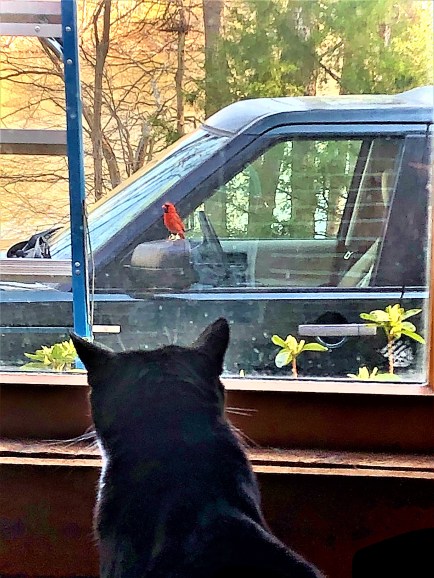
There is a cardinal, who for weeks has been fighting with fisticuffs, or whatever feathered version there is of that, with nearly every window I have on my house.

And on my car.

And with my head if I’m outside and happen to have extra shiny hair that day.


Obviously, one must protect one’s nestlings from intruders—even if you mistake them for your own reflection. And I, obviously, must protect a smaller-brained organism from leaving his nestlings fatherless.

But my efforts are thwarted by the cardinal’s span of territory to patrol. I cannot blackout every window to diminish the glare, as I have limited supplies and a biological need for vitamin D.

He will have to take his chances with the likelihood of beak repair.

There is also a squirrel. One who suffers from great impatience.

The rule in my childhood neighborhood, adhered to by anyone with one season of vegetable growing experience was thus: plant 1/3rd for the deer, 1/3rd for the birds, and 1/3rd for your family.

For years this directive was sage and followed by all participating creatures.

This year, I cannot get the seeds in the ground without a squirrel—one I now recognize because of the prison art tattoo on his back—digging them up the second I’ve stepped away.

First, I tried netting the box. He must have opposable thumbs. He easily unnetted the netting.

Then I tried heavy-duty tree trunk wiring. He must have tools. Unwired, and again I am seedless.

Then I just put out half a pound of already grown green beans and a sign that said YOU WIN.

(*insert squirrel snickering here)

Lastly, there is a beaver.

He is industrious. He is relentless. And he has expensive taste.

He has already struck down and carried off three massive bayberry bushes and is now working on a beautiful thick oak that will take him years to gnaw through. Gauging his angle of approach, it will likely land directly on my house.

It’s okay. I’ve got time.

But to deter him from this great specimen of timber—which may or may not survive his insatiable appetite for cellulose and lignum—I have begun laying piles of thick branches and small logs at the base of the tree. A gift. An impediment. A message that suggests If you carry on with this task, you will soon become a part of my winter wardrobe.

Nevertheless, he persists.

My next step would be to enmesh that tree with the heavy-duty tree trunk wiring, but it’s still currently in use with my next squirrel-thwarting endeavor which involves a small makeshift catapult.

I know these minor skirmishes sounds like small potatoes as we’re all muscling our way through day after day of the pandemic which forces us to revisit and ration our daily wants and needs.

But might there be a silver lining out there for many of us? The substantial amount of people who have yet to experience the oh-so-real terror of scarcity?

Is it such a bad idea—despite the fact that it has been forced upon us—to reevaluate what the word need truly means? Or to press each of us into a state of deliberative ingenuity?

I’m not suggesting we all slap on a coonskin hat and become some version of Daniel Boone, but would it be so awful to think like an Italian nonna when facing the dwindling supplies on one’s pantry shelves and you’ve got thirteen hungry bellies to fill?

I think most of us would benefit from a few hours of bootstrap thinking.

Certainly, when I look at the microcosm of The Hunger Games event I’m involved in with Mother Nature and her brood, I can see that there’s more than one way to skin a cat—or a beaver, if you will.

I see them effortfully striving, every day, for the same things: food, shelter, and the protection of one’s progeny.

That’s the focus. And I don’t blame them.

That said, being the individual with slightly more gray matter, I find it’s possible for me to not only endeavor to achieve those same things, but maybe help a few of them in their pursuit as well.

Now is the time for inventiveness, resourcefulness, and innovation. Along with that comes the eye-opening bonus of gratitude.

We may never view the necessities—the essentials of life in quite the same light. Whether you’re handing out bags of successfully grown green beans to neighbors, or you’re delivering face masks made from the hairy hide of a befallen beaver, you’ve seized the chance to be a section of a solution and not part of a problem.

Most important, this is a critical time for self-reflection. The point is none of us have to be bird-brained about any of it.

~Shelley

For the time being, the blog is closed to comments, but if you enjoyed it, maybe pass it on to someone else. Email it, Facebook it, or print it out and make new wallpaper for the bathroom. If it moves you, show it some love and share. Cheers!

Don’t forget to check out what’s cookin’ in the Scullery and what we all gossiped about down in the pub. Or check out last month’s post and catch up.

On the Cutting Edge of Shear Madness

There is a venerable phrase many of us have heard countless times in our lives:

Doveryai, no proveryai.

Or if your Russian is a little bit rusty, Trust, but verify.

It’s an old proverb American writer Suzanne Massie passed on to Ronald Reagan before he began traveling to Russia to discuss U.S. and Soviet relations during his presidency.

It became for him somewhat of a trademark phrase.

It became a lodestar for many of us, a crutch for a few, but sage advice for all.

A week ago, my hound, Haggis, had none of the typical skepticism that normally washes across his face unless spotting a jar of peanut butter, his leash, or the hind leg of a freshly shot deer in my hands. But this was because he could no longer spot anything.

Literally. His hair had grown to a length where it could serve as an emergency ladder should he be close to a second story window and we had a fire.

So, when he finally heard the hair-raising snippets of my hair-cutting scissors, that skepticism shifted straight into suspicion and finally parked itself at defiance.

I had never cut his locks before, and he believed it was best if we left it that way.

Today, we find a great swath of our population experiencing a crisis of trust.

And why is that? The reasons are many. Understanding them is paramount and will likely shift the way we think, plan, behave, and move forward.

Together, this globe is redefining what life upon this planet is like. We are forced to assess our work, our relationships, our lifestyles, and the unforeseen shape they will morph into down the road.

Over the next several days I employ great determination during my time of internationally urged self-isolation to convince myself and my great hairy hound that I can accomplish the Herculean task of carving through his shrubby mane in the same way most of my fellow humans try to muddle their way through the maze of subterfuge, pretext, and great gobs of misinformation clouding our sight of the truth.

Daily, I place him in an unnatural position and beg him to be still as I scissor away for the space of an hour. I listen to the news: the practitioners, pundits, the press, and the president—each one with a decreasing sense of belief.

I feel Haggis tremble beneath the sound of sharp shears, and I put the scissors down and soothe him with all the ridiculous cooing tones meant to bring forth some ease. But I echo his same tiny twitch of skin when I’ve nipped him with the tip, or when they broadcast some new tally.

Every day certain numbers shoot up, and others slide down. We are warned by some and encouraged by others. Who do we trust? Who should we trust?

With boastful reassurance, I tell Haggis that he’s going to look fine—don’t gaze in the mirror, don’t question my actions, don’t think about it too hard. Trust me.

Each afternoon I hear about people who have heeded and those who’ve just balked. About those who have saved lives and those who have risked them. I wonder if, when this is all over, and I’m face to face with strangers, will I look at them with a fresh question: can I trust you?

And each afternoon I stand from my work, look at the dog, take a deep breath, and exhale with despair.

Good lord, what a mess. I’ve never done this before. And clearly it shows.

I fill him with flattery and maudlin praise, hoping he can’t see through my bluster and swash. But he feels my inexperience. And he knows that whatever my actions, I’ll not feel them as keenly as he does. He discovers at some point—day four or day five—that I’m frustrated with this routine, I’m wishing it over, and I’m unhappy with the results.

But he also knows that there’s no turning back, and this is where his lack of trust in my skills begins to crystallize into disregard.

I am somewhat offended as each day he pulls away from me, refusing to hand me a hoof or his chin.

You’re going to slow.

You’ve made a right mess.

Look here, now I bleed.

I hear him.

I should have left this up to the professionals. Although this is not a choice. We work with what we have, and a large team of experts does not appear at my door.

Each day I scooch the hound outside, toward the mile-long stretch of road between us and the mailbox. I keep my fingers crossed, hoping no one sees as we walk along. Haggis is only mid-way through this pruning, sporting a thick Mohawk down the length of his back, a mop-head, and four legs that are shaved only three-quarters down, making it appear that he is a belligerent teen prancing about in dog-friendly Uggs.

A neighbor stops his truck and rolls his window down slowly. He eyes the two of us with suspicion.

Has he got the virus?

No, I answer. He’s in the middle of a haircut.

Looks like he’s got the virus.

It does my ego and my confidence no favors to receive yet more criticism, and I mope the rest of the way home.

But tomorrow comes, and after convincing Haggis to climb atop the coffee table/barber’s chair once more, I ask myself a critical self-esteem building question:

What would Vidal Sassoon do?

It’s true—it’s not particularly hashtag worthy, but it seemed relatively uplifting for the moment.

And when one is on one’s own, navigating uncharted waters and expecting choppy results, one will search for signs of inspiration, direction, and security wherever one may find it.

(I’m lookin’ at you Dr. Fauci …)

We muddle through and trudge along. We rise to the occasion and make a small difference.

We find places to put our faith: in facts, in evidence, in one another.

And until we emerge on the other side, knackered, shaggy, and injured, we offer kindness if not confidence.

A spoonful of peanut butter can go a long, long way.

Surely the Russians knew that.

~Shelley

This slideshow requires JavaScript.

For the time being, the blog is closed to comments, but if you enjoyed it, maybe pass it on to someone else. Email it, Facebook it, or print it out and make new wallpaper for the bathroom. If it moves you, show it some love and share. Cheers!

Don’t forget to check out what’s cookin’ in the Scullery and what we all gossiped about down in the pub. Or check out last month’s post and catch up.