A root awakening in the garden of evil (I mean Eden).

I love the color green. I love wearing it, seeing it and eating it. I even strive to be it. It’s a lot to live up to, and more often than not, I end up falling back into my default color … brown.

I am basically a method of transportation for DIRT.

Living where we do, and how we do, I find life is a constant struggle between these two hues. Since there are animal chores to be done twice daily inside and out, you are likely to find yourself, come bedtime, with clods of clay, fragments of feed and patches of poop annoyingly clinging to clothes, skin and hair.

In anticipation of this, six years ago when we began building this barmy abode, I repeatedly requested that everything be earth-toned: floors, walls, furniture and fixtures. We currently sport every shade of muck and mud known to Benjamin Moore & Sherwin-Williams.

Seeing the wall calendar currently show the month of August, I know it truthfully to always be two months ahead. Signing checks and school permission forms with October in the date department throws a constant reminder under my nose that the chore list is changing.

romancing the garden glove

romancing the garden glove (Photo credit: curlsdiva)

Seeing the multiplying emails from our homestead’s chief strategist and tactician, Roger, arrive in our inbox, or guiltily acknowledging the growing stack of precisely laid out hacienda homework he has purposefully proposed, leaves no doubt with the message: get your gloves on, it’s time to tame the terrain.

Everyone in my family will attest that when it comes to gardening, my thumb is khaki-colored at best. I can successfully grow the fruit and veg needed to supply more than enough for my family’s culinary needs, with the extras pushed into the hands of our visiting Fed-Ex drivers, propane deliverymen and lawnmowers, as well as anyone who happens to accidentally come upon the house by taking a wrong turn. This particular garden is rich with offerings, and I’m beginning to believe, capable of enormous resilience after sessions of either my absence or mismanagement.

What is truly frustrating is that I’m surrounded by people who are incredibly capable landscapers, horticulturists and master gardeners. Give any one of them a sliver of someone’s fingernail and they can propagate the rootstock for a new human being. They have immeasurable talent, energy and knowledge.

Gardening equipment and tools, and grafting di...

Gardening equipment and tools, and grafting diagrams. (Photo credit: Wikipedia)

I, on the other hand, merely look at the garden and sigh with exhaustion. I immediately come to the conclusion that I need a nap.

When my mother arrives at the house, armed with a flotilla of tools, soil and a gleam in her eye, I detect the blood draining from my head and begin to feel woozy, realizing I’ve left things too late and will now have to pay for my negligence by sucking up forty-eight hours worth of nettled knees and a barking back. It’s my own fault. Somehow I’d hoped no one would notice the overabundance of choking weeds, smothering vines and disfiguring deadwood.

Not many people can appreciate the prairie look, but it does grow on you after a while … if not around you after laxity.

There is a massive difference between her glistening, well-oiled and surgically-sharpened gardening implements and my rust-covered, jagged-edged Ginsu knife picked up at a local county fair from a slick kitchen demonstration by a Brylcreem carnie.

My mother prods me through the gardens, requiring I take notes as she instructs what will need doing once she leaves me on my own. There are precise methods of pruning—“One can’t just hack!”

I like the satisfying sound of a good hack.

Believe it or not, not everything is a weed, which makes my efforts to weed whack tedious and tricky. Long tall green things look so much the same to me. The only reason I don’t rip most crops out of the potager is because I give them two months to get going and usually by that time there’s a berry or a bean hanging from it. Anything outside of the kitchen garden looks suspicious to me and if it does not sport a flower or has not been painstakingly labeled by Roger, my instinct is to cleave and yank.

There were multiple times this weekend when I heard sharp intakes of breath that did not come from my lungs. What followed were my mother’s masked attempts to cover an overwhelming urge to tsk. I don’t blame her. If I were her, I’d probably take a shovel to the back of my head. Trailing these negative assessments of my lack of familiarity was my insistence that duct tape is man’s best friend. Apparently, Mother Nature does not share this opinion.

Rip Van Winkle Illustration by NC Wyeth

Rip Van Winkle Illustration by NC Wyeth (Photo credit: Wikipedia)

Still, we carried on, my mother pruning, snipping, coaxing and trimming, me … carving, lancing, docking, gashing, lopping, sawing, severing and slashing. Some of us did better than others.

Regardless, there is a small chunk of the garden that is now, thanks to the know-how and hard work of other people, ready for a winter snooze of around forty winks. Sadly, the rest of the garden will have to face certain insomnia until I can review all my notes. Seeing as though it’s only August, I’ve got plenty of time.

~Shelley

Don’t forget to check out what’s cookin’ in the Scullery this week (here) and what we’re all talkin’ about down in the pub (here)!
Pitchforks to fancy forks

Farm to table. It sounds so easy, so simple, so … no brainer, right? You farm your food, pick it, eat it.

Tah dah!

Except anyone who farms realizes there might be a few whoopsy-poos that can happen somewhere between dirt and dinner.

Yet surprisingly, you can’t turn around these days without bumping into somebody who is  ripe with success, making headlines in the food world.  Either they have a forthcoming book all about the way they turned a small third-world village into a new sustainable enterprise with nothing more than a tractor made from Legos, or they’ve opened five new restaurants which are run on recycled potato skins and leftover lemon rinds. I’ve even stayed in a hotel that stocked toilet paper made from sheep poo pellets.

I would love to be one of these people.

I am not.

James Shikwati, Kenyan economist, at the TEDGl...

So, until I come up with an ingenious way to run a dairy farm on methane gas, or discover an unknown symbiotic relationship between worms and non-recyclable plastic, I can only support the people who do find jaw-dropping ways to make the news and soon show up on stage at a TED talk.

One of those ways is to attend a farm dinner.

Farm dinners, also known as meals in the meadow, pitchfork to plate, farm to fork, or cowpie to peach pie (only kidding), are a growing trend inspired by the healthy locavore movement. Usually a local chef lends his name and talents to the community’s neighboring food producers and creates a memorable multicourse meal in a farmer’s barn, a field among the livestock, on the beach beside the roaring surf, or in the vineyards between the chardonnay and the pinot noir.

Oftentimes, diners get a farm tour and listen to the chef and farmers chatter about what Bessie had for dinner last night in the barn just before slaughtering time. They might even throw in her final words, surely a message of thanks to the farmers for a true quality of life experience. It was probably something like, “Moo,” but it might have been, “Mooove that knife. It’s too close to my throat.”

We’ll never know.

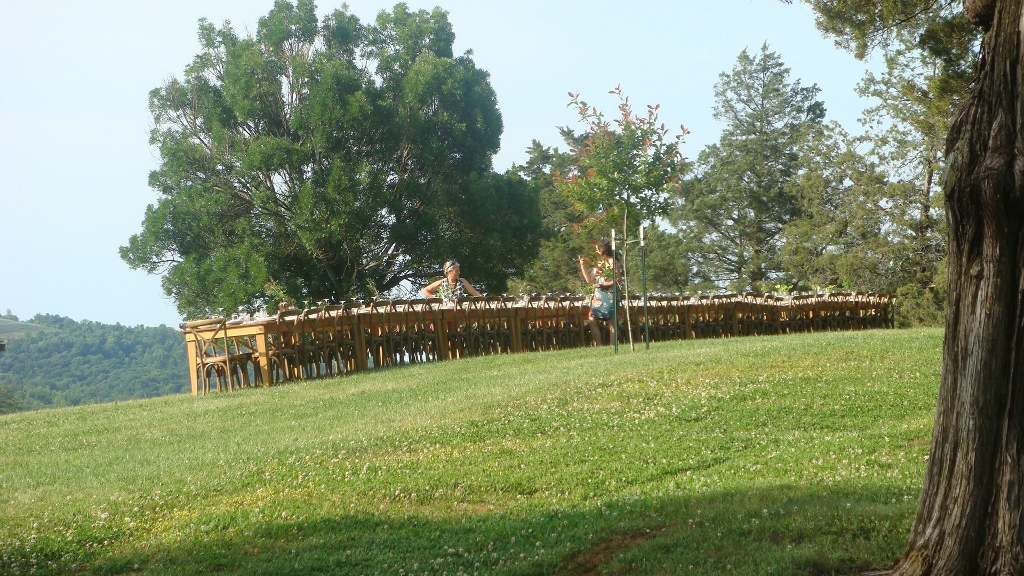
I actually went to my first farm dinner last night. It was held at the historic Virginia estate called Morven: a property with a pedigree that likely links back to biblical times when Moses was trying to rent a summer home to get out from under the skin-shriveling heat of the dessert. Okay, I totally made that last bit up, but click on the property link and make yourself a large pot of tea. There’s a bucketload to learn about the estate.

The dinner was held in support of the Charlottesville City Schoolyard Garden program that uses a garden-based curriculum to help promote health awareness, scholastic success, and neighborhood involvement. Math? Measure and chart plant growth. Science? Understand and view firsthand what chlorophyll is all about. Music? Tomatoes are said to be partial to Handel and The Rolling Stones. (I’m joking. They hate Handel.)

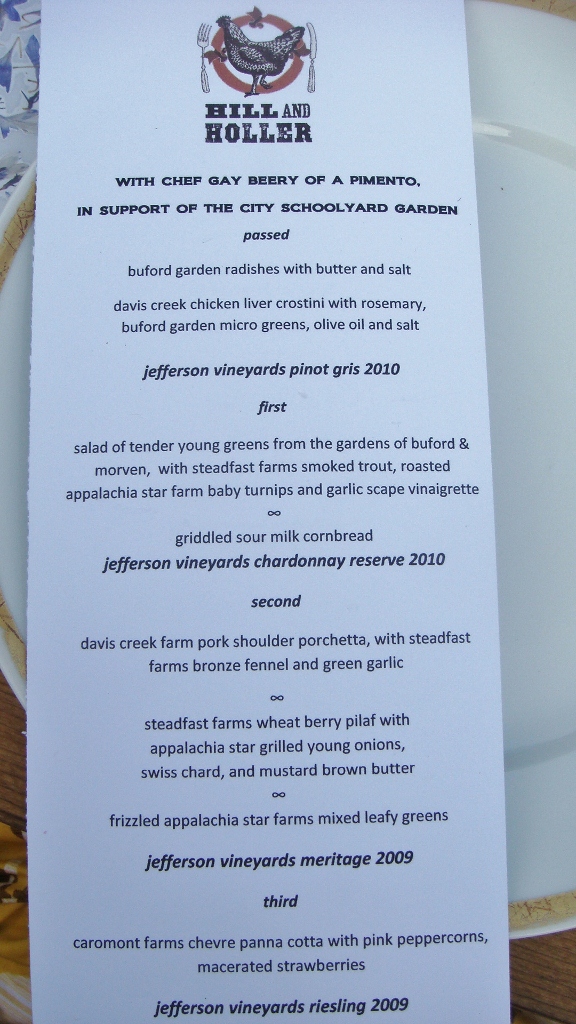
Chef Gay Beery of A Pimento put out a luscious spread for 90 + diners under the setting sun on an old Virginia farm, using food from at least five surrounding farms and one school garden.

Thomas Jefferson was no doubt smiling in his grave as folks sipped wines from the soil he’d first planted vines in shortly before the Revolutionary War.

The food, the farm and the fruit of the vines created a spectacular evening—one I think everyone should be able to take part in.

Go ahead. Look it up. Google farm to table and see what pops up in your neighborhood. Then make a reservation and see what happens. Shortly afterward you may find yourself:

-eating more vegetables

-buying local food

-starting your own garden

-heading up a community veggie patch

-solving world hunger

-writing a book about it

-giving a TED talk

Even if you only make it halfway down that list of exceptional accomplishments, you have done yourself and many others a great deed.

Now go forth. Grow. Eat green. Be green.

Get a farmer’s tan.

~Shelley


PS If you’re searching for seeds (from arugula to zucchini and everything in between), I’m recommending a company that not only has a worthy mission creed but a wonderful moral code. Give The Mauro Seed Company a looksee.

Their motto? Grow One, Give One. I’m impressed. Maybe you will be too.

Don’t forget to check out what’s cooking this week in the Scullery (here) and what folks are talkin’ bout down at the pub (here)!


Sheep; The long and short of shearing.

His Secretary

Well, it’s near the end of April. And you all know what that means: Administrative Professional’s Day. It used to be called Secretary’s Day.

I’ll tell you what else happens during April. Sheep shearing. It used to be called Make Your Farm Animals Hate You Day, but that was a lot to fit into the little calendar squares, so it was changed.

Now guess what else has changed? The way my sheep look at me.

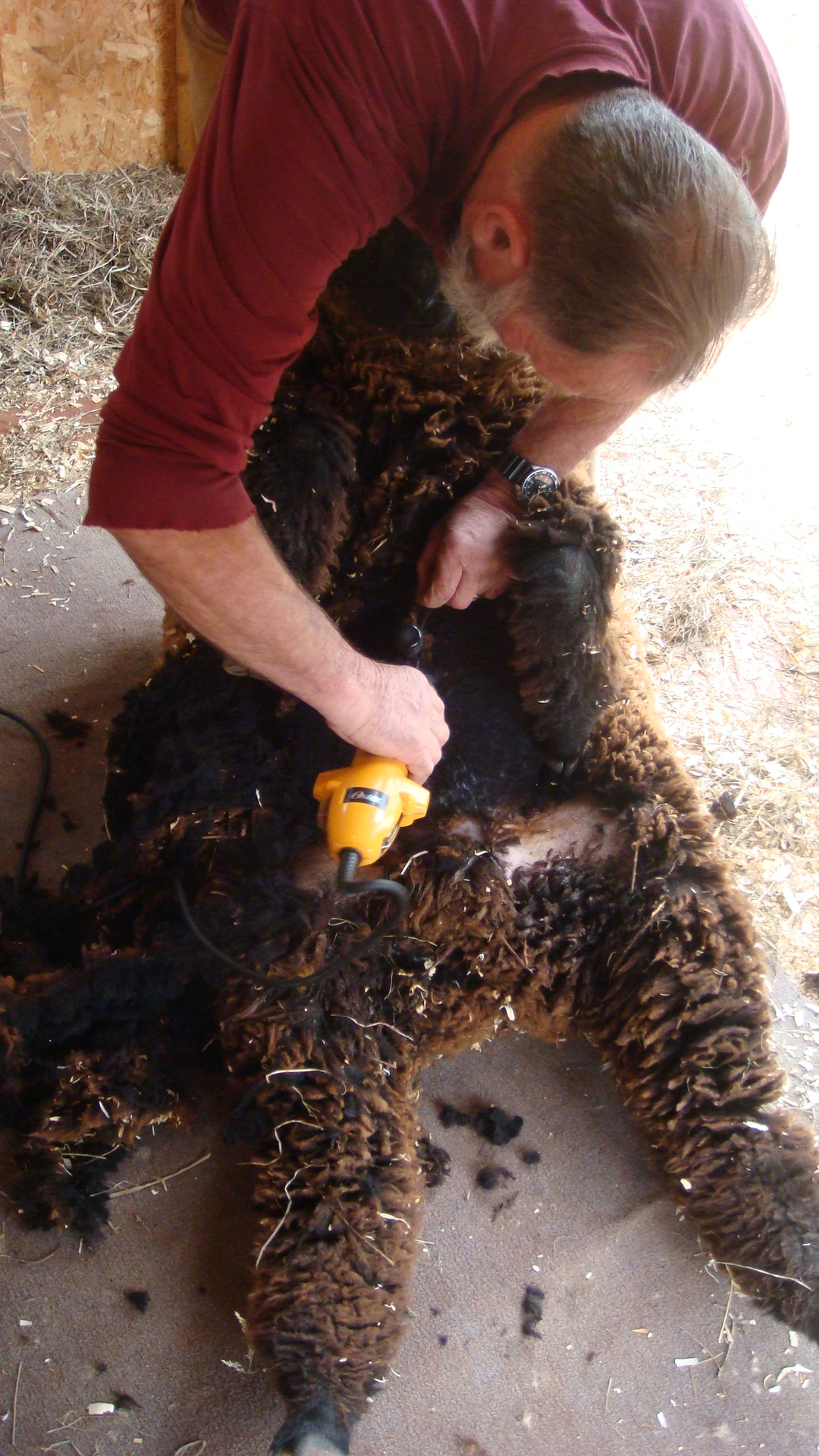
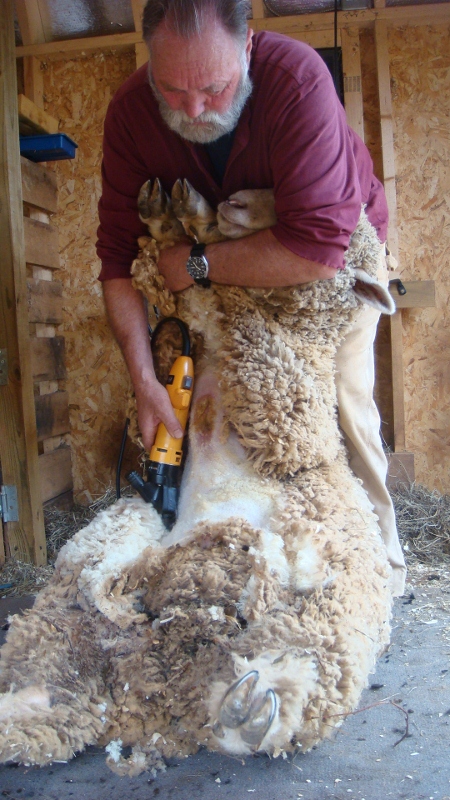
Peter, our Welshman sheep shearer, gave me fair warning. But I didn’t listen to him. I was too busy snapping over 300 photos of what was happening to Toot & Puddle, our wide-eyed woolly lambs.

It took Peter 3 minutes and 29 seconds to undress each shaggy form, an eternity in sheep shearing standards, but these fellahs were the first two of his season. He normally whips them out a mutton a minute.

It wasn’t until I scanned through all the uploaded photos on my computer that I realized what really took place, what Peter attempted to communicate.

To our sheep, I was provider of food, water, shelter and a good nightly noggin scratch. The perfect shepherdess. After Peter had them spread, splayed and speechless, trust left their eyes as the fleece fell away. They stumbled back to the meadow, not recognizing each other nor understanding why I stood three feet away and did nothing but document the entire assault.

Peter said I’d likely never catch them again, that they have a memory like an elephant, and I think we all have seen how well most elephants remember our birthdays.

I’ve never seen sheep suffer from depression before, and for two weeks following what I’m betting they’re now considering the attack, I have been subtly shunned from their little flock. Hearing sheep sigh can kill you, just a little bit each day.

If you have never witnessed a shearing, I encourage you to pack a picnic and send out feelers to find out where you might be able to watch such an event. As displeased as my two little fellows were over the sordid ordeal, I think it was more than amazing and expect the pair of them will come to their senses in a few short weeks when the temperatures soar and the shade is nothing more than a variance in ground color.

Seeing a sheep get placed into what farmers refer to as the chair hold will make small children fall into fits of giggles and most adults sympathize with what it must feel like to have four stomachs and all of them stuffed right after a Thanksgiving dinner. It’s just … unnatural.

As soon as Peter had one of the guys in position, it was easy to see the animal register a few things in double quick time.

Not only was he unnerved and unprotected, but he also found out he was … unendowed. He looked at his barn mate and belched out a collection of sounds that I translated to, “I knew something didn’t feel right down there.”

He then turned to me with a look that said, “I’m assuming this was another one of your ideas?”

They must have thought I was hiding behind the camera, refusing to make eye contact or take ownership of what they clearly believed needed nothing short of an apology in triplicate, if not recompense.

After the Barber of Shearville left, I spent the next couple of weeks keeping tabs on the woebegone woolies. They either stood, with heads bent, barely touching each other’s foreheads, or sleeping their sorrows away in the barn.

Maybe it was their bulk that gave them bounce and vitality, their commanding identity. It appears I have stripped them of their Superman suits and revealed a couple of Clark Kents.  They are not impressed and want their capes back.

It’s a good thing their clumsy hooves cannot manage Peter’s shaving gear, for given the opportunity and shifty glint in their eyes, I’d not be surprised if they’d attempt to wrestle me into a chair hold and give me the exact hairstyle of who they really see me as …

LEX LUTHOR

Luthor in Superman: The Animated Series

Luthor in Superman: The Animated Series (Photo credit: Wikipedia)

Don’t forget to check out what’s cookin’ in the Scullery this week (here) and what we’re all talkin’ about down in the pub (here).


Flyboys & Farmhands

No one needs to bring an airsick bag with them if they’re going for a ride on a tractor. It’s not one of those things you’d find on a “be prepared” list if you were fixing for an afternoon stroll in the grassy fields on a warm spring day.

On the other hand, tucking a barf bag into the pocket of your delicate calico dress—the one meant to impress the third date fellah you’re seeing—should be somewhat of a warning. Especially if the suggestion came from him.

Back up a few years to the day I first took a ride with my pilot boyfriend, back to when he was fresh off the boat from his homeland where lands are granted, titles bestowed and heads beheaded. And still far from any recent ideas about reclaiming rightful colonies.

“A flight with you? In a tiny aircraft? Okay, sure!” (Giggle giggle.)

“Bring a plastic bag? You bet!” (Apparently, there’d be leftovers from a picnic.)

“Aerobatic maneuvers? Nope, never heard of them.” (Batting of eyelashes.)

“Yes, an aileron roll would be great!” (Must be some kind of sandwich.)

plane's manuva:Aileron Roll

plane’s manuva:Aileron Roll (Photo credit: Wikipedia)

“Holy Mother of Pearl! The ocean is above us!” (Frantic pawing at flimsy, flirty dress in search of pocket and bag.)

“Breakfast does not taste half as good the second time around … Sorry about your ceiling … and the cockpit … here, just scrape that off and you can see outside … ugh.”

Fast forward two years. No pretty dress. No plastic puke bag. “No way, José. Move over. I’m left seat. You can read the charts and do radio.”

Fast forward further. “Hey, honey, building a house on a mountain would mean we’d be closer to the sky, wouldn’t it? And lookie there, it’s right on the flight path to the sweet little airport that’s your home away from home, isn’t it? I could follow you on Flight Aware and jump out of the kitchen with a sign telling you what to pick up at the market just as you zoom past  on your way home. Cool, huh?”

A 1948 Gambles Farmcrest by the Cockshutt & CO...

A 1948 Gambles Farmcrest by the Cockshutt & CO-OP tractor company. On display in Harvard, Illinois during Milk Days 2007. (Photo credit: Wikipedia)

Fast forward more. “I’m tired of looking up at the sky. Look down at the dirt. Hey, let’s dig in it.”

F.F. one more time. “We need a tractor.”

Yesterday. “Farmer tans are sexy, sweetheart.”

Present day discourse. “There’s a pile of sheep poo out there that ain’t gonna move itself!”

It’s true I became a pilot like my husband, but it was a long time ago and largely because one of us lacked a fundamental sense of direction. The thing most challenging for me is that radio talk is short. Purposefully short. Compulsorily short. I love words. I’m a writer. And even though I work very hard, attempting to find the best words to quickly convey my meaning to a reader, I’m super slow at it. Lots of extra words get thrown into my scripts before they’re weeded out. Flowery adjectives. Prosaic adverbs. Purple prose is in ample abundance. The words are sublime to my ears, but like fingernails on a chalkboard to Air Traffic Control.

ATC wants quick and informative. I like descriptive.

ATC wants: Montgomery tower Bonanza 422MA 5000 inbound runway 23.

What I’ve been known to do: Good morning Montgomery tower! This is the super sleek Bonanza November four two two Mike Alpha with you at five thousand glorious feet in truly blue skies requesting the newly paved and hopefully extra long runway two three in just a couple of quick minutes, okey dokey?

When I first learned how to fly, people were always asking me to state my position. Sitting down and facing forward was not the expected reply. I long ago learned a sense of humor is not appreciated up there—and that access to the airwaves did not grant me time to practice a hopeful stand up routine.

I am not allowed to do radios unless it’s an emergency now.

I’m not that fussed. Especially since I don’t work well under pressure. I was always asking ATC to hold on a sec so I could piece together the right code-like answer. It sucks to get shouted at while you’re desperately trying to remember what all the lighted buttons in front of you are for and why some of them are flashing and others are making siren-like sounds.

Which is why riding a tractor is so much easier and a whole lot less stressful.

And more forgiving.

If I forget to put the bucket down before making a pass at a pile of pine shavings, I back up.

If I forget to put the wheels down before making a swoop at the runway, no do-overs allowed.

If I forget to put enough gas into the tractor and get caught short way the heck down by the sheep barn, I trudge back up the hill and haul down the gas cans.

If I forget to put enough gas into the plane, there’s no trudging, just plunging. Big difference.

I suppose I’m grateful to have gone through the experience of learning how to fly if for no other reason than simply because it impressed my high school science teacher who thought I’d probably go no further than learning how to master a weed whacker.

It really goes to show you just how far a plastic puke pouch and picnic can take you.

Roger and out.

Ten-four, good buddy.

Wilco.

~Shelley

Don’t forget to check out what’s cookin’ in the Scullery this week (here) and what we’re all talkin’ about down in the pub (here).

The Long, Eternal, Relentless, Never-ending, Unremitting Year

If pressed one day to reveal my dream tattoo, its explanation would arise as a result of watching far too many Monty Python skits.

Group shot of the Monty Python crew in 1969

the men who raised me

More than likely I’d need to find a space massive enough to accommodate this:

All right, but apart from the sanitation, medicine, education, wine, public order, irrigation, roads, the fresh water system and public health, what have the Romans ever done for us? 

The one thing missing, I would hazard to say, is the calendar we depend upon today.

Imagine this– you are a farmer, tied to the land and your animals, agrarian in every sense of the word, and counseled beneath the Roman emperor Numa Pompilius’ calendar.

Numa Pompilius consulting Egeria.

Lunar to begin with, it consisted of a mere ten months—March through December. Now as much as many folk would wish to be rid of January and February, Numa spit in the eye of his subjects’ greatest fears and threw two months into the beginning of the year, officially recognizing the missing sixty days of terror, when unmentionable fiendish ghouls ruled the streets. Yes, you could still walk around covered in ash and leap through the flaming pyres of purification meant to ward off those who shall not be named, but now you’d be able to pencil in on which day you’d prefer to have a chalky complexion and ones where you’d singe your coattails.

Fast forward around six hundred years. Same ancient farmer—well preserved from a fine diet off the land—and same ancient calendar: lunar and totally bungled. Sure, Numa threw in a few extra days here and there to appease those around him with better mathematical skills. But complaints were rife. A 355 day year falls a little short for the agricultural savviness of most farmers, and after a decade or so, they’re getting reminders from Outlook to start planting seeds around December 23rd. Houston? We have a problem.

Русский: Бюст Юлия Цезаря, Летний сад, Санкт-П...

Cue Julius Caesar. Even though the guy had a lot on his plate: a budget crisis, political corruption, throwing a few dinner parties complete with gladiators and lions, he apparently got tired of showing up way too late for the Vernal Equinox Festival each year. Things had gotten so out of whack while Rome was busy conquering the world, nobody noticed—unless you were friends with a farmer—that the first day of Spring was scheduled for somewhere in June, just after school let out. Something had to be done.

Since he had friends in high places, Caesar sought the help of someone whose influence was of the highest order, astronomically speaking.

Sosigenes, an Alexandrian greatly envied for the size of his telescope, er … astrolabe, was beckoned forth and instructed to untangle the calendrical conundrum. Pronto.

Up for the challenge, Sosigenes took out his freshly cleaned slate and chalk, came up with a slick marketing plan and presented the new Julian Calendar, complete with slides. The only glitch was that before implementing the shiny new calendar, they had to set straight the old one.

Thinking no one would mind—or even notice—Sosigenes threw a few missing days into the current year. Sixty-seven to be precise. Thirty days were added in between February 2nd and 3rd and thirty-five snuck in just after the last day of November and the first of December. The other two might have been tossed in as a couple of three day weekends.

Still, no matter how much publicity sparkle the PR department tried to spin it with, the Romans became a cranky bunch. And who could blame them?

English: A girl's wish list for Santa Claus.

February now seemed like an unending Lent, and Sosigenes was getting hate mail from kids who were expected to be ultra patient for the start of the Christmas season. People were going to have to wait an ungodly amount of time see if Caesar would put a menorah on the front lawn of the Basilica. Sadly, they’d never know.

Regardless, there are a couple of things we can take from the lesson of what soon became coined as The Long Year. Firstly, Rome realized their kids were falling way behind in math and sciences and that the Chinese were catching up. Secondly, Romans back then were older than what their driver’s licenses said. And lastly, we’ve got little to complain about when every four years we tack on an extra day in February, because seriously, look what the Romans did for us. If you can’t remember, I’ll show you my tattoo.

Don’t forget to check out what’s cookin’ in the Scullery this week (here) and what we’re all talkin’ about down in the pub (here).