Feasts & Famine, Saints & Sinners.

English: Statue of a woman praying. Decoration...

English: Statue of a woman praying. Decoration of the Aedicule in the Church of the Holy Sepulchre in the Old city of Jerusalem (Photo credit: Wikipedia)

When I was a child, I went to church.

A lot.

It felt like every day.

It was probably no more than twice a week—services on Sunday and catechism classes on Wednesday afternoons. Except for when we had choir practice, which was often held on Thursday nights. Or when my mother had a National Council of Catholic Women Who Needed a Night Out meeting in the church basement with coffee and pie, and I had to tag along. Or when there was an “extra” service celebrating a special saint.

There are over 10,000 named saints in the Catholic Church. Folks have stopped counting because they lost track a few years back. I’m pretty sure it’s somewhere in the fine print of a contract that all saints are dedicated a special service.

We have more saints than we’ve had presidents, astronauts and American Idol contestants combined. Throw in the number of iPhone updates we get in a year and we’re getting close.

The nuns from my class would get testy over the fact that we had trouble recalling which saints we were honoring each week, which I felt was terribly unfair, as they’d clearly had more time to familiarize themselves with the Pope’s Picks.

Magnesium Crystal Cluster Close-up

Magnesium Crystal Cluster Close-up (Photo credit: Paul’s Lab)

Simultaneously, we were in the process of memorizing the Periodic Table of Elements in science and things could get really tricky there. Was there a saint named Vanadium or was that a material found imbedded within meteorites? Were Valerian, Niacrinus and Gordian martyrs or metals?

It was even harder to concentrate during classes when a service was taking place upstairs in the church. The shuffling footsteps, the thumping of the prie dieu—that’s the fancy name for the kneeler benches–the muffled sound of the organ whirling away and the faint smell of incense that smelled like a combination of decomposing cabbage leaves and burning bleach. Eye watering. Oftentimes, the nuns would collectively sigh and direct us all up the back steps to join the service. When asked why we had to sit through church again for the second time this week, this is what we were usually told:

–        It’s a day of Holy Obligation—which I eventually found out was not true. There are six Holy Days of Obligation each year, not counting Sundays, and the year I finally started keeping track we’d gone seven times and it wasn’t even the end of January.

Occasionally, they threw in this explanation:

–        God has big ears and is keeping track of your lack of enthusiasm.

Saint Martin and the Beggar

Saint Martin and the Beggar (Photo credit: Wikipedia)

The one Feast Day I did happen to like was St. Martin’s Day, or Martinmas. Yes, the saint had an intriguing story, but I was smitten by the cryptic, hocus pocus magic of the celebration’s numbers.

Although America chooses not to make a big deal of the day, many other countries in Europe have bonfires, sing songs, have a family feast and give presents on November 11th. The thrilling bit was that they begin their Martinmas celebrations at the eleventh minute of the eleventh hour of this eleventh day of the eleventh month.

As a kid, this blew my mind. How could something magical not take place?

As an adult, I continue to look everywhere for magic.

I find it on the early morning breath of the sheep, in clouds of pillowy warmth, surrounded by whiskers filled with grain dust from breakfast.

It’s in the family of whitetails, sporting their shimmering, thick autumn coats in the slanting November sunlight, surprised at the iron beast that roars past, pitching them into nimble-footed flight from their deep, grassy beds.

I cling to the sky at dusk, marveling at how the thin, streaky clouds grow stained and saturated with crimson flames and plush blue velvets.

English: White-tailed deer

I search the inky heavens to discover the return of Pegasus, his wings beating breath into the blustery, black cloaked winds, sweeping the papery leaves about and whispering with a whiff of arctic air as winter chases him across the sky.

The snap of crackling logs, the heady, wood smoke scent, and the flush of radiant flames make a brick box come alive and funnel the focus of attention, enticing the harried and rushed to come sit a spell.

These are my saints, these are my feasts. These are my days of holy obligation. To notice, to celebrate, to capture, to treasure.

This is my church.

I hope God notes my enthusiasm.

~Shelley

Don’t forget to check out what’s cookin’ in the Scullery this week (here) and what we’re all talkin’ about down in the pub (here)!

Slaughter & Mayhem. How I love November.

This image was selected as a picture of the we...

During the past couple of weeks, and throughout the next month and a half, I’ll have celebrated four family members’ birthdays. Okay, one family member was celebrated twice, but she really deserved it and wasn’t totally “present” for the first gala I threw for her.  Still, I figure the event counts no matter how you look at it.

In between all these cakes, candles and moments of merriment, I have to fit in a lot of dishwashing.

Oh, and the Festival of the Dead.

I might be a pagan at heart, but not wholly. I pick and choose all the parts of Samhain I deem acceptable to participate in, and blindly wave off the others.

For instance, I will drive my sheep up from the far reaches of the meadow toward the barn to be stabled for the cold winter months ahead, but once there, they will argue like two bloated barristers, insisting that as long as I leave the cover off the grain barrel, they’ll ration themselves and keep an eye on the forecast.

I draw the line at sacrificing horses. They’re meant to represent the fire deity, Bel (or Belenos the sun god), and apparently will win back the world come springtime. But equine sacrifice is such a messy job. Plus, if you’ve ever seen dead horses, they’re really not up to winning back anything for you after you slay them.

English: Wicker man, engraving

Next, I’m happy to extinguish my hearth fire and march through the fields alongside the rest of my townspeople with the intent to kindle a new blaze from some choice sacred oak, and then take my flaming torch back to relight my home fires. The snag is that usually somebody has issued a secret declaration to reinstate the ancient rites of human sacrifice to please a few disgruntled gods, and you won’t know till you get to the big bonfire if it would have been wiser to simply stay at home and grout some tile.

Worse still is when you arrive at the glowing gala get together and find yourself looking up at a massive effigy, The Wicker Man. You hazily recall something about the forcing of not just one unlucky fellow, but a whole slew of folks into giant wood and thatched cages, along with every flavor of farm animal, some bread and honey, and a few jugs of vino. It’s only after everyone and everything is stuffed in there nice and tight that the large light bulb in your head illuminates just as a rosy glow from below sheds some extra light on all of you—in the form of a giant pyre. There’s a lot of protesting at first, but things eventually quiet down.

Martel and van Over have friends for dinner an...

Of course, most of us know that on All Hallows Eve the veil separating the dead from the living is tissue thin—see through for many if you regularly make a habit of chatting up dead relatives. I’m totally fine with that. In the ancient days of Samhain celebrations, spirits were greeted warmly from their regular gloomy, dank haunts. Everyone scooched over a bit on the couch to make room round the hearth, and a few nibbles of barley cake were offered as well as a cup of grog. Most ghosts were grateful. A few remained mulish and curmudgeonly. But who can blame them with the months of back breaking chain clanking and heavy breathing they have to repeatedly practice for the Big Night? I’m sure there are times when The Other Side is no picnic, so one should be somewhat understanding of the occasional gripe.

It's that time of year once again, Halloween u...

On the other hand, I always get a bee in my bonnet with Trick or Treating. I appreciate the historical significance—the several explanations for the favorite activity. In days of yore, one had to deal with not only a few departed relatives, but also fractious fairies and spiteful sprites. Today, our children want to keep that memory alive by participating in the pranks of these wraiths. What’s the harm in frightening the neighbors into parting with a handful of sweets, cakes or coins, right? Your choice: a few tiny terrors or a couple of confections? To me, it’s just fancy begging.

Because of my disagreeable definition, my children hate me with a particular vengeance on Halloween. Or maybe it’s the fact that I refused to take them round the neighborhood beseeching comfits of any kind. One year, after so much bellyaching, I allowed them to dress up and run around the house a few times, ringing the doorbell when they reached the front door while I rummaged through the pantry shelves, determined to find some forgotten Easter candy. It worked for a year or two. Not so much anymore.

Lastly, I welcome anything that sheds light and warmth during the ever increasing dark days of oncoming winter. Stingy Jack, or Jack of the Lantern, proves to be a piece of folklore I’ve always found entertaining.

In this old Irish tale, Jack—a tightfisted farmer—manages to trick the devil twice, resulting in one livid Beelzebub. God, who apparently watches the entire event unfold, is thoroughly annoyed by Jack’s seedy character. In the end, neither wants his company in the afterlife. He’s given the boot by both and told to head back from whence he came.

Jack-o'-lantern

Jack-o’-lantern (Photo credit: wwarby)

Apparently, Jack is a bit of a baby and still carries with him a fear of the dark. Just to prove he’s got a heart of gold, the devil tosses old Jack his version of an Everlasting Gobstopper to light his way —a lump of burning coal from the fires of Hell. Jack hollows out a turnip and wanders the earth to this day, ready to pop out of the shadows of any porch that sports a carved out pumpkin.

Kids love that story.

So as much fun as reliving my last few days has been, I’ve got to run and make another batch of barely cakes. A few of my dead relatives refuse to leave the comfort of my couch.

~Shelley

Don’t forget to check out what’s cookin’ in the Scullery this week (here) and what we’re all talkin’ about down in the pub (here)!

Know your Cupid, Stupid!

English: THE TREATY BETWEEN THE SHEEP AND THE ...

Last night, as I was finishing mucking out the sheep barn, I paused mid-muck, and shivered at a sound that pierced the silence of this early February evening.

Coyotes: Virginia’s scraggly version of a sheep’s Freddy Kreuger and capable of causing such nightmares, no amount of counting themselves aid in a good night’s rest.

The sound of their yipping and howling was so primal, it brought images of ancient scenes: priests, rings of fire, sacrifices and savage rituals. And it’s merely a hop from all that to Lupercalia—perhaps the forerunner of our modern Valentine’s Day.

A lot of folks would have you believe our currently appointed Day of Love

Cupid and Psyche

developed from one of three sainted men possessing the surname Valentine, and that through his deeds of medical miracles/imprisonment and/or writing love letters sprouted a holiday simultaneously celebrated and feared by men and women around the globe today. Maybe it’s true. Maybe it’s hogwash.

But long before these fellas were martyred and thrown on to the Pope’s big calendar of feasts celebrating someone’s demise, another ritual existed. Lupercalia was one of those totally raucous fiestas that nobody in Rome pretends to remember—unless you’re a Wiccan, in which case, nobody pretends to notice.

Curious to get to the real meat of the history, I was surprised to discover the uncanny similarities between the old Roman shindig held February 13th -15th and our fresh take on love, sponsored by Hallmark, held on February 14th.

See if you can follow along.

Lupa capitolina al Campidoglio. Ne esiste una ...

The Romans: Two teams of Luperci (upper crust youths from Roman society) run a footrace around the Palatine Hill and end at the entrance to a cave—supposedly where Romulus (founder of Rome) and twin brother Remus were nursed by Lupa, the she-wolf. Please note that in some texts, Lupa is interpreted as another slang term for prostitute.

Us: Men, no longer in teams but rather solo, run through any series of mazes, hoops, fire and monetary ruin in order to arrive first at the front door of their “prize” for the evening. I doubt many of the women offer professional services, but wouldn’t be surprised to see them bear wolf-like fangs if the man is late.

The Romans: Now in the cave and upon a shrine, priests sacrifice a couple of goats and throw in a dog for good luck, then mix the blood and smear it on the foreheads of those quick-footed lads.

Us: Now at dinner—be it house or restaurant—some sort of meat is slaughtered and whatever wine is paired with the meal is often smudged on the tie of our skittish young stud.

The Romans: The blood is now wiped away with whatever is on hand, usually some milk sodden wool, and everyone has a hearty chuckle at the good-natured prank. You’re asking me why they laughed at this. I shrug; maybe it was akin to blacking out a tooth.

Us: The waiter comes running with a fresh napkin soaked with club soda and everyone inwardly rolls their eyes at the inelegant act of folly. It seems we’ve outgrown the hilarity of the wine on the tie routine, too.

Flagellants practiced self-flogging at the tim...

The Romans: The sacrificed goat’s skin was then divided and handed over to the youths to both wear as loincloths and make into hairy whips for later on.

Us: Upon leaving the table, many men forget they’ve tucked their napkin into the top of their pants and depart from the restaurant with their own special loincloth.

The Romans: Now the youths get to run through the city streets flogging semi-naked woman (requested to be so by their Roman priests) with those bloody, hairy, goat hide whips, all under the guise that by purposefully getting in the way of the thongs the women will gain newfound fertility.

Us: At last, dinner done, our young man has great hope and expectation to see at least one woman expose herself in some manner or form, although this is where the traditions divide. Nowadays, it is the woman who does the whipping at the end of the evening, usually in the form of self-flagellation rapidly followed by self-loathing. Of course the end result is oftentimes the same as those of the Roman women. Newfound fertility.

To wrap things up, it’s easy to see we’ve not changed much. Apparently, getting to thwack a girl on the backside with some shredded bits of goat is still a winning Valentine’s Day plan for most guys.

A 2 month old goat kid in a field of capeweed

So no kidding, Happy Lupercalia.

~Shelley

Don’t forget to check out what’s cookin’ in the Scullery this week (here) and what we’re all talkin’ about down in the pub (here).


Lads & Lassies, Pipers & Poets

English: Robert Burns Source: Image:Robert bur...

January 25th marks the birth of Robert Burns. The Ploughman Poet. The Bard of Ayrshire. Scotland’s favorite son. Sadly, most people only admit knowledge of the catchy tune he penned that they drunkenly mumble along to come New Year’s Eve at midnight: Auld Land Syne.

He wrote poems and lyrics, collected and improved folk songs and fathered as many children with as many women who would have him. No wonder so many people claim him as their ancestor. The guy was a rogue—and a quick one too. He died at age thirty seven, making a remarkable attempt to populate half of Scotland.

Regardless, numerous individuals, whether of Scottish decent, whisky aficionados, or enthusiasts of poetry, annually plan to commemorate this man’s existence and accomplishments (both bardic and bedroom) with an evening of debauchery and boredom.

Scotish dirk

The whisky I love, but somewhere during the third hour of poetry, I’m looking to impale myself on the first dirk  I can slip from any man’s stocking. Consequently, I appreciate the whisky with more enthusiasm than I probably should. Of course, this is what everyone else is doing and why they believe they’re channeling Laurence Olivier.

A typical Burns Night, or Burns Supper, as it is both commonly known, used to be (and I’m sure remains in some stuffy circles) a “boys only” getup held on the anniversary of Rabbie’s birth. Gathering that Burns himself likely preferred the company of women and wouldn’t have missed the chance to gaze upon the legs of a lovely lassie, a few welcome mats have been placed at the feet of the fairer sex. It seems to have spiced up the evening for many a current soirée and is gaining popularity, as more women begin to view whisky as something more pleasurable than a root canal.

The supper components make or break any Burns celebration. More often than not, you’ll find most of the guests sleeping with their eyes open at the table, making frequent lavatory trips, or curled up in a fetal position in the cloak room, arms cradling a depleted Lagavulin bottle.

Assembling your own Burns supper should not be undertaken lightly; get it wrong and you will find attendees plotting your grisly death and funeral. One must consider the key factors needed: the proper guests, the right food, the liquor and the entertainment.

The guest list is crucial. Have a gathering of wallflowers or self-indulgent bores and your evening feels like watching the weekly defrag session of your computer: it will never end. That’s when I find myself making crosshatch paper cuts on the inside of my wrist with the edge of the menu in an effort to locate a vein that may end it all.

If you find the menu is reminiscent of something even Fido would shake his head at, do not blame it on the Scots. Just because these folk were once scrap cloth clad savages does not mean they couldn’t wield a torch with just enough finesse in order to perfectly caramelize the tops of their Crème Brule.

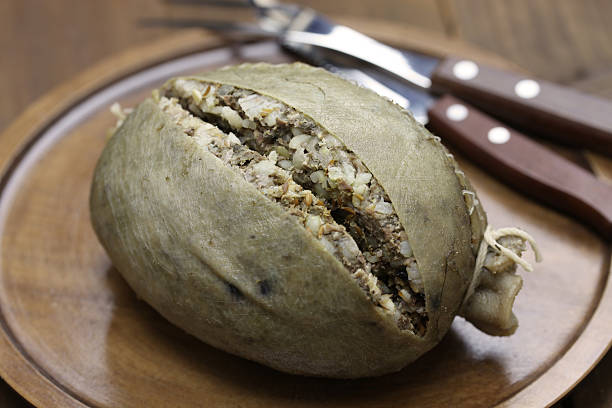
homemade haggis, scotland food stock photo


The main course, haggis, (aka sheep pluck), is a dish whose preparation and success requires deft skill in the kitchen. Try to find a large animal vet who moonlights as a Michelin rated chef to construct yours. Avoid the kind sold in a tin can.

The liquor is simple. Only the best. Famous Grouse need not apply.

When it comes to entertainment, if there isn’t a piper you might as well call it a nice little dinner party because without Mungo MacBugle blowing the cobwebs out your ears, it’s just going to be a slightly Celtic book club meeting with weird snacks.

The Scottish Piper - Victorian print vector art illustration

I have attended other peoples’ Burns Supper and I have thrown a couple of my own. Let me be honest. It is much easier to have a “babysitting emergency” in the midst of someone else’s grand Gaelic failure than in your own living room, among fifty hungry guests, who can clearly see your children alive and well, and currently working as unpaid wait staff.

My suggestions for you? Start small.

Gather your children, your parents and spouse—or anyone you trust not to blog about you the next day, and ask them to come to dinner prepared to recite a short poem, quote or bawdy limerick.

Check out a couple of the easier recipes offered by the BBC (click here).

Then head on over to the nearest (and reputable) liquor store and purchase yourself a good bottle of uisge bathea. Do not skimp and buy something that can double as mouthwash or battlefield disinfectant. If you’re new to whisky, look for a spirit that isn’t heavy with peat or smoke.

Finally, toast with abandonment. The more frequently you do, the quicker everyone becomes pithy, handsome and hungry enough to eat sheep pluck.

Slàinte!

~Shelley

Don’t forget to check out what’s cookin’ in the Scullery this week (here) and what we’re all talkin’ about down in the pub (here).