A Little Knowledge is a Dangerous Thing. A Lot … is Exhausting.

“What do you know about rye grains?”

This was a question from my boss at the distillery I worked at.

“I know that we use them,” I’d answered. I’d been working for the company for what felt like mere minutes at that point.

“Well, you’d better know a helluva lot more than that by tomorrow morning at nine, because a journalist is going to call you with questions, and I’ve pitched you as an expert. Best crack open some books.”

Example number one.

My boss: “You’re a writer, right?”

Me: “Yes?” I soon came to answer every question of his with an upward pitch of hesitation.

My boss: “Great. Write a technical manual for the distillery. Standard Operating Procedures, maintenance schedules, testing protocols—the whole kit and kaboodle.”

Me: “Wait. I write children’s literature. For children.”

My boss: “Good point. Do not, under any circumstances, allow the machinery on the production room floor to have dialogue. Or feelings.”

Example number two.

I was undecided for all of about 30 seconds before sharing with my boss the exciting news that I had connected with a woman who owned an old historic farm and was interested in working with me on planting a small number of heritage grains. She wanted to do something environmentally interesting with the property, and I’d finally found a way to potentially run a small experiment for our distillery that would not cost an arm and a leg.

“Great,” my boss responded. “You should apply for the educational grant that’s on offer to the spirit industry right now.”

“A grant?” I said this like it’s the first time I’d used the word.

“Yes.”

“I would have to apply? Like … fill out an application? Or is it a bit more like a research paper?”

“No. It’s like a grant proposal. Documents you submit to secure funding for a research project.”

Project?? This was going to be an experiment for our distillery.”

He nodded and typed something into his computer. “It still will be. Only now, it will benefit the whole industry.” He punched a key and spun around in his office chair to face me. “I’ve just sent you the application. Make sure it shines because you’re up against a bunch of university professors and professional research organizations.”

My eyes popped wide. “Oh, good god. I don’t know how to do this. How much time do I have before it’s due?”

“Seven days.” Then he glanced over his shoulder. “Six. You’ll be fine.”

Example number three.

I came home that night, curled up on the couch in a little ball and heard Dave, my partner, whistling in the kitchen and then making his way to the living room. “Here you go,” he said. He had two drinks in his hands, one outstretched to me.

I closed the one cracked eye I’d used to identify him with and did not move to take the drink. “I hate my boss.”

He chuckled. “You love your boss.”

“He sets me up to fail.”

“I challenge you to learn.”

“Your learning challenges suck all the fun out of working, and living, and breathing. I want to be less challenged. I want to be less learned. I like breathing, and I don’t want it to be so difficult.”

“Have I ever let you fail?”

“And—” I interrupted, “I would like to come home and be able to complain about my boss. That is a right of every person in a relationship.”

His brows rose an inch. “Is this a safe space for me to complain about my employees too?”

“Yes,” I smiled. “Everyone except me. If you have complaints about my work, then we have to set up a formal meeting with HR at the office. This might be your safest method so that I’m not throwing kitchen knives at you from across the room once I hear of them.”

He reached out again to hand me a glass. “What about poisoning the other person’s drink if you’re unhappy with them? Is that off the table as well?”

I took it, and enjoyed a long swig, then looked up at him. “You love your employee.”

“She challenges me.”

“Yes, but she knows more about rye than anyone else in your distillery. And she is the only person who knows how to write a technical manual in your company.”

And,” he added, “she will shortly know how to successfully write and win a grant proposal.”

I groaned. “She is exhausted.”

“She is indispensable.”

“She is cranky.”

“She is invaluable.”

I looked at Dave and gave him a small smile. “She appreciates hearing this.”

“Great,” he said, and made his way back toward the kitchen. “By the way, how much experience do you have with—”

I quickly buried my head beneath a couch cushion. I did not hear whatever it was I would soon have experience with. I would remain blissfully ignorant for just a few moments more because I felt certain that I was not missing out on an opportunity. The illustrative scenarios above are but a smattering of my future, as one thing I knew for sure, there would be ample examples to come.

~Shelley

For the time being, the blog is closed to comments, but if you enjoyed it, maybe pass it on to someone else. Email it, Facebook it, or print it out and make new wallpaper for the bathroom. If it moves you, show it some love and share. Cheers!

Don’t forget to check out what’s cookin’ in the Scullery and what we all gossiped about down in the pub. Or check out last month’s post and catch up.

My Garden’s Grassroots Plan to Poison Me

I grew up in Wisconsin in a family that gardened.

Correction—I grew up in Wisconsin, birthed by a woman who is a gardener but who did not have as many hours in the day to tend to the gardens she created and, therefore, I was compelled to garden like the rest of my siblings.

It’s not that we were gardeners; we were the labor force of the head gardener.

Her gardens were beautiful. Flowers with spectacular colors and scents, shrubs that displayed more varieties of green than Sherwin Williams could ever creatively conceive on their swatches, grasses that were feathered, plumed, tufted, and willowy, and young saplings planted for following generations to enjoy. Truly beautiful.

And I hated them.

But then there was the vegetable garden.

It had all the bog-standard roots, tubers, vines, and greens. It had berries and herbs, beans and sprouts. It had a seasonal design. It had function. It served purpose and gave back more than you put in. Anything ornamental was likely a fluke of Mother Nature who had leftover bedazzling supplies from the other “just for show” pretentious gardens. Everything was strictly edible.

And I loved it.

It’s not that I couldn’t appreciate my mother’s other gardens, it’s just that I like functional art. I take no issue with fruits and vegetables who display flowers at first, but once they move out of that stage, they produce secondary gifts that serve more than the purpose of simply being eye candy.

Because their task is to be stomach candy.

My mother has also been proclaiming the same statement for years: Just wait, one day the gardening bug will catch up with you too.

The gardening bug has never caught me, but it has done plenty of other things. It has bitten me, wacked me, stung me, and left me with skin diseases that are akin to that of a biblically impressive, untreated leper.

I get it. I am not meant to be gardening. In reality, I think the whole physical kingdom of the outdoors is threatening me with warning shots off the bow the moment I step foot into the open air.

Three weeks ago, I ventured outside to tame just one small area around a tree—one small area within one small garden surrounded by myriad other gardens my mother had meticulously, painstakingly, exhaustively established over the nearly two decades when she lived in the house I now occupy and must tend to.

I was armed to the teeth, as I always am, when finally overwhelmed by the guilt of not tending to her Eden properly. I was covered in tick repellent, sun repellent, and enough fashion repellent clothing to deter any misguided compliments should another human make eye contact.

Alas, surely nefarious nymphs were afoot and saw me as their springtime fling, for shortly following the grueling three hours of bending, digging, pulling, and yanking then gathering, dragging, piling, and swearing, I stripped off my clothes and dashed to the shower to pummel sore muscles and purge myself of sweat.

The first thing I saw in the mirror was a bullseye mark on my elbow, and as I leaned in, as anyone with eyes north of forty will do, I squinted and scowled to identify the interloper. A deer tick, of course. And apparently one who defied years of scientific research and the chemical laboratories in which they discovered how to thwart the appetites of blood sucking creatures.

My luck. But not surprising. I dug him out with freshly cleaned nails and likely took a patch of much needed elbow padding flesh with him just to be safe.

The next morning, I woke up with a bump and then two, and then ran out the house to work with the quick “must have gotten a spider bite on my arm during the night” type of assessment.

It was only while I was knee deep in a field of barley—well waist high actually—and listening to a professor of small grains lecturing about just how difficult it is to deal with covered smut, downy mildew, and net blotch that a farmer standing next to me kicked my toe and said quietly, “Whoooeee! Looks like you just had a tussel with some sumac—just like a dog rollin’ in a big ol’ cowpie patty. What happened?”

He was looking at my arms.

I looked down at my arms.

Oh, dear god, these were not arms. Surely, they were in truth barley stalks with covered smut, downy mildew or net blotch, right? Had I caught the blights the professor was talking about? I glanced up to the sky.

What have I done to piss off whomever is in control here? I muttered.

I drove home and tried not to notice the new symptom of itch.

How did this happen? How was I now breaking out in blistering bumps of poison ivy?

The next morning it was not just my arms, but my trunk and eyelid, and earlobe, and the bridge of my nose that sported the hot pink pustules. It was hideous. And unbelievable. And unbearable.

I called my dermatologist.

You must have had a gap in your clothing. Urushoil likely got between your gloves and your shirt, then you sweated, then that sweat carried the oil all over, and of course you tried to wipe off your face. You’re an idiot.

This is how my dermatologist speaks to me. She knows my luck with anything epidermally- related. Every year I’m forced to pay for skin scrapings and disparaging rebukes. In fact, even my insurance company knows my ill-fortune with greenery and sunshine, and they have announced they will no longer support my relationship with the outdoors. They’ve given me an ankle bracelet that sets off an alarm when I’m within two feet of a window.

I have managed though, and I’ve come across a motherlode of hazmat suits leftover from the pandemic’s PPE phase of fashion, so I’ll likely invest in one of them befor my next gardening venture.

But I seriously must truly reconsider any “next gardening venture,” as if there’s one thing I’m tired of being categorized as, it’s someone who makes rash decisions.

~Shelley

For the time being, the blog is closed to comments, but if you enjoyed it, maybe pass it on to someone else. Email it, Facebook it, or print it out and make new wallpaper for the bathroom. If it moves you, show it some love and share. Cheers!

Don’t forget to check out what’s cookin’ in the Scullery and what we all gossiped about down in the pub. Or check out last month’s post and catch up.

If I Truly Loved You, I’d Treat You Like Dirt

One of the best, most desired gifts I received this year during the holidays was a box to hold garbage.

I know, you’re all wondering if I’ve accidentally held my head in the oven too long whilst last cleaning it or, if finally, all those heavily scented, potentially carcinogenic candles from Bath and Body Works that I sniff on an hourly basis to keep me meditatively peaceful have created some cognitive disorder, but I assure, neither have occurred.

That said, my new container truly has me skipping about with a euphoric outlook because Rumpelstiltskin—my big new bucket—turns garbage into gold.

That’s right you clever clogs, I finally got a compost bin.

For the last two months I have been studying everything for its C/N ratio. It’s a beautiful formula for anyone growing closer to ditching their tax ID and social security number to live off the grid, or serial killers studying John Wayne Gacy and making mental notes as to how to improve on his form.

Decomposition can be deadly, but also beautiful. Therefore, for true success, one must know any material’s carbon to nitrogen proportions.

I promise this is not a lesson in organic chemistry, but who doesn’t love the idea of your old food making your new food?

Apparently, most people coming to my house.

Yes, I know, a good chunk of folks visiting my little log lodge leave less than stellar reviews when they begin to realize that a stay with me means you’ll likely be too cold or too hot, there’s a fair to middling chance you may get a teeny touch of dysentery because comestible manufacturer’s expiration dates on packages in the fridge are bogus, and you’ll need to memorize a list of things that go into a) the recycling bin, b) the compost bin, and c) the landfill bin.

The latter is highly discouraged and comes with a free set of annoying questions wondering if we might find another use for that object and an array of facial expressions that clearly cast doubt on whether you’ve truly watched any documentary of Greta Thunberg like you promised you did.

No judgement. She’s not for everyone.

But it’s plain to see I’ve now upped my game in the kitchen. A massive stock pot sits on the counter and is the receptacle to all things that will fortify my soil, enrich my diet, and likely cure cancer. The timeline is somewhat futuristic with each addition, but I’m in it for the long haul.

Basically, I have a new job. I now tell people that I am a terra firma farmer. A sod shaman. A ground grower. An anthrosol alchemist. Maybe the last one goes a bit over the edge, but you get my point. I’m harvesting dirt.

Into the stock pot go greens and browns. Everything from vegetable peels to coffee grounds are tossed in with delight. Egg shells, fruit, tea bags and olive pits. Pumpkins, tofu, peanut shells, and potato eyes. Old paper napkins? In they go. Q-tips and chopsticks? Join your friends. Pencil shavings and Ugg boot fluffage? Step right up and dive right in. Once that pot is chock-a-block full, they’re dumped into that beautiful new spinnable bin outside.

These are just your Joe-Average bits and bobs that fall under the category of acceptable, but Google appears to understand that nearly every day I start a fresh search with my standard question of “Can I put (insert questionable item) into my compost bin?”

So along with the above, I’m tossing in lint and dust bunnies, old match sticks and house plants (RIP, I swear I tried), holey wool socks and burlap sacks. I’m drawing the line at nail clippings. Just can’t do it.

Of course, there’s all the outdoor additions—the leaves, the grass, the weeds, and twigs. Pine cones, and bird’s nests (once they’re done with them), sawdust, and straw. I am finding it all. Picking it up, shoving it in, and swirling it about.

I’m sure my family thinks I’m losing a few more marbles because it then appears that I’m having a conversation with my compost pile, but obviously, they have no idea that I’ve popped in a handful of hardworking worms and are simply offering a few words of encouragement. It’s not like I’m talking to the bacteria or fungi, as that would be ridiculous.

We all know that fungal intelligence is geared more toward spatial recognition and memory, so I just leave them Post-it notes as reminders of where they are and what to do. Duh.

And now I churn, I peek, I poke, and wait.

I check temperatures, humidities, pH balances, and take weekly requests for movie night.

If I find a worm on the ground, I give him a noble Roman name and introduce him to the giant Saturnalia party where all his soon to be friends are closely gathered in the vomitorium.

This huge metropolis is teeming with life and death and decay–microbes, mites, nematodes, and invertebrates.

I encourage gluttony, as they are only doing their job.

I nurture meaningless affairs because reproduction is critical.

I tell heroic stories of their ancestors—those who have cleaned up polluted spill sites and made communities safe to live in again, or of those who went into medicine and actually became medicine.

I inspire futuristic dreams of outrageous proportions. Fungi? You are capable of becoming buildings and replacing concrete. Bacteria? You can become biofuels or gobble up greenhouse gases. Worms? A growing number of people find that it is equally as important to save one of you as it is to save a panda.

I tell my new friends who are feasting on these precious scraps the same thing: You is kind, you is smart, you is important.

I’m hoping they will remain as down to earth as I know them all to be. I am rooting for them because I know them all now. I be-leaf in them, and I feel like we are soil-mates.

Okay, maybe, just maybe, I have held my head in the oven too long.

But even if everyone around is begging me to stop with the wordplay and move away from the compost, I will only agree to drop the puns because I’m keeping my ground.

Happy dirt season!

~Shelley

For the time being, the blog is closed to comments, but if you enjoyed it, maybe pass it on to someone else. Email it, Facebook it, or print it out and make new wallpaper for the bathroom. If it moves you, show it some love and share. Cheers!

Don’t forget to check out what’s cookin’ in the Scullery and what we all gossiped about down in the pub. Or check out last month’s post and catch up.

Kindness Costs Nothing, but Tomatoes are a King’s Ransom

I am a procrastinator.

Although my explanations for delaying any decision or activity are crammed with reasonable details, I am also fraught with unreasonable guilt for the pile up of decisions left unmade and activities left undone.

One day I’ll get to that bucket list which is now a barrel list.

One day I’ll see to that niggling pain I’m hoping will disappear (obviously, it’ll definitely disappear by the time of my funeral, so I’m kinda covered on this one).

One day I will discover how many licks it takes to get to the center of a Tootsie Pop.

For the last couple of years, on my one hour and fifteen-minute route into work, winding through farm fields, cow pastures, and five-house towns, I have passed a little wooden shack—a farm stand selling vegetables. I remember thinking, One day. One day I’ll stop and check it out.

Finally, the excuses of I need to get home, or I need to get to work were put aside because one of those John Deere combines that claimed 620 horsepower but only 6 mph speed stopped traffic on my tight and twisty farm road. Coincidentally, in front of that farm stand. I now had absolutely no excuse not to investigate that which has been a colorful blur out my window. Countless bountiful months—those spring through fall harvest seasons—simply whizzed by for years where my only excuse was “not enough time.”

Farmers have a way of putting the advice of “stop and smell the roses” (or the newly mown hay, or the freshly dropped cowpie patties) into crisp and unignorable perspective. It is not so much advice as it is a forced bit of guidance.

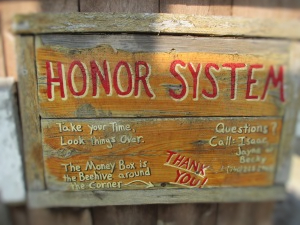
I pulled off onto the semi-circular dirt road that advertised the large hut with a few wooden shelves full of tomatoes, green beans, shallots, and corn, okra and peppers, potatoes, and beets. Each bin held a price, and I stared dumbly at them for a full two minutes. I glanced up to see a dry erase whiteboard with an entire menu and coordinating costs that matched the bins’ prices.

Ten cents for any tomato larger than your fist. Five cents if it’s one you can shove wholly in your gob.

No way, I thought. That’s got to be wrong. Or maybe they all tasted like they should sell at a K-Mart Blue Light Special event.

I found a five-center to test, overestimated the size of my mouth as I crammed it in, and then experienced the delayed response of one who realizes just how determined tomato innards are to gush past the house of their skin and any other boundary one feebly tries to embrace them within. Juice, seeds, and an exclamation of surprise came flying out my mouth.

But this is a farm stand in the middle of nowhere. Who’s watching, right? Who saw me splatter the wall and the front of my shirt, and the whole whiteboard menu?

Umm … maybe the fifteen cars idling on the road waiting for the great green beast to give them passage around him. Apparently, my faux pas was entertaining enough to produce a couple of honks and one “Nice work!” from the audience.

I trudged back to my car and found an oil rag, hoping I could erase some of the whiteboard’s woes I’d crafted. Word by word, and price by price, I replaced the tomato splattered menu with fresh listings, thanks to the dry erase marker on a ledge beneath it. I was mid-way through my work when I stopped to marvel at the taste of something so magnificent and a price so unmatched. I can’t believe I’d been missing out for years on this vegetal treasure chest.

Returning to my work, I’d turned to hear the squeaky hinges on a truck door slam. An elderly man in grass-stained overalls tottered toward me on legs so bowed they looked like parentheses rather than appendages.

“You changing the prices, young lady?”

“No, sir,” I answered as he stared at the marker and rag in my had.

He snorted and pointed to the vegetables, “You city folk come by here lookin’ for a bargain and still aren’t happy with what you find. I’ve told Beatrice that her prices are too low anyway, but she’s just a good-hearted woman easily taken advantage of.”

“I’m not city folk, and I promise I’m not changing the prices. I’m just redoing the whiteboard because I accidentally splattered tomato all over it. I was trying to do the right thing.”

He pointed toward the empty see-thru plastic bin with the sign above it displaying the words Money Box – Honor System. “The right thing round here is to pay before you consume, and most people—city or farm folks would know that.”

I felt like I was back in school, chastised by the principal for some second-grade misdeed. And I also felt a little bit miffed that I’d been unfairly accused of said misdeed, but I knew what it must look like to this guy, so I unzipped my purse and searched for my nickel.

Of course, I had no change. Of course, I had no dollar bills—no fives or tens.

I pulled out a twenty. “Do you by chance have change?”

The farmer slapped a hand to his thigh and cackled. “Do I look like an ATM machine to you?” He shook his head and moved back toward his truck, mumbling, “You city folk.”

Except I wasn’t whatever negative version of city folk he had in mind. And I was about to shout that out when I saw the old guy returning. He held up a silver coin, dropped it into the plastic box, and then said, “This one’s on me.”

I nodded with my humble thanks. “Please tell Beatrice her tomatoes are amazing.”

He shrugged and snorted. “I have no idea whose farm stand this is actually. I was a couple cars behind you in the line and was getting grouchy with the wait. I saw what happened and just had some fun while stretchin’ my legs. You drive safe now.” He got in his truck and pulled back onto the road, the traffic now cleared.

With a face likely as red as the tomato I’d mostly eaten, I finished off repairing “Beatrice’s” whiteboard.

When I was done, I pulled out my $20 bill and dropped it into the “Honor Box.” The way I looked at it, I was half paying a fine for all the wasted time of never stopping by and purchasing the best tomatoes ever, and I was half paying for that exceptional fruit.

Some life lessons are a little pricier than others, and somehow, I felt like it made sense to purchase a twenty dollar five-cent tomato.

Next time I’d bring a pocketful of change.

And a change of clothes.

~Shelley

For the time being, the blog is closed to comments, but if you enjoyed it, maybe pass it on to someone else. Email it, Facebook it, or print it out and make new wallpaper for the bathroom. If it moves you, show it some love and share. Cheers!

Don’t forget to check out what’s cookin’ in the Scullery and what we all gossiped about down in the pub. Or check out last month’s post and catch up.

Hatching Happiness through Husbandry

When I was a kid, the word stress had a few specific meanings:

  • “Please stress the notes in your right hand, as there you’ll find the melody.” (I played the piano.)
  • “Hey! Get off the tire swing, dummy. Dad said it can’t hold two people cuz it’ll stress the branch and make it snap!” (I played with my brother.)
  • “I cannot stress enough how you must never eat any mushroom on the forest floor that looks like it is cherry flavored.” (I played being a Pioneer Princess when going for woodland walks with an elderly neighbor.)

As an adult, the word stress emits a different tone. It effectively and uncomfortably punctuates the feelings of anxiety, burden, anguish, and fatigue.

The CDC stresses the importance of social distancing and face masks for the safety of you and your neighbor.

The long-ignored stresses of systemic racism are experiencing a resurgence of interest and commitment from more than just those who experience it.

The constraints of quarantine have placed an abundance of stress upon the economy where many manufacturers may never find recovery. The toilet paper industry, however, is finding their lack of stress is primarily experienced by grocery shore shelves meant to hold their product.

The fact remains, we are inundated with strain and tension, and must find new ways to counteract the effects of them.

It reminds me of a story I once heard when attending a synagogue service long ago. The rabbi—an elderly man who missed his calling on the stage—delivered his sermon with this dramatic narrative.


Once upon a time, there lived a Jewish man—miserable in his existence and driven to alter it. He traveled to his village rabbi, and once seated face to face, began to unload the cause of his unhappiness.

“You wouldn’t believe the tumult, Rabbi. My wife, she heckles me all day long. My daughters bicker between themselves. I cannot find a moment’s peace. I need your advice. What should I do?”

The rabbi nodded sagely, and looking him straight in the eye, said, “Do you have a cow?”

“Yes,” said the miserable man.

“Then go home. Bring that cow into your house and come back to see me in the morning.”

The miserable man was confused, but did not resist, and carried out the rabbi’s advice. The next morning, the miserable man returned to the rabbi, looking woeful and confused.

“Rabbi, I think there must be some mistake. I took your advice, brought the cow into the house, and had the worst night ever. My wife still heckled, my daughters still bickered, and now as well, the cow has made a mess all over the floor and the whole house stinks. I’m very unhappy. What do I do?”

The rabbi nodded sagely, looked him straight in the eye, and said, “It’s as I thought. Do you have chickens?”

“‘Yes,” said the miserable man.

“Then go home. Bring those chickens into your house with the cow and come back to see me in the morning.”

The miserable man, again confused, carried out the rabbi’s advice. The next morning, he returned to the rabbi, dismal and depressed.

“Rabbi, again, I feel there must be an error, as I took your advice with the chickens, and last night was even worse than I could have imagined. My wife with her heckling, my daughters—such bickering, the cow and her mess, and the chickens—well, the chickens clucked and crowed all night. There are feathers everywhere, and I have been pecked more times than I’ve had hot dinners. I’m terribly unhappy. What do I do?”

The rabbi placed his hand upon the miserable man’s clasped grip. “Do you have any sheep?”

The man nodded, hope filling his face.

“Bring the sheep in with the cow and the chickens and see me in the morning.”

The following morning, the man returned, beleaguered, exhausted, and bleak. “Rabbi, the heckling, bickering, cow’s mess, and chicken clucking had the added awfulness of a night filled with unending bleating. No one can sleep, there is no room, and the place is in shambles!”

The rabbi walked the miserable man to the door, his arm around his shoulder. “There is one last thing you must do. Have you any pigs?”

The miserable man reeled back, his faith in the rabbi’s wisdom beginning to wane on his face. But he did as was advised and returned again the next day.

The man slumped into a chair across from the rabbi, put his head on the table, and announced his defeat. “It was worse than worse. More horrid than anyone could imagine, Rabbi. The heckling, bickering, cow’s mess, clucking, and bleating was joined by a ruckus so unbelievable. The pigs ran amuck of everything—toppling furniture, eating our food, bringing in flies. I cannot stand it anymore. I give up.”

The rabbi put his hands on the miserable man’s shoulders and said, “Go home. Remove all the animals from your house and give it a good cleaning. Come to me tomorrow.”

The following morning, the miserable man appeared at the rabbi’s door looking … happy.

“I don’t know what you did, Rabbi, but I feel wonderful! My wife is so pleased with our house free of animals. My daughters smiled gayly at breakfast. And I slept peacefully, at last. I cannot thank you enough.”

The rabbi walked the contented man to the door and smiled broadly as he said, “There is nothing so simple as to live through misfortune to illuminate one’s blessings. The real point is to not lose sight of them from the beginning.”


And I think it’s easy to state unequivocally, that life at the moment feels like we’re living within chaos. But, as has been asserted by the greatest of philosophers, from within crises we experience fog, upheaval, turmoil, and finally clarity.

The stresses we put on systems are often purposeful and meant to reveal where we should place our greatest attention and energy.

I think with dedication, sacrifice, and perseverance, we will increase that which is right at our fingertips and has been the entire time … peace.

~Shelley

For the time being, the blog is closed to comments, but if you enjoyed it, maybe pass it on to someone else. Email it, Facebook it, or print it out and make new wallpaper for the bathroom. If it moves you, show it some love and share. Cheers!

Don’t forget to check out what’s cookin’ in the Scullery and what we all gossiped about down in the pub. Or check out last month’s post and catch up.