Why I Wrote DEAR OPL

Who Writes a Prologue to a Blog Post? … Umm, Me.

A heads up to this beautiful community I have come to know and embrace. The next three posts are not ‘blog posts’—they are a polished rough draft of a speech.

I’m crowdsourcing and asking for your valuable input.

The speech isn’t about the book I’ve written for children, it’s about the messages within the book that I’m trying to highlight by spreading awareness. Years ago, these topics grabbed me by the shoulders, shook me until my teeth rattled and demanded I do something about them.

The book is a vehicle to address these topics with children. The speech is my outreach campaign to engage parents, educators, and activists who care about how food politics are aggressively influencing our health.

So, I’m asking you to read and comment. Help me make an impact. Tell me what works for you, what doesn’t, what you’d like to see more of, or what you feel detracts. Your opinions matter to me.

This is not a plea to purchase my book. This is an appeal to help me make a difference. If this isn’t your shtick, I promise your names will still be rattled off in my nightly prayers of Please let these folks win some lottery in life. The point is to take advantage of eager, willing voices and collective brain power.

Your thoughts mean a great deal to me. I want to carry them with me as I carry this message to others.

And now … Why I Wrote DEAR OPL.

~~~~~~~~~~~~~~~~~~~~~~~~~~~

I’m usually not one for eavesdropping—okay, who am I kidding? I’m a writer. I’m always listening in on conversations all around me. It’s a fountain-like source of creativity I regularly tap into. And it’s addictive. But it’s part of my job.

On this particular occasion—while I was working—I just happened to overhear a conversation that made me cringe. We were in Australia, and my then seven-year-old son was chatting with an Australian lad who was just a little bit older than him. The boy asked my son where he was from. I heard my son answer, “America.” The other boy’s response was, “Oh. Where the fat people live.”

200615OPL_01 (800x658)

I sat back and thought about that unflattering national slogan. It did not have a sexy ring to it.

I thought about a few other places that had slogans to capture the essence and beauty of what they had to offer.

Egypt: Where it all began.

Bahli: The islands of gods.

Disneyland: The happiest place on Earth.

And now …

America: Where the fat people live.

The more I thought about it, the more a few other slogans repeatedly popped into my head. Like this one:

McDonald’s: I’m lovin’ it.

It gave me a lot to chew on—excuse the pun—but it really had me thinking about how big ideas could be distilled down to a few simple words. And sometimes those words could leave a bad taste in your mouth.

But I like slogans. I am all about slogans—or catchphrases or mottos—whatever you want to call them. I surround myself with them because throughout my whole life I’ve found them to be effective.

In fact, here’s an example of just how powerful one became:

As I was growing up, studying classical music was a precise and strictly defined practice. There were rules and not much wiggle room for interpretation of any of them.

I remember as a teenager sitting at the piano with a friend of mine who had not studied classical, but was rather raised playing jazz and improv. We were very different musicians. One afternoon we tried to find a song that both of us could play together on the piano. It ended up being something I could read off sheet music and he improvised alongside.

When we’d finished the piece, he turned to me and said, “Okay, now don’t do it regular.” I didn’t know any other way but regular, and when I found out that’s what I was, I aimed to change it.

In fact, that became the slogan with which I raised my children. My children weren’t particularly thrilled with my ‘swim against the current’ motherly advice as it made them stick out in ways that would make most kids’ toes curl. Their complaining fell on deaf ears and was usually followed with that old parental pearl of It’ll build you some character!

When years ago I heard the highly acclaimed entrepreneur, Seth Godin, say, “Ordinary is boring,” I nearly leaped out of my skin. I wanted to rush to my children and point out that I wasn’t crazy, I wasn’t trying to ruin their fun, I was simply trying to enrich their lives.

That phrase of Just Don’t Do It Regular became a theme song I was determined to sing when coaching my kids through countless situations as if I were some first draft version of Maria Von Trapp or a slightly more colorfully dressed adaptation of Mary Poppins. The last thing I wanted for them was a ‘go with the flow’ predictable experience. I wanted them to counteract the narrative of their generation. If they had something to say to the world, it would take words noteworthy and uncommon in order to be heard above the fray.

And people pay attention to noteworthy and uncommon. After that trip to Australia, it seemed like I repeatedly stumbled upon the same message directed at a growing swath of our planet’s population.

We are in trouble, people. We have a big fat problem on our hands … and hips and thighs and bellies.

I couldn’t ignore the message.

After slogging through a forest full of research articles and data authored and collected by the World Health Organization, the Center for Disease Control and a compilation of all of Dave Letterman’s Top Ten lists, I realized that some of my sources were—although meticulously detailed and scientific—extremely dry and nearly impossible to swallow.

It’s as if the WHO and CDC embraced both Seth and McDonald’s mottos and made an unlikely lovechild tagline for themselves: We’re boring, and lovin’ it.

My guess is that neither of the big research and data collection agencies thought their articles could use any spicing up—with something like a massive neon lit memo—in order to hail the attention of the folks who were most desperately in need of reading it.

Extracting the main point message was easy though:

A shocking number of people are eating themselves to an early death. In particular, children.

I spent a lot of time looking around and asking the silent question, Does everyone know this? And then I spent a lot of time thinking it really shouldn’t be a silent question. And lastly I spent a lot of time trying to figure out how I could take the message about our world’s growing epidemic of obesity and spread the word in a way that wouldn’t make people fall asleep with their eyes open.

To reach children, I wrote a book.

But for all of you, I’ve broken the message into three bite-sized portions of important information that I’ve gathered from myriad experts—aka folks far more clever than me—whom I’ve hunted down from all corners of this great round ball we live on. Those three points—the meat and marrow of this talk—are thus:

  1. WHAT WE EAT
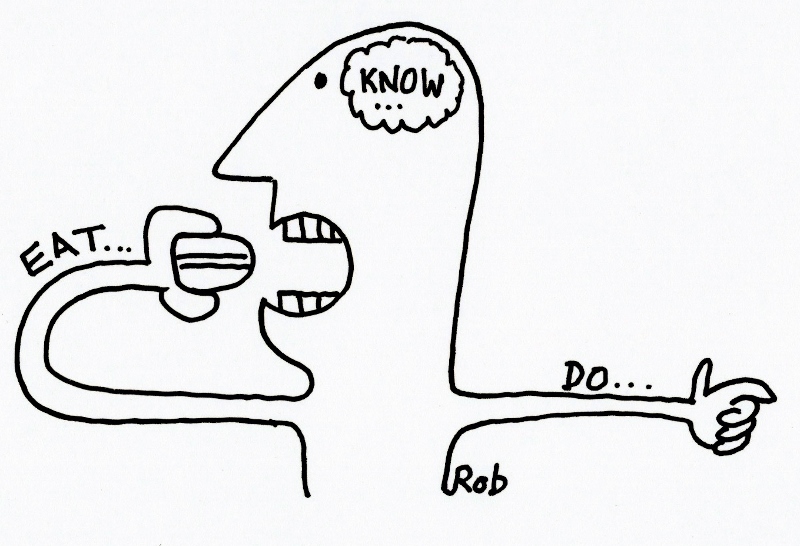
  2. WHAT WE KNOW
  3. WHAT WE NEED TO DO

200615OPL_02 (800x546)


*I hope you’ll come back next week for part 2 of 3. And I hope you may consider offering your thoughts thus far.

Cheers everyone!

~Shelley

Don’t forget to check out what we’re cookin’ in the Scullery and what we all talked about down in the pub. Plus, you can see more of Robin Gott‘s humor–all from the only pen carved from a human funny bone.

A Peek at What’s Coming Down the Pike

And here we are, folks. A peek into DEAR OPL–a project of mine that began probably around the same time ancient Babylonian astronomers were first discovering some of our solar system’s inner planets.

You’ll see the synopsis, the first chapter, and the first press reviews by Kirkus.

I hope you’ll enjoy.

~ShelleyDearOpl---FacebookBanner (800x296)

SYNOPSIS

There is a sinkhole deep inside thirteen-year-old Opl Oppenheimer, and for two years she’s plugged the leak with a wad of junk food. But a hole from heartbreak is tricky. And anyone who’s experienced eighth-grade science frog dissection knows a heart can’t be repaired by a bubblegum band-aid. Worse still, overweight Opl now faces diabetes and must swallow the bitter news that sugar is the problem and not the solution to filling the empty space her dad’s presence used to occupy. Even the school’s galling version of celebrity chef Alfie Adam’s Meal Madness is turning Opl’s self-prescribed soothing syrups into miserable medicine. Mock meat and healthy colon slogans plague the lunchroom walls, encouraging change. But Opl can’t see the value of changing her whole life to save her future since it’s the past she wants to retrieve.

Opl identifies a scapegoat for her growing burdens and rallies an internet attack on Alfie Adam. The plan backfires, threatening the success of her mom’s bookstore, the loss of her best friendship and an international lawsuit. To win back her friend, Opl is forced to pledge allegiance to her arch enemy–the health-crazed chef, but in doing so realizes that, just like kimchi, festering problems, if handled correctly, can produce something a whole community can savor.

 ~~~~~~~~~~~~~~~~~~~~~~~~~~~~~~~~~~~~~~~~

092314_DearOpl_HiRes (533x800)092314_DearOpl_HiRes (533x800)092314_DearOpl_HiRes (533x800)092314_DearOpl_HiRes (533x800)092314_DearOpl_HiRes (533x800)092314_DearOpl_HiRes (533x800)092314_DearOpl_HiRes (533x800)092314_DearOpl_HiRes (533x800)092314_DearOpl_HiRes (533x800)092314_DearOpl_HiRes (533x800)

~~~~~~~~~~~~~~~~~~~~~~~~~~~~~~~~~~~~~~~~

DEAR OPL

by Shelley Sackier

Chapter One

The dark enveloped me, squishing my lungs. Like the engulfing bear hug you get from an uncle who’s built like a lumberjack. But this black was so tarry and thick, it made me feel as if I were breathing syrup and forced my heart to thud in my chest. I blinked again and again, and squinted hard, hoping something—anything— would come into focus. I wanted to sprint for my bed, to hide beneath my quilt, where nothing but fuzzy warmth and an old licorice stick are allowed. But I needed this. I couldn’t leave because I had to get rid of the awful ache that poked at my sleep. If I fed it, like a lion at the zoo, it would circle and grow quiet. Sometimes.

Even though I wasn’t supposed to.

My hands fluttered in front of me, like a couple of blind butterflies. They bumped against a pointed edge. I jerked back, thinking I’d been bit, but I took a breath and crept forward until I touched it once more. I traced my skittish fingers along its form until I felt certain the thing wouldn’t strike at me with sharpened fangs and light up with red demonic eyes. It was a box of cereal. And it had to be Froot Loops because the pantry was a bundle of lip-smacking scents like tangy lemon, zingy orange, electric lime, and mouth-watering cherry. This meant Ollie had left the bag open and steam would shoot out of Mom’s ears because it’ll have gone stale by morning. I sighed with relief because as far as I knew, no one has ever been seriously injured by sugary, ring-shaped cereal. Then, again, maybe my younger brother would be the first.

I pushed the box aside and moved my hands higher up. I knocked another smaller carton to the floor, where it bounced off my sock-covered foot. I squatted, sweeping my hands across the floorboards until I found it. Bringing the package to my nose, I sniffed its edges. It smelled like Thanksgiving—well, not the last one, but the twelve others before that. It smelled of cinnamon and apples. It smelled of happiness.

I opened the box and felt inside, my fingers searching for more of the memory. They picked up a tiny pouch. A tea bag. It made the sound of Mom’s old flower seed envelopes, the ones she held up each spring and shook like tiny maracas. “April showers bring May flowers! Let’s go plant some future sunshine.”

That didn’t happen this spring. Or the one before it.

I fumbled about until I found an empty spot I could push the tea bags into and then let my fingers wander farther across the shelf. They collided into something crinkly. Bingo!

I pressed my hands around the package. It had the right sound—like crunching plastic—when I squeezed it. I pulled it to my nose. Yes, definitely the right smell. And not one I could attach to any other thing. It was powdery sweet. Buttery. Not quite chocolate but deep, like cocoa. It mixed with scents of sugared vanilla—a cream so luscious, it ran slickly against your tongue. This was not just a food; it was a feeling. I wanted those Oreos so badly my mouth started watering like a mini sprinkler.

I felt around for the opening, the plastic pullback tab that granted you access right to the very heart of the package and the cure-all cookies. Tonight’s remedy. But something was wrong. The pull tab was missing. I groped the front and back, skimming its sides, trying to catch the sticky edge like you do when your Scotch tape has come off the metal ridge and sealed itself back onto the roll. It wasn’t there. I couldn’t find it.

Something brushed against my cheek and I reeled back in fright, bumping into the rickety pantry steps behind me. My fingers slapped at my face, but found only my hair falling out of its messy ponytail. With a racing heartbeat, I ventured a hand along the wall, searching for the light switch. Then I pulled back. I’d better not turn on the pantry bulb, because the glow would creep down the hall and shine like a headlight through Mom’s open bedroom door. She was a super light sleeper. She could leap out of bed at the sound of a cricket passing gas on the back porch.

But I needed those cookies.

A flashlight! That’s the answer. I bent down to hunt the lower shelf beneath the microwave. In my mind I could see four of them on the ledge, lined up like eager soldiers: sentries of the dark. But I bumped into one and they tumbled like dominos. I held my breath, trying to absorb the clunking sounds. I made that lungful stay put and listened, wishing I had a third ear. At the relief of no footsteps rushing into the kitchen, I grasped one of the tipsy warriors against the dark, flipped its switch, and looked at the package in my other hand. I held the Oreos all right, but they’d been double packaged, slipped inside a Ziploc bag along with a folded piece of stationery.

I sat down on the old wine crate Mom used as a step, forgetting about how badly it creaked, and unzipped the plastic bag. I pulled out the note and tilted the beam toward the words. It said:
Dear Opal,
Please don’t eat these. Remember your diet.
I love you,
Mom

092314_DearOpl_HiRes (533x800)

To Pre-order DEAR OPL (Published August 4, 2015)

Amazon

Barnes & Noble

Books a Million

Indie Bound

Indigo

iTunes

KIRKUS REVIEW

In the two years since her father’s death from cancer, Opal’s life has gone awry.

Grief and her family’s altered dynamics have contributed to Opal’s struggles with food and weight. She is increasingly at odds with her mother, who is overwhelmed and distracted. When her mother encourages Opal to start a blog as a way to document her food intake, Opal decides to use it to express her thoughts instead. Soon, Opal’s sharp, humorous observations as “Opl” garner interest as people respond to her commentary. Sackier captures Opal’s emotional turmoil as she grieves for her father and resists her mother’s campaign to persuade her to diet. When a savage blog entry directed at a popular chef earns Opal criticism from her best friend, remorse—along with an alarming health diagnosis from Opal’s doctor—compels Opal to reconsider the chef’s healthful-food philosophy. Sackier conveys a message about healthy habits without lecturing. Opal’s adventures in cooking and yoga—with occasionally comical results—alter her perspective, and her changing attitudes reflect her personal and emotional transformation. As Opal endeavors to better understand who she is, she gains a greater awareness of others’ life circumstances as well. When a chance encounter leads to Opal’s acquaintance with Rudy, a regular visitor to the local soup kitchen, Opal devises a kindhearted plan to help him.

By the story’s conclusion, readers will be happy they traveled with Opal on her journey to self-acceptance. (Fiction. 10-14)

*ROBIN GOTT’S NEW POST* (click)

Don’t forget to check out what we’re cookin’ in the Scullery and what we all talked about down in the pub. Plus, you can see more of Robin Gott‘s humor–all from the only pen carved from a human funny bone.

I Knew It! It’s Only a Matter of Time.

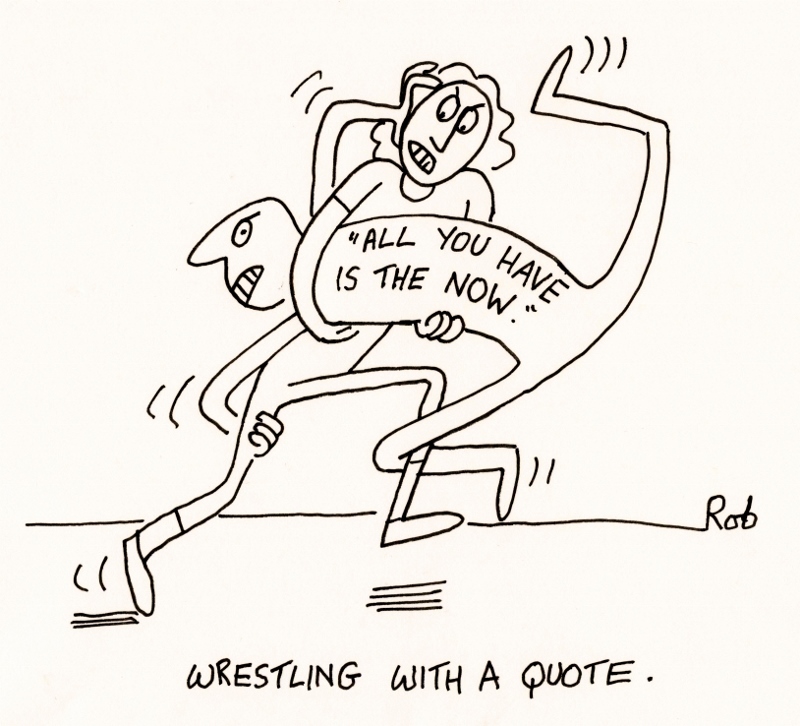
All you have is the NOW.”

240515wrestling (800x726)

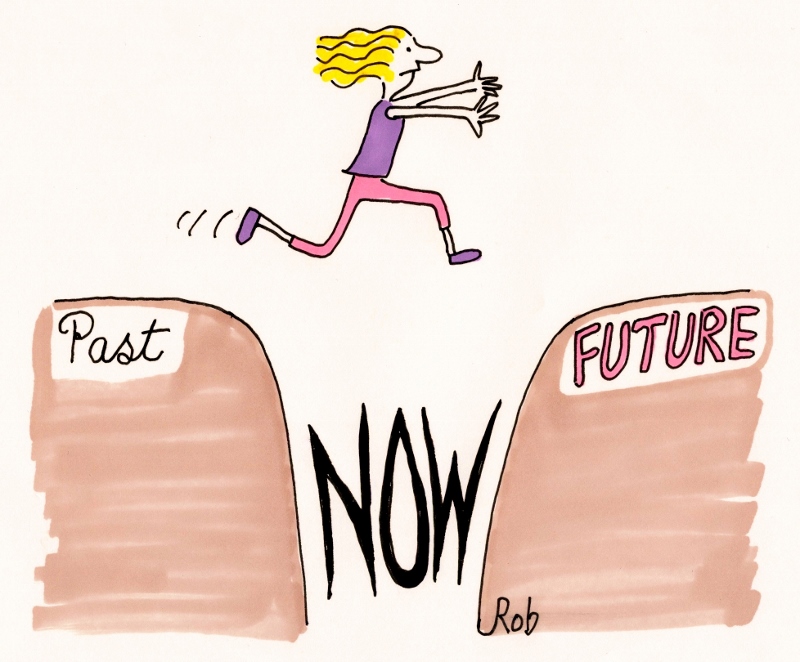
This is a quote from my yoga teacher. She reminds me twice a week that there is the past, and the potential, but most important is the present.

This moment.

And once it goes, it’s gone.

I wrestled with that quote for an entire hour last week during class, trying to unravel it. Those six little monosyllabic words. It was harder to pay attention to than I thought it would be. My thoughts have a habit of being way ahead of my body—or way behind it. The idea of syncing the two together is about as easy as the concept of bowling in space or playing tennis underwater. Not a lot of success, and hugely effortful.

I understand the need for a point of convergence mostly because I’ve benefitted when I’ve arrived at exactly that spot. But these are tiny chunks of time—slivers really. Twenty minutes of meditation where maybe out of those twenty minutes I was fully present for about four of them. The other sixteen were thinking about my grocery list, what books were due at the library, or how to encourage my plumber to put whisky, red wine, and chocolate sauce on tap in my kitchen.

I know. I get distracted. But it’s nearly impossible for me shut down that thought factory.

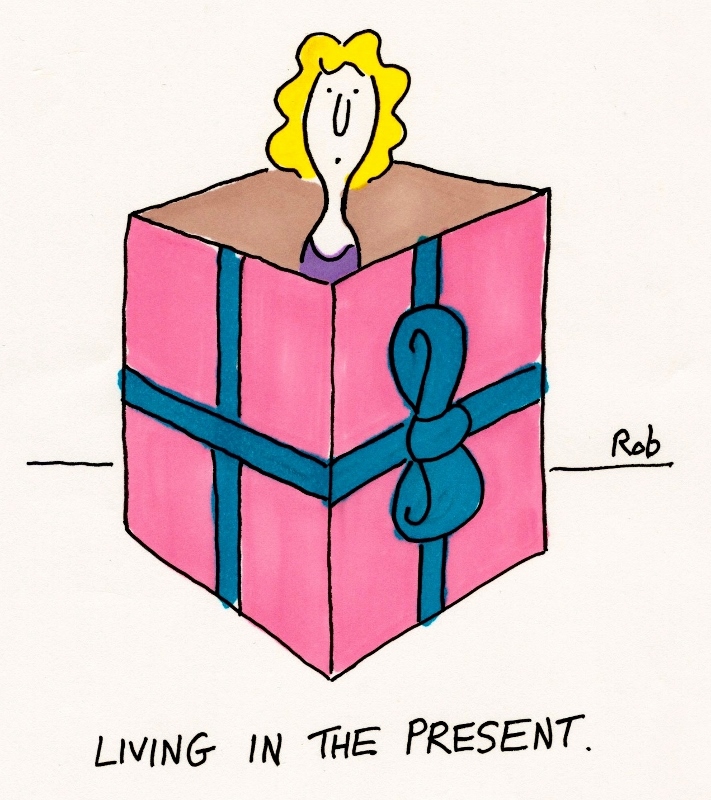
240515present (711x800)

The idea of remaining mentally engaged is a no-brainer for me—although that’s clearly a poor choice of words. As a writer, I need access to my stores of creativity and a method of churning up its source to keep the vault filled to capacity. Damned is the day I open that door, reach in and pull out nothing but a fistful of mothball scented air. I also need cerebral acuity in order to keep up with my kids. Once I discover they’re slowing their speech and purposefully choosing words that would be dismissed as too difficult for a fourth-grade spelling bee I am toast.

I’m grateful to my yoga and meditation teachers who all seem to carry the parade-sized banner that states: Found yourself distracted by other thoughts? No worries! Start again. It’s rather an amazing club to belong to where you thankfully realize that J.K. Simmons is not your mentor and you will never get slapped upside the head for losing the count.

But the measurement of time—or time perspective—is often where I get caught in a circular loop. I once heard psychologist Philip Zimbardo lecture about how time—as our current culture defines it—can be broken into six segments.

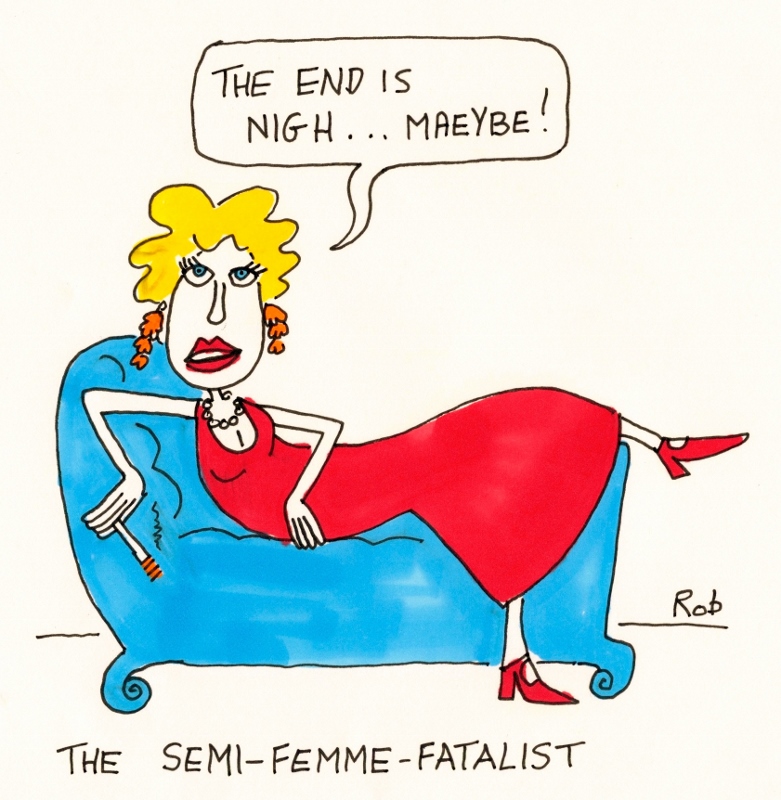
You can have a Past time perspective, where you focus on the positive or negative, a Present time perspective, where you focus on hedonism or fatalism, or a Future time perspective, where you focus on life goals or the transcendental.

240515potato (736x800)

I may pen Dr. Zimbardo a note to suggest a quick conversation with my hero Neil deGrasse Tyson who believes we could possibly add a seventh segment to time perspective that I’ll call Sideways. Neil says, realistically, if there’s a forward and backward and a ‘stay where you are’ on the measurement of time, there’s likely a left and a right built in there too, but we’re just not seeing it yet.

Yep. Mushroom-shaped, mind-blowing thought, eh? See why I can’t stay focused?

But I think I’ve discovered what would help me on all fronts of time measurement and it’s a ridiculously simple solution, and yet an impossible one.

HIT PAUSE.

240515now (800x662)

Stopping time altogether seems like an answer that would affect the past, the future and the present—and likely those wonky side bits Neil says are invisibly hanging about. How?

If for twenty-four hours I could stop time entirely I could work at fevered pitch, press play and then realize that the next day I’d wake up and be a paltry nineteen days behind schedule rather than the overwhelming twenty I’ve currently tallied. That might make a dent in the past and I’d feel a more ‘positive past time perspective.’

Or I could use the time to make a massive deposit in my depleted sleep bank and snooze through the two dozen hours. This would surely display my tendencies toward ‘hedonistic present time perspective.’

Or lastly, I could finally fill out that Last Will & Testament, write sappy farewell love letters to my children, build myself a sturdy pine box and locate the tree I’d like to be buried beneath as a clear illustration of my ‘transcendental future time perspective’ because the alternative of devoting those windfall hours to ‘life goals’ would do nothing but demonstrate that God had somehow managed to insert an eighth day to the week, as it would be the same as the seven before it.

No. It must be unique.

Twenty-four blissful bonus hours of time not moving even one tiny inch forward. I could catch up, I could sleep or I could focus entirely on my impending death.

240515fatalist (781x800)

Umm … it may not be as tough a choice as I once thought.

Yep. Those extra hours sure would be appreciated. In fact, maybe the best idea would be to devote the day to increasing my success with that whole mind/body being in the moment goal.

So, for now I’ll put the past behind me and I’ll set aside the future. Because as all the great Zen masters say, there’s no time like the present.

Except for the ones Neil says we can’t see.

~Shelley

*BONUS ROBIN GOTT CARTOON!* (click)

Don’t forget to check out what we’re cookin’ in the Scullery and what we all talked about down in the pub. Plus, you can see more of Robin Gott‘s humor–all from the only pen carved from a human funny bone.


You Want to Step Outside?

You can tell a lot about a person by the way they drive.

You can tell even more about a person by the way they drive AT YOU going 40 mph on a thin and curvy country road while you are out for a leisurely Sunday stroll.

Not everyone is paying attention, as is clear by the amount of drivers that will suddenly swerve when they finally identify that you are a person on the side of the road and not a woodland deer on two feet, or a slow moving tree attempting to make a break from the forest.

260415forest (800x590) (2)

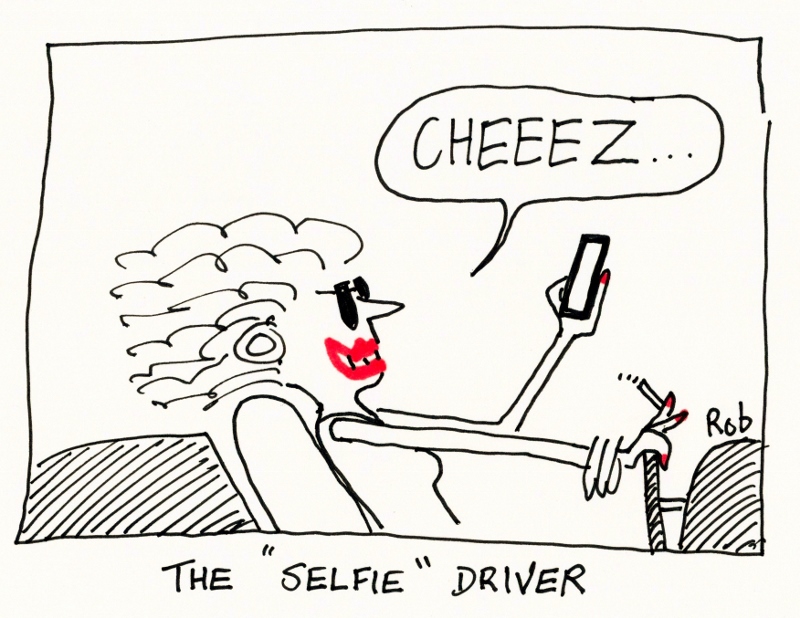
And not everyone is particularly concerned about speed, or laws, or the fact that studies have shown it is easier to drive a vehicle if you are in charge of the direction you’d like for it to move. Pesky windshields and steering wheels. They so get in the way of reading emails.

260415selfie (800x618)

As a person who spends the majority of my conscious, upright hours in a chair, I have made a pact with myself (or Beelzebub) that states that if I fail to take a head-clearing, leg-stretching, lung-cleansing walk by the end of the day, I must refrain from breathing for a full thirty minutes as punishment before going to bed. Or for as long as the dog’s last nap divided by pi and rounded up to the nearest tenth. Whichever is longer.

I rarely fail to take a walk.

When at home, my routine is measured and predictable. There is no choice in direction living on the peak of a great chunk of rock. You are allowed to go … down. But then you have to come back up if you’re hoping to get dinner. As I never tackle this adventure without my trusty rusty hound by my side, and because it’s clear to anyone who has heard me wax lyrical about the animal (and declare I’d give him a kidney if he needed it), I am usually swayed to flip a 180 once we arrive back to base camp and trek down half the mountain again as a bonus for a little added caloric burn.

I have been warned that I am way too indulgent with this mound of fur on four feet, but as he assures me he would pull me out of a burning house fire, I feel I need to continually shore up our relationship—and his muscle strength—as a just in case insurance plan.

260415mound (729x800)

If I’m visiting my parents, my walk is more residential, peppered by driveways, cars, and the containers holding last night’s dinner—a gift tossed out truck windows from a good chunk of folks who have yet to meet an area of the world that does not confuse them as being an extension of the county landfill.

Should I find myself in town and in between appointments, I make use of the tennis shoes I keep in my car for such an occasion and stroll in whichever direction the wind is blowing. Coincidentally, the wind seems to push me right to the nearest bakery, which I take as a sign from the universe that I need a lot more gluten in my diet.

260415baker (800x423)


And I’m all about tuning into cosmic conversations. I’m like a fully carbed out Jodi Foster, only instead of sitting on the hood of my car surrounded by giant, rotating satellite receivers, I am standing in the city center, inhaling in all directions seeking the tiny refrains of active yeast strains.

I can smell otherworldly puff pastry creations from sectors of space that have yet to be mapped by astrological spectrographs.

There are countless things to learn on one’s habitual daily walk, like how much the winter snow contributed to the health of the burbling brooks, or how fast maple trees leaf out in spring, or how much porcupines do not appreciate being taken by surprise.

260415porcupine (800x571)

Where folks are closer together I’ve discovered that neighbors like to communicate their personalities through mailbox and yard art. Perhaps as a way of scaring off any real forest critters from feasting on hedges, flowers and veggies, fake ones are strewn about the lawn. Most complete with bullet holes. Some driveways are so crisply outlined in nighttime headlight reflectors, one could safely guide a Boeing 757 into the garage at the end of it. And if one house has decided to grandly name their abode, you can bet your bottom dollar that ‘Ben & Jen’s Lake House’ will soon find it’s sharing the same street as ‘The Earl of Norfolk Hall,’ ‘Chateau Belvoir,’ and ‘Killkerny Castle.’

In closing, it doesn’t matter if I’m in the forest, with my folks or following the fragrance of fine French bread, I really love to walk.

My hope is that I will remain healthy enough to do it for years and years to come.

260415walk (800x558)

Another hope is that I will continue to recover from all the ditch diving I have had to practice in order to avoid speeding vehicles driven by amateur multi-taskers.

And my last hope is that I will finish this post before the clock strikes midnight so that I can squeeze in my daily walk and not be forced to calculate how long the dog’s last nap was.

I love to walk.

But I love to breathe more.

~Shelley

*BONUS ROBIN GOTT CARTOON!* (click)

Don’t forget to check out what we’re cookin’ in the Scullery and what we all talked about down in the pub. Plus, you can see more of Robin Gott‘s humor–all from the only pen carved from a human funny bone.
Related articles


Sleep’s Dark and Silent Gate

When hearing the term “spring break” many of us easily conjure up the images of families taking off for that one last round of late winter skiing, or finding a child-friendly cruise, with wallet-friendly options. We see ourselves organizing the garage, and sifting through closets, a cathartic cleanse that gifts us new space. And it’s especially easy to picture a throng of college students making their way en masse toward sandy white beaches far removed from the cramped, windowless lecture halls they’ve occupied through dark winter months.

But this year spring break was anything but the above depictions. For me, that is. And I think for my daughter too.

This year I spent the time uneasy and restless, tense and observant. I spent it hoping to hear the words in someone else’s thoughts. I needed to measure the struggle, my daughter’s level of distress.

Her campus was in crisis mode, all parents on high alert. The same lamentable word refused to be muted, would not release its steadfast grip.

Suicide.

It is a word that strikes through the strength of a family and weakens the backbone of a community. It is an action that brings us to our knees with the senseless loss from an unheard cry.

Chronic stress is a familiar disease most every college student is acquainted with. Its unforgiving malady inflicts academic anxiety, depletes crucial sleep, and unleashes widespread social struggles, challenging our children to fit in somewhere new in someplace foreign.

A known and nerve-wracking fact among parents and educators, the leading cause of death among university students is suicide. The statistics are varied, and we brace ourselves to hear of the wretched news. One is horrifically tragic. A second is a spreading concern.

But five?

Five within one year? And all on one campus.

It left me desperate to talk to my child … and to hear my child talk.

I wanted her home, with me where I could see her. But I forced a stillness within myself, remembering that she was attempting to build herself a new home. To stretch and redefine who she was. To discover where she will next belong.

We’d speak on the phone. I’d offer her words. But words are paltry and may only provide an anemic effect. It’s nearly impossible to feel you are getting an accurate reading in a situation such as this. It is a terrible tug of war. The wanting. The wanting to rush someplace and fix something. But that is not always the answer.

Your answer is not always their answer.

In the last 19 ½ years I have known this child, a few things have bubbled to the surface to claim the top box if she were filling out an application profile, describing who she is. It’s likely she’d say:

A scientist

A musician

An activist

But there is a tiny little baker buried deep inside her that materializes when in desperate need to combat ironfisted stress.

When spring break arrived, I met her at the airport. Encased in a hug that I hoped echoed a million words of warmth, I breathed her in. I’d missed the spice of her hair, the honeyed notes of her perfume.

I took her home—and not to a beach, the garage or the slopes. To no great surprise her personal Pillsbury Doughboy punched in daily on his flour-dusted time clock. Within minutes of arriving, he had transformed my kitchen into a satellite city patisserie.

Dorms consider a communal kitchen to be a closet with a microwave from 1957. College cafeterias are considered fresh and contemporary if they could advertise they’ve been cooking ‘nose to tail’ recipes long before it was considered hip, and were nearly certain there was a fork somewhere in the utensil bin that was dedicated as “peanut free.”

Winters can be bleak and mournful if the closest you can come to home cooking are dorm room banned candles crafted to smell like meatloaf and chocolate chip cookies.

My kitchen became an invisible big-bosomed therapist, warm from the heat of the oven, smelling of Madagascar vanilla, and costing a considerable amount of money which insurance companies would never reimburse under the umbrella of preventative healthcare.

It didn’t matter.

I savored the fact that she was home. And day by day the smudgy, dark circles beneath her eyes—the circles I at first took for a potential dabble into a late teen Goth phase, but knew were the result of a schedule where sleep was rarely granted before 3am—slowly faded. I would not have been surprised to see her drop her bag at the end of her childhood bed, fall prone and not rise until I told her it was time to head back.

But there was that urge to bake. To turn the bitter into sweet.

Every day the pantry was scoured, the fridge was raided, and recipe books were consulted. Every day something fragrant appeared in finished form, its come hither whispers accompanied by an invisible finger, crooked and beckoning.

There were mounds of muffins and breads, cookies and tarts. Chocolate covered confections and lime zested pies. Graham crackers married sticks of butter and served as a crumbly hug for whatever they embraced. Coconuts and pecans toasted themselves beneath the fiery, wiry heat of a broiler set to suntan. Apples, dates, bananas and carrots had every gram of sugar coaxed out of them with the deep calm of an individual lazily spinning through the quiet hours of an unnoticed afternoon.

Day by day, ample perfumes mingled with each other to signify a steadily budding state of grace.

Taste this.

Eat that.

Try those.

Little words, big flavors, potential aid promising relief.

Every day I told myself, Okay, either she’s going to run out of steam, or I’m going to run out of ingredients. The end is near.

The “End” did not arrive until I returned her and her tiny duffle bag to the airport where she was soon whisked back to seven more weeks of muddling through those stressors she’d left; the disquieting uneasiness locked behind a dorm room door and strewn about a grief-stricken campus.

The list of things I have to offer this child may be rapidly diminishing in terms of parental care, but there is still comfort. I will hold what she cannot contain, I will hear what she cannot say, and I will eat what she cannot finish.

She may not have had a traditional respite from school this year, less spring break more spring bake. But I hope it was what she needed.

When I walk into a space that is filled with the heady aroma of caramelizing sugar, I am immediately reminded of my daughter. Transported to a nearly tangible encounter, it is at once comforting and then painful. It is something I wish I could return to those heartbroken parents—the unmistakable scent of their child.

120415springbreak3

~Shelley

Related articles

Don’t forget to check out what we’re cookin’ in the Scullery and what we all talked about down in the pub. Plus, you can see more of Robin Gott‘s humor–all from the only pen carved from a human funny bone.