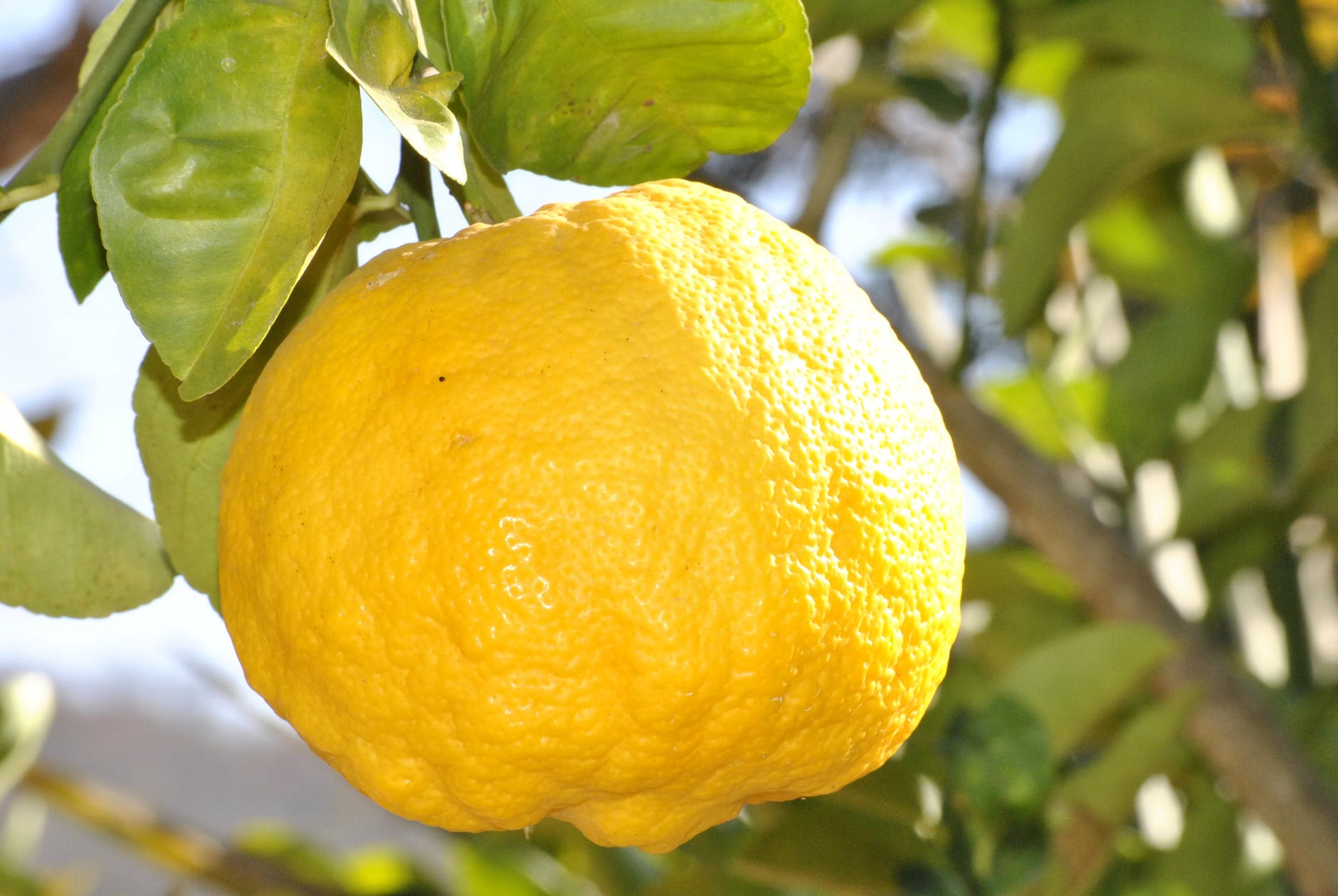
Life’s Luck: From Lemons to Sour Grapes, Mine is Weirdly, all Fruit Related.

Last month sucked. I mean really, really came out looking like an ugly puckery lemon.
I smashed a finger in between two 75lb boulders (yeah, while trying to do that rock wall myself—from last month’s blog).

I got a wicked thrashing from a wrathful, hell-bent-on-sparing-no-one poison ivy plant.

I got diagnosed with a second basal carcinoma (treatable skin cancer that plagues many pasty white Midwesterners who are unfamiliar with this thing local people call summer).

I broke my lawnmower.

I was stung by a wasp whose last dying wish was to leave a flesh wound and memorial to himself the size of an award-winning walnut.

And I got a UTI.

Okay, none of this stuff actually happened last month. That was a lie.

It happened this month.

Month and candor aside, the reality of so many calamities all at once did not bode well under the “Thank God, I got my Covid vaccine—it’ll sure be great to get back to normal” mindset I was cultivating.

Those thoughts ultimately tanked, and in their place crawled splints, bandages, skin grafts, physicians, lab techs, prescriptions, pills, ointments, potions, and spark plugs.
It was often hard to keep track of what went where, and on one miserable afternoon I found myself visiting the library to pick up a book I was hoping would take my mind off my miseries.

I was in line, waiting in the lobby for my turn to come in and approach the desk, when I heard someone triple tsk from behind me. I turned to see a woman as wrinkled as an old crabapple, her white hair braided and wrapped into a bun, held together with what looked to me like a couple of birch twigs and a meat thermometer.

I smiled, nodded politely, and turned to face forward again, only to hear her sigh and utter, “Dear me,” under her breath. She tapped me on the shoulder and when I turned, pointed to one of the many bandages wrapped around my arms and said, “You really should let that breathe.”

“Let what breath?” I asked.

“Your poison ivy.”

I looked down at the book she was holding in her arm. Kitchen Witchery: Spells, recipes, and rituals for something something magical something enchanted something something. I narrowed my eyes at her and tried to ascertain how this witch had discovered one of my ailments. “How do you—”

“You haven’t quite covered all your blisters,” she said matter-of-factly.

“Yeah, I really got walloped this time.”

She shook her head. “What did you do, roll in it like a dog in a cowpie patty?”

“No, I was weeding, but I bet my dog had a hand in spreading it.”

“Do you hug your dog?” she asked, pointing for me to move forward in line.

“All the time. He’s the best dog I’ve ever—”

“Stop doing that.”

“Exactly. I know. The oils on his fur transfers to my skin …”

“Not where I’m going. Stop doing it because dogs hate to be hugged. It makes them feel like they’re being devoured, and they’re helpless in that arm lock of stupid humans.”

“Oh.” I stared at the floor for a second before catching sight of her book again. “Well, I’d have to say that I truly feel like I’ve been cursed with something these last few weeks. Just one thing after another.” I looked up at her with a crooked smile. “Any hex breaking spells in that library book of yours?”

“You’re hoping some magic wand will wave away your poison ivy?”

I shrugged. “And my rock-smashed finger, wasp sting, skin cancer—anything that can alleviate those scourges?” I pointed out the ailments around my person.

The old woman studied me for a second or two, opened her book, thumbed through a few pages, and then slammed it shut with a crisp snap. “The book suggests not so much any incantation or elixir, but it is very precise on one specific action.”

“Oh?” I felt my eyebrows raise with hope.

She rolled her eyes. “Stay inside.”

I felt like an idiot.

She looked at me like I was an idiot, so I suppose my feelings were justified. “Ah, well. I suppose most of those wonky spells are simply drivel and gibberish. Are you just reading the book for fun?”

She glanced down at the book again and then spread it wide open to a page with a black iron caldron holding a bounty of vegetables from the garden it sat within. “Nope. I wrote this little beauty—there’s only one copy, and I convinced the librarian to put it here on the shelves. The problem is, I lost the original recipe for my mother’s tomato soup, and every time I want to make it, I have to come back and check out the book. Now that,” she pointed at the page, “is a cure-all for just about everything.”

I gave her a wary look. “How about a urinary tract infection?”

She cracked a smile and spat out, “Ha! That, my friend, is just a curse on all womankind. And no amount of kitchen witchery can make much of a dent in its presence.”

I shrugged. “I guess sometimes we’re just unlucky.”

“As I see it, your dog is going to get a bit luckier with no more hugs. Although sadly for you, I’d say it’ll be some time before anyone is going to want to wrap their arms around your bandaged body.” She searched the ceiling and then said, “Maybe try a bottle of wine.”

“Hug a bottle of wine?”

“No. Drink it. It won’t cure anything, but it’ll sure keep you from being cranky while Mother Nature deals with all your ailments.”

~Shelley

For the time being, the blog is closed to comments, but if you enjoyed it, maybe pass it on to someone else. Email it, Facebook it, or print it out and make new wallpaper for the bathroom. If it moves you, show it some love and share. Cheers!

Don’t forget to check out what’s cookin’ in the Scullery and what we all gossiped about down in the pub. Or check out last month’s post and catch up.
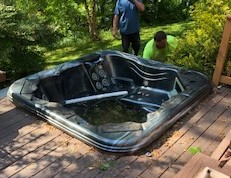
Why You Should Always Bring Two Trucks to a Demolition

“I’m going to get rid of that hot tub,” I said to no one in particular about 500 times in the last two years.

Okay, that’s not true. I’ve said it to everyone who has ever walked past the antiquated, broken down, monstrous piece of rotomolded plastic that surely had people wondering if I was going to invite them to a bubbling bacterium filled night from the 70s.

Nope. Not gonna happen.

Never happened ever.

I hate hot tubs. Hate them.

They make my skin crawl both figuratively and literally. I am just not a jacuzzi natured nut. I’m not much of a pool person either. More of a “if you’re hot, go stand under the garden hose” kind of a girl. I don’t even own a bathtub, so why was there a giant tank of promised tranquil times in my front yard taking up valuable real estate where other valuable, contributing items like tomato plants, a patch of grass, or a host of plastic pink flamingo might live?

I’ll tell you why. Because no one wants to haul that junk away.

So, I looked at doing it myself. But there’s the tiny component that includes “disassembling” involved. My thought was this is doable, for if there’s one thing I’ve learned in life thus far, it’s that the solution to any problem is viable even if you only have access to three things:

  1. Duct tape
  2. WD40
  3. YouTube

It was a great idea for about 30 seconds. At the 31st second mark of the first video I watched on how easy it is to dismantle your old hot tub I’d changed my mind. Easy is not a word I would pick. I would instead pick words like onerous, laborious, and ignorantly ambitious.

They required power tools with gas tanks, multiple blades, and signed waivers in order to purchase. As I was far more fond of my fingers than farcical waterfowl, I picked up the phone and furthered my search for anyone willing to haul this sucker away.

After countless calls to every variety of company with the name “junk” in it, I finally settled on one who’s name I can’t recall but could aptly be named “Umm … Sure, if I Can Shove it in My Truck.” It wasn’t necessarily their enthusiasm that won me over, rather that basement price of stating they could do the work for 60% less than everyone else.

I am a penny-pinching son of a gun, and the thought of holding onto a few more pennies made me suddenly envision buying my new flock of plastic feathered friends at someplace fancy like the Garden Decor´ section at Walmart, rather than straight off the clearance shelves at the Dollar General. 

But then Willie and the gang showed up with a pickup truck that would definitely always be chosen last when team captains were divvying up the choices for all the pickup truck games. Tiny red flag.

Willie put his son to work—Willie Jr—and then left to answer the phone. I heard the sound of angry steel come to life, ripping through fabric and plastic and wood and thought that could have been me. And then a minute later I heard the sound of Willie Jr cry out and thought that would have been me.

“Snake!” I heard lil Willie cry.

I came out onto the porch and looked at Willie Jr. pointing out to Willie Senior the head of a black snake who was obviously just as surprised as the two of them and shared the same expression.

“Don’t kill him. That’s Hortense. He’s just a garden snake,” I said.

“Hortense? Is he a biter?” Willie Jr. asked.

“Only if you’re a rat,” I answered.

“Well, you have the face of a rat, Willie, so I’d watch out if I were you,” his sister said.

The sound of Willie Jr’s angry steel sprang to life again in answer.

That could have been me, I thought.

I brought out a pitchfork and handed it to Junior. “You ever had spaghetti? You just need to twirl that feller up onto here and then walk Hortense out to the woods where he can be safe.”

Junior was not thrilled. But he did it. And then the angry steel returned with a chorus that began to sound like it was running out of steam.

From the porch where I sat studying a library book, I heard snippets of phrases like Did you bring the extra battery? And Well, we’re gonna have to plug her in. Also, What do you mean it’s not working? Did you hit water? And finally some sort of thunk. Like a head falling to the table.

Junior and I finally found another suitable and working outlet for the angry blade brigade and the work resumed. Until …

“Snake!”

I came out onto the deck again. “That’s Hildegard. She’s probably wondering where Hortense is.”

And she’s probably wondering what the hell is happening to her house, I thought looking around with despair. Plastic, insulation, fiberglass, foam, and wood were scattered everywhere. Good lord, it looked like my attic went on a binge and vomited onto the lawn.

“How’s it goin?” I asked, noting it had been over three hours of work thus far. Three hours for five people against one hot tub. The YouTube video has one guy, one crowbar, and fifteen minutes, seven of them spent explaining to the camera what he was doing.

“Nearly done,” I heard Willie Senior offer up. Behind him, Junior was wrestling with Hildegard who was determined to stay in her home come hell or high water … or high-powered chain saws. Maybe she had babies to protect.

Poor Junior. That could have been me.

An hour later, as the sun was setting, I brought out a tray of glasses and a bottle of bourbon. “Good work, lads and lasses,” I said, seeing nothing but a concrete slab where the hot tub used to be.

“The truck is full up. Can’t fit anymore into it,” Willie Senior said, pointing toward it.

I saw half the hot tub, or what used to be the hot tub, shoved into the back and spilling out the sides. The other half was in several large piles on the lawn and driveway.

“We’ll come back for the rest tomorrow,” he said.

“And the check for payment of services?” I asked, suddenly realizing that question now took the place of whatever last sentence was in first place for Stupidest thing I’ve ever asked. My sluggish brain now foresaw being stuck with a driveway full of junk while I chased down a handyman who’d never return my calls.

Willie Sr. smiled and winked. “We’ll come back for it tomorrow.” He hitched a thumb again toward his truck. “Can’t fit anymore into it.”

Well, there you have it, I thought to myself, a man who owns a garbage company is a valuable treasure of honesty himself.

Maybe instead of the flock of flamingos, I’ll erect a statue of Willie.

~Shelley

For the time being, the blog is closed to comments, but if you enjoyed it, maybe pass it on to someone else. Email it, Facebook it, or print it out and make new wallpaper for the bathroom. If it moves you, show it some love and share. Cheers!

Don’t forget to check out what’s cookin’ in the Scullery and what we all gossiped about down in the pub. Or check out last month’s post and catch up.

Galapagods and Goddesses

“So what are you most excited about, Mom? The giant tortoises? The penguins? The Blue-footed Boobies?”

That last one always makes every one laugh—until you see a picture of the bird, in which case you’re trying to figure out how to slyly shove one of those cutey patooties into your suitcase to return home with.

“The distillery,” I answered truthfully.

I heard the distinct sound of a hand suctioning itself onto a forehead. It would be a familiar thump as well over the next couple of weeks, as we were nearing the end of Chloe’s “Countdown to the Galapagos” calendar—the trip of a lifetime my daughter had gifted me.

Weeks earlier she had surprised me on a Zoom call.

“I’ve checked with your work—all is thumbs up, and all the animals will be looked after. I’m taking you to the Galapagos Islands.”

“What?” I was stunned. “Why?”

“Firstly, you’re welcome. And secondly, as a thank you.”

I chose to ignore the firstly bit and moved on to the latter half of her explanation. “Thank you for what?”

“You know, the whole thanks for raising, clothing, caring, feeding bit, plus all the extra effort helping me get to where I am so that I could accomplish what I have.”

She was referring to her ever so awesome job and lifelong dream of sending shit up into space. “You are welcome. I knew those math flash cards were going to pay off one day.”

“I’m serious,” she said. “You were there with the support and encouragement and shoulder—”

“Don’t forget ice cream.”

“Yes, and ice cream too,” she added.

“Why the Galapagos?”

She smiled with glee through the screen. “Well, I may never be able to take you to Mars to study what we’re hoping to discover there—possibly some origin of life, so I’m taking you to where Charles Darwin first studied it on our little planet.”

Obviously, Chloe knew exactly how the poetic parallel would fill me with admiration, and it neatly explained why she had mailed me a beautiful copy of On the Origin of Species just a few days before phoning.

And so, every day for the next two weeks I received some version of the text ELEVEN MORE DAYS TILL GALAPAGOS, MOTHER!!! And I would send her back a picture of one of the animals I could not wait to lay eyes on.

This, of course, after researching whether any of the islands had some form of working distillery upon them, and after discovering one did, announcing that this was where we had to go first.

“We are leaving work behind, Madre—no computers, no spreadsheets, and no liquor apart from that which any charming South American bartender hands you in a glass, got it?”

“But this is not work, Chloe. This is learning. This is research. And as we are going to be spending hours wandering through the ample exhibition halls, gardens, library, and living labs of the Charles Darwin Research Station, we surely will wish to further our research on other aspects of the islands’ elements as well, right?”

“Discovering how some old geezer is distilling sugarcane will likely disappoint you. It’s not going to be like you’re in Scotland, and as you’re hunting through castles and stone circles you accidentally stumble upon some ancient, perfect, long silent but suddenly brought back to life prized distillery.”

I huffed. “I will not be disappointed, Chloe. Clearly, there is an artist waiting to be appreciated—and likely frustrated that Charles Darwin is constantly overshadowing his work. I aim to aid his need for recognition.”

“You aim to be poisoned, likely by a large dose of methanol, is my guess.”

But my sweet, generous, overly and uncomfortably educated child was wrong. Meeting Adriano Cabrera of El Trapiche was one of the most memorable moments ever.  Maybe because having seen some of the world’s most impressive and flush-with-cash companies, with their shiny copper pots, their massive barrel-filled warehouses, and their gleaming tasting rooms, experiencing Adriano’s barebones setup was the refreshing, reaffirming chapter I needed to slip in to my ‘book of life.’ It brought back the this process is magic feeling that can sometimes be buried beneath all the new glamour whisky making tours now provide to consumers.

Not one of the countless distilleries I’ve visited ever employed animals as part of the workforce, and yet Adriano had harnessed not just a braying donkey to run the press that squeezes the liquid out of the cane sugar, but every bit of flora and fauna he had available to utilize.

All throughout the facility—and by facility, I mean a long, open air shack—he was growing plants indigenous to his island of Santa Cruz. Whether it was the sugar cane, the coffee bushes, or cacao beans, the surrounding landscape was filled with flowering plants.

Those flowering plants brought birds, butterflies, and bees to pollinate them, and those thriving plants introduced an abundance of wild, ambient yeasts. Those indigenous yeasts then fermented that sugar cane juice, which attracted a good handful of insects looking to score a solid buzz on their buzziness and ended up dying for the cause. And still flying with the theme that Adriano was capturing flavor everywhere, surely there’s got to be a scientist who would agree with me that those insects added a bit of nuttiness to the mash, or that their natural fats and mineral-rich exoskeletons left some “flavorprint” behind.

It doesn’t matter. I have empirical evidence. My tongue was the judge.

Once that mash trickled downhill via garden hose to the antiquated, blackened oil drum that was his makeshift still, flames licking and embracing its bottom half as it heated and fractionated the fermented juice within, the magic was nearly done.

Adriano’s method of testing his alcohol’s proof was to use a scuffed-up glass hydrometer, but more to my amusement, was his flamboyant technique of simply throwing a cupful of distillate right onto the still’s flames.

If it goes boom, we bottle, could be a motto he might consider putting onto the label.

Of course, the proof is in the pudding as well, which to me—any small, albeit worrisome, overdose of methanol aside—was a nip worth sipping and a risk worth taking.

As I see it, the El Trapiche distillery succeeded in distilling the entire experience of The Galapagos Islands’ essence of origins into liquid form. The smells, the taste, the sights, the sounds. The true flavor of all its endemic species.

Charles Darwin would have been proud.

~Shelley

For the time being, the blog is closed to comments, but if you enjoyed it, maybe pass it on to someone else. Email it, Facebook it, or print it out and make new wallpaper for the bathroom. If it moves you, show it some love and share. Cheers!

Don’t forget to check out what’s cookin’ in the Scullery and what we all gossiped about down in the pub. Or check out last month’s post and catch up.

Wandering Off with Profound Purpose

There is a trail I’ve grown to love. A roughly kept path, both rutted with roots and covered in cobwebs, it’s a weekly venture I now refer to as six miles long and two hours deep.

I’m the only one on this stretch, just me and my hound. It feels abandoned and forgotten—or perhaps never discovered. As if prepared for footfall but neglected of promotion.


It’s divided into neatly portioned passages, each segment unique with temperament and attitude. To enter one is to be enrobed within that identity, where changes, both subtle and of magnitude, shift your focus and your vigilance.

A spread of one mile bears a perfect canopy, deciduous arms reaching to embrace and braid, the rustling sounds of leaf brushing leaf and branch chafing branch.

Another offers the heat of sun and great crunch underfoot, as in this landscape, only those forged in a fever can cope and thrive.

Along the route there are dens and burrows. Fallen trees extend the invitation to any fauna weary of their old abodes to nestle somewhere new, a chance to peak from behind still rooted tubers and discern if this view will suffice.

There sits a sanctum halfway through where modern day has not been given permission to bloom. A small, grassy clearing dotted with the remnants of those who lived on it first—or died on it last. A lichened crop of chimney stones resist the urge to collapse, to follow those who built it toward a soft grave of repose.

The surreally green colored moss floor muffles all that travels across or through it, a lush weighted blanket keeping history quiet, but comforted.

Three corner stones, the vestiges of walls, invite the visitor to conjure the past and evoke voices long suppressed by the quelling power of isolation. They still whisper though. But only if you listen.

And I do.

I listen more, hear more, breathe more, smell more. I feel the gnarly rough-skinned barely buried roots that spread beneath my feet, catch my shoe, stub my toe. I feel the sponginess of rotting trees as I traverse across them, the pliable composition of their cells. The crack of their forgiving nature resounds across the hollow or the hilltop, upsetting the status quo soundscape and thrusting a hush upon the busy conversation of all woodland tongues.

There is an unraveling that takes place when walking unencumbered. When untethered from manmade sound, sights, and people. This is a forum for the memory reels to unspool, for the strolling narrator to develop his tale, for soliloquy in all its unpracticed inelegance to gush forth without restraint.

This trail is where I find rebalance. Where presets are over-ridden, and recalibration transpires. It is where rejection is handled, malfunctions are tackled, and failures owned. Insight is sought—if one hopes to move forward—for there is little benefit to a walk such as this if deep and soulful pursuit of the truth is ignored.

Emerging on the other side is transcendent and electrifying. Revelatory in that the accomplishment of such a trek was as feasible as hoped, and wondrous with the fresh new mental space now unoccupied.

The trail stays with me only fleetingly, the feel of crushed pine needles beneath me, the scent of forest floor decay, the melody of life as it exists in that treasured space.

So, I soldier on until next time. I muddle through the concrete days, the desk-filled hours, the mundane and must-be-dones.

The path waits there for me … or for no one.

But it is there, and I have felt its wonder.

~Shelley

For the time being, the blog is closed to comments, but if you enjoyed it, maybe pass it on to someone else. Email it, Facebook it, or print it out and make new wallpaper for the bathroom. If it moves you, show it some love and share. Cheers!

Don’t forget to check out what’s cookin’ in the Scullery and what we all gossiped about down in the pub. Or check out last month’s post and catch up.

A Problem Shared is a Problem Halved (or not Felled if You’re Quick)

Currently, I’m in the middle of a fight with three people.

Well, they’re not actually people, they’re animals, but they are just as stubborn, unreasonable, and small-minded as some of my closest friends, so it’s easy to confuse the two groups.

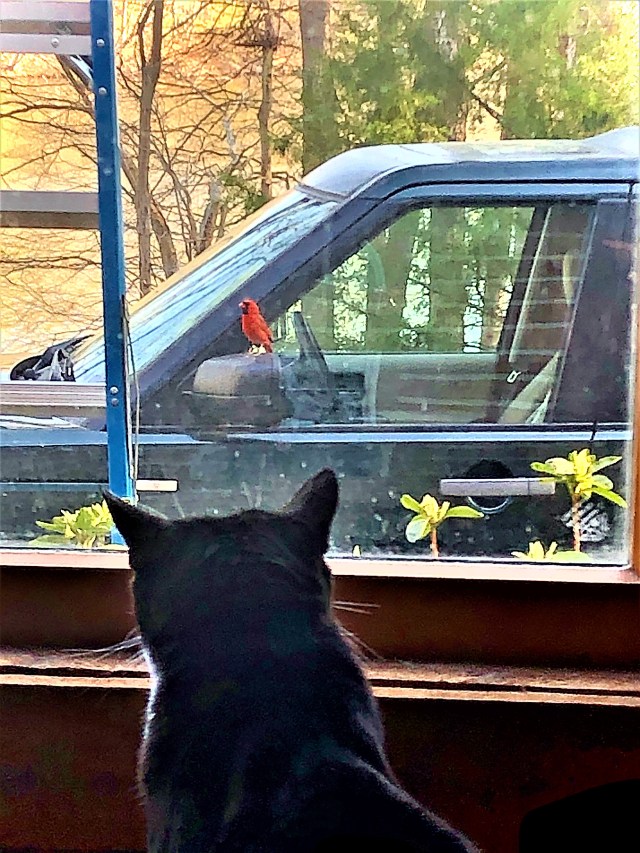
There is a cardinal, who for weeks has been fighting with fisticuffs, or whatever feathered version there is of that, with nearly every window I have on my house.

And on my car.

And with my head if I’m outside and happen to have extra shiny hair that day.


Obviously, one must protect one’s nestlings from intruders—even if you mistake them for your own reflection. And I, obviously, must protect a smaller-brained organism from leaving his nestlings fatherless.

But my efforts are thwarted by the cardinal’s span of territory to patrol. I cannot blackout every window to diminish the glare, as I have limited supplies and a biological need for vitamin D.

He will have to take his chances with the likelihood of beak repair.

There is also a squirrel. One who suffers from great impatience.

The rule in my childhood neighborhood, adhered to by anyone with one season of vegetable growing experience was thus: plant 1/3rd for the deer, 1/3rd for the birds, and 1/3rd for your family.

For years this directive was sage and followed by all participating creatures.

This year, I cannot get the seeds in the ground without a squirrel—one I now recognize because of the prison art tattoo on his back—digging them up the second I’ve stepped away.

First, I tried netting the box. He must have opposable thumbs. He easily unnetted the netting.

Then I tried heavy-duty tree trunk wiring. He must have tools. Unwired, and again I am seedless.

Then I just put out half a pound of already grown green beans and a sign that said YOU WIN.

(*insert squirrel snickering here)

Lastly, there is a beaver.

He is industrious. He is relentless. And he has expensive taste.

He has already struck down and carried off three massive bayberry bushes and is now working on a beautiful thick oak that will take him years to gnaw through. Gauging his angle of approach, it will likely land directly on my house.

It’s okay. I’ve got time.

But to deter him from this great specimen of timber—which may or may not survive his insatiable appetite for cellulose and lignum—I have begun laying piles of thick branches and small logs at the base of the tree. A gift. An impediment. A message that suggests If you carry on with this task, you will soon become a part of my winter wardrobe.

Nevertheless, he persists.

My next step would be to enmesh that tree with the heavy-duty tree trunk wiring, but it’s still currently in use with my next squirrel-thwarting endeavor which involves a small makeshift catapult.

I know these minor skirmishes sounds like small potatoes as we’re all muscling our way through day after day of the pandemic which forces us to revisit and ration our daily wants and needs.

But might there be a silver lining out there for many of us? The substantial amount of people who have yet to experience the oh-so-real terror of scarcity?

Is it such a bad idea—despite the fact that it has been forced upon us—to reevaluate what the word need truly means? Or to press each of us into a state of deliberative ingenuity?

I’m not suggesting we all slap on a coonskin hat and become some version of Daniel Boone, but would it be so awful to think like an Italian nonna when facing the dwindling supplies on one’s pantry shelves and you’ve got thirteen hungry bellies to fill?

I think most of us would benefit from a few hours of bootstrap thinking.

Certainly, when I look at the microcosm of The Hunger Games event I’m involved in with Mother Nature and her brood, I can see that there’s more than one way to skin a cat—or a beaver, if you will.

I see them effortfully striving, every day, for the same things: food, shelter, and the protection of one’s progeny.

That’s the focus. And I don’t blame them.

That said, being the individual with slightly more gray matter, I find it’s possible for me to not only endeavor to achieve those same things, but maybe help a few of them in their pursuit as well.

Now is the time for inventiveness, resourcefulness, and innovation. Along with that comes the eye-opening bonus of gratitude.

We may never view the necessities—the essentials of life in quite the same light. Whether you’re handing out bags of successfully grown green beans to neighbors, or you’re delivering face masks made from the hairy hide of a befallen beaver, you’ve seized the chance to be a section of a solution and not part of a problem.

Most important, this is a critical time for self-reflection. The point is none of us have to be bird-brained about any of it.

~Shelley

For the time being, the blog is closed to comments, but if you enjoyed it, maybe pass it on to someone else. Email it, Facebook it, or print it out and make new wallpaper for the bathroom. If it moves you, show it some love and share. Cheers!

Don’t forget to check out what’s cookin’ in the Scullery and what we all gossiped about down in the pub. Or check out last month’s post and catch up.