Why You Should Always Bring Two Trucks to a Demolition

“I’m going to get rid of that hot tub,” I said to no one in particular about 500 times in the last two years.
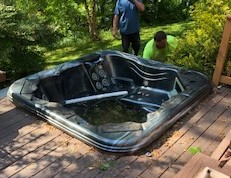
Okay, that’s not true. I’ve said it to everyone who has ever walked past the antiquated, broken down, monstrous piece of rotomolded plastic that surely had people wondering if I was going to invite them to a bubbling bacterium filled night from the 70s.

Nope. Not gonna happen.

Never happened ever.

I hate hot tubs. Hate them.

They make my skin crawl both figuratively and literally. I am just not a jacuzzi natured nut. I’m not much of a pool person either. More of a “if you’re hot, go stand under the garden hose” kind of a girl. I don’t even own a bathtub, so why was there a giant tank of promised tranquil times in my front yard taking up valuable real estate where other valuable, contributing items like tomato plants, a patch of grass, or a host of plastic pink flamingo might live?

I’ll tell you why. Because no one wants to haul that junk away.

So, I looked at doing it myself. But there’s the tiny component that includes “disassembling” involved. My thought was this is doable, for if there’s one thing I’ve learned in life thus far, it’s that the solution to any problem is viable even if you only have access to three things:

  1. Duct tape
  2. WD40
  3. YouTube

It was a great idea for about 30 seconds. At the 31st second mark of the first video I watched on how easy it is to dismantle your old hot tub I’d changed my mind. Easy is not a word I would pick. I would instead pick words like onerous, laborious, and ignorantly ambitious.

They required power tools with gas tanks, multiple blades, and signed waivers in order to purchase. As I was far more fond of my fingers than farcical waterfowl, I picked up the phone and furthered my search for anyone willing to haul this sucker away.

After countless calls to every variety of company with the name “junk” in it, I finally settled on one who’s name I can’t recall but could aptly be named “Umm … Sure, if I Can Shove it in My Truck.” It wasn’t necessarily their enthusiasm that won me over, rather that basement price of stating they could do the work for 60% less than everyone else.

I am a penny-pinching son of a gun, and the thought of holding onto a few more pennies made me suddenly envision buying my new flock of plastic feathered friends at someplace fancy like the Garden Decor´ section at Walmart, rather than straight off the clearance shelves at the Dollar General. 

But then Willie and the gang showed up with a pickup truck that would definitely always be chosen last when team captains were divvying up the choices for all the pickup truck games. Tiny red flag.

Willie put his son to work—Willie Jr—and then left to answer the phone. I heard the sound of angry steel come to life, ripping through fabric and plastic and wood and thought that could have been me. And then a minute later I heard the sound of Willie Jr cry out and thought that would have been me.

“Snake!” I heard lil Willie cry.

I came out onto the porch and looked at Willie Jr. pointing out to Willie Senior the head of a black snake who was obviously just as surprised as the two of them and shared the same expression.

“Don’t kill him. That’s Hortense. He’s just a garden snake,” I said.

“Hortense? Is he a biter?” Willie Jr. asked.

“Only if you’re a rat,” I answered.

“Well, you have the face of a rat, Willie, so I’d watch out if I were you,” his sister said.

The sound of Willie Jr’s angry steel sprang to life again in answer.

That could have been me, I thought.

I brought out a pitchfork and handed it to Junior. “You ever had spaghetti? You just need to twirl that feller up onto here and then walk Hortense out to the woods where he can be safe.”

Junior was not thrilled. But he did it. And then the angry steel returned with a chorus that began to sound like it was running out of steam.

From the porch where I sat studying a library book, I heard snippets of phrases like Did you bring the extra battery? And Well, we’re gonna have to plug her in. Also, What do you mean it’s not working? Did you hit water? And finally some sort of thunk. Like a head falling to the table.

Junior and I finally found another suitable and working outlet for the angry blade brigade and the work resumed. Until …

“Snake!”

I came out onto the deck again. “That’s Hildegard. She’s probably wondering where Hortense is.”

And she’s probably wondering what the hell is happening to her house, I thought looking around with despair. Plastic, insulation, fiberglass, foam, and wood were scattered everywhere. Good lord, it looked like my attic went on a binge and vomited onto the lawn.

“How’s it goin?” I asked, noting it had been over three hours of work thus far. Three hours for five people against one hot tub. The YouTube video has one guy, one crowbar, and fifteen minutes, seven of them spent explaining to the camera what he was doing.

“Nearly done,” I heard Willie Senior offer up. Behind him, Junior was wrestling with Hildegard who was determined to stay in her home come hell or high water … or high-powered chain saws. Maybe she had babies to protect.

Poor Junior. That could have been me.

An hour later, as the sun was setting, I brought out a tray of glasses and a bottle of bourbon. “Good work, lads and lasses,” I said, seeing nothing but a concrete slab where the hot tub used to be.

“The truck is full up. Can’t fit anymore into it,” Willie Senior said, pointing toward it.

I saw half the hot tub, or what used to be the hot tub, shoved into the back and spilling out the sides. The other half was in several large piles on the lawn and driveway.

“We’ll come back for the rest tomorrow,” he said.

“And the check for payment of services?” I asked, suddenly realizing that question now took the place of whatever last sentence was in first place for Stupidest thing I’ve ever asked. My sluggish brain now foresaw being stuck with a driveway full of junk while I chased down a handyman who’d never return my calls.

Willie Sr. smiled and winked. “We’ll come back for it tomorrow.” He hitched a thumb again toward his truck. “Can’t fit anymore into it.”

Well, there you have it, I thought to myself, a man who owns a garbage company is a valuable treasure of honesty himself.

Maybe instead of the flock of flamingos, I’ll erect a statue of Willie.

~Shelley

For the time being, the blog is closed to comments, but if you enjoyed it, maybe pass it on to someone else. Email it, Facebook it, or print it out and make new wallpaper for the bathroom. If it moves you, show it some love and share. Cheers!

Don’t forget to check out what’s cookin’ in the Scullery and what we all gossiped about down in the pub. Or check out last month’s post and catch up.

Will Goldfish be More Clever than our Children?

Because of the nature of my work, I often find myself in the company of children and teenagers. If one intends to write for young adults, or those peeking over the wall into young adulthood to see what the fuss is all about, one finds benefit by listening to them, conversing with them, and generally just taking a softly tipped stick and poking about in territories you might not normally be invited into.

Curiously, that same ‘nature of my work’ is growing more challenging as it does not fit into the current timeframe of many young adults’ attention span—a trajectory of current evolution where now every fleeting second of focus counts and best be saturated with impactfullness.

Where I used to describe the concept of story to young readers as a richly developed plot with engaging dialogue, a diverse set of problems that might tangle complexly at first but unravel beautifully in the end, and a few solid examples of struggle, failure, perseverance, and finally success, now my definition has been forced to change. Currently, I define story as “Once upon a time there was a guy, he had a problem, he figured it out, the end.”

Much more TikTok, much less time-honored tale.

Short-form episodes are now the norm. One can see information streamed about nearly anything and those sessions require a mere 15 seconds of focus. The problem is, is that a recent study determined that the average human attention span has fallen from 12 seconds in 2000 to a whopping eight seconds today.

Goldfish have a better chance of making it to the end of that video as they are believed to have an attention span of at least nine seconds.

Somehow, our youths are being encouraged and pushed to find satisfaction with a story that lasts less time than we expect them to be standing in front of a running sink, washing their hands. I grapple with this especially hard when I realize that oftentimes just one of the myriad sentences I shove into a paragraph far exceeds the newly allotted timeframe many kids will devote to scanning words across a page. And how does one cram a beginning, a middle, and an end into a curt and clipped few moments?

One of the most difficult tasks authors—or anyone with something to sell—must do, is create a pitch. Something that answers Why should I devote my attention (or hard-earned pennies) to you? It often involves boiling your story or your product down to its bare bones—the skeletal structure that shows all strength and no fluff.

The process for authors often happens like this:

  • take a 325-page book and reduce it to one page (hard)
  • take that one page and tighten it to one paragraph (ugh)
  • take that one paragraph and shrink it to one sentence (facepalm)

If you’re writing a film script, the next bit is to slash it to fit the form Blank meets Blank. Godzilla meets The Godfather, Dirty Harry meets Harry Potter, Jaws meets The Little Mermaid—or something like that. Somehow the mash-up is supposed to bring immediate clarity to anyone hearing the phrase as to the plot, struggles, and triumphs within the storyline.

But does it really?

Can one short phrase really tell us the necessary amount needed to exclaim, “I get it”? Can a fifteen second video really reveal the depth of dance, comedy, or education? Is it even possible to jampack a “How to Fold a Fitted Sheet” into 30 seconds or “The History of World War II” into a three-minute YouTube video? Will our next generation of surgeons learn how to remove our gall bladders via Instagram stories?

Personally, it takes me donkey’s years to learn anything. And it’s not because I’m slow. It’s because I’m slow and stubborn. New information that crosses my path is met with skepticism until I can research its source, decipher which end of the political spectrum it may live on, and see Anthony Fauci demonstrate it at a White House Press Conference. It took me literally decades to watch the series MASH because I believed, like the execs telling the show’s writers, that the series run would be limited because the Army isn’t really a pool for humor.

I need convincing. I need repetition. I need my children to walk through the door at holidays and declare amazement at the fact that they’ve actually time traveled into history and perhaps I should let someone in the science department know that it’s possible.

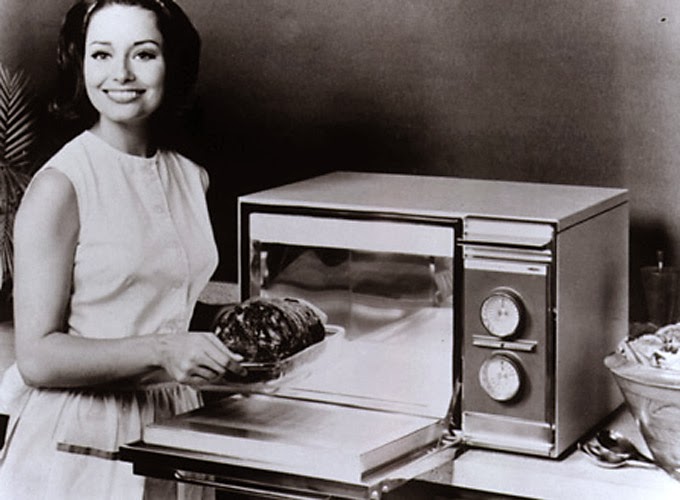
“When are you going to get a new microwave, Mother?”

“As soon as I’ve researched all the newfangled ones on the market. There’s a lot to learn and compare.”

“Have you yet learned that this antiquated piece of junk is a fire hazard?”

“DON’T TOUCH MY RADARANGE!”

But it’s more than just diving deeply into any subject to learn its function, purpose, and capability, it’s also about staying with something long enough to feel the comfort of its complexities. Typically, you cannot learn to play the piano by just watching someone else on video, and it’s downright impossible to sum up our planet’s horrific battles by declaring into a camera lens, “Humans fight. War bad”. There is nothing wrong with embracing the depth and breadth of any subject, but I feel it’s wrong to lead kids into believing any topic can be shortened into a framework of explanation that would have the writers of Cliff Notes blush at its brevity.

Our world is huge in scope and requires effortful thought to make sense of even its least complicated aspects. It’s a daunting task, and we’ll never finish it, but we certainly shouldn’t allow our children to shy away from it. History takes time to be explained. Skills take time to be acquired. Stories take time to be told.

Perhaps we can quote American author and keynote speaker Michael Altshuler more often to our children: The Bad news is time flies. The Good news is that you’re the pilot.

~Shelley

For the time being, the blog is closed to comments, but if you enjoyed it, maybe pass it on to someone else. Email it, Facebook it, or print it out and make new wallpaper for the bathroom. If it moves you, show it some love and share. Cheers!

Don’t forget to check out what’s cookin’ in the Scullery and what we all gossiped about down in the pub. Or check out last month’s post and catch up.
One Man’s Trash is Another Man’s Singles Club

There is one area in my life where I prove I’m a walking dichotomy. It’s the space that divides how I write, and then … everything else.

As a writer, one is usually tossed into one of two buckets. You can be defined as a plotter or a pantser. Plotter people are diligent with outlines, with creating the beginning, the middle, and the end of their story before penning any work on the manuscript, and they have a good sense of direction for the scope of the project when they first pull up that blank page and begin inserting the rest of the necessary details.

Pantser people (as in fly-by-the-seat-of) are more like archeologists who stumble upon a small protrusion of bone under foot. They then find their tools and carefully start digging, sweeping away all debris surrounding the bone until they’ve unearthed the complete animal that is their marvelous story. That story is mostly hidden from them until they’ve completed the dig. They typically have little to no idea as to the type of animal (the genre), the number of bones (characters, plot points, etc.), and whether the animal is whole (does this baby have a beginning, middle, and end or is it riddled with mind-boggling gaps?).

I’m a pantser with my writing and a plotter in life.

It is unexplainably weird.

One would think that with the freewheeling way I like a story to unveil itself, I would reflect that same sort of attitude in daily life. Except I cannot stomach the risk. Planning and organizing everything brings me the same level of calm as eating a giant blueberry muffin. When finished doing either, I just feel all is well with the world, and maybe a little bloated.

Which is why I struggled against the universe this month as it tried to make me switch hats without warning.

To set the stage, I am big on recycling. I am also a penny pincher and a teensy bit of a hoarder, but I think in healthy doses, these three can go hand in hand and not have people worrying you should be institutionalized. I’m more thrifty than anything else, saving things until I can no longer gain benefit from them. Like the four old computers and their accompanying monitors sitting in a corner and waiting for me to decide on their futures.

My county has a biannual “hazardous material and home electronics” recycling day at the dump. This would be my first visit participating in the festival, but I chose only one computer to do the test run with—as I wanted to assess the safety factor of handing over defunct equipment that had previously held all my life’s most protected information within it.

I thought it would be easy. As in, drive in, hand over, say thanks, drive off.

It was not. It actually was more like: drive in …

My county dump had opened its golden gates at 8 am. I arrived at 9. It wasn’t until 9:30 that I realized I’d possibly made an error in judgment. It wasn’t until 9:31 that I realized I’d definitely made an error in judgement.

Photo by Tom Fisk on Pexels.com

I had a whole plan for this day—a million things to do—and those things had each been assigned a very specific time slot. Today was all about efficiency, and the fact that I was inching forward in a line I couldn’t see the front of meant someone was messing about with my day’s plot.

After half an hour of waiting in a mostly idle position and spotting one car leaving the dump every five minutes, I began to study my surroundings and not just stare at the entertaining piles of refuse divvied up into appropriate heaps. I surmised several things:

  1. My county dump had obviously hired engineers from Disney World to create a snaking path toward the attraction we were destined for.
  2. That snaking path was going to take each car around the entirety of the landfill, circling its footprint so that all of us could see just how wasteful a county we actually were.
  3. The entire county had shown up to throw something away.
  4. I left my smart phone at home.

It was now 9:45 and I had inched five cars farther along the circumference of madness mountain. I was in the middle of doing a complicated mathematical spreadsheet in my head inputting data that included the number of cars I could see in front of me, a guestimate of how many lengths of the chain of cars in front of me it might require to circumvent the entire rock of rubbish, how long it took to empty out the trunk of each car, and a little side bet on when anyone would become angry and frantic enough to get out of their car and climb the trash tower and get a look on the other side.

Two things were certain—one was that you could not turn around and leave. It was one way only. And two was that I could not do a complicated mathematical spreadsheet in my head.

I looked longingly into the backseat and wished I could make that computer come back to life.

I had mail to answer. I had a book to edit. I had a lawn to mow. And somewhere around hour two I realized I had a bladder to empty.

I spent the time watching the girl in front of me and the guy behind me get out of their cars and start chatting. I cleaned out my glove box. I listened to the only radio station without static interview a famous Indian chef about the best traditional Diwali recipes one should cook. I watched the car in front of me run out of gas and the car behind me fill it up again from red plastic containers. I watched two people hug. I wondered how many people had left their kids at home with a “be back in a sec!” statement. I watched the girl in front of me and the guy behind me share an incredibly romantic picnic on the hood of one car. I meditated in 7-minute increments, in between each eight-foot leap forward. I panicked thinking about the nearly three hours sitting in my car, the potential to run out of gas, and the desperate need to pee. I cried during the makeshift wedding involving the girl in front of me and the guy behind me. I shouted out my window that I could cook them Gulab Jamun and Paneer Tikka if they needed catering for the reception.

At 1 pm—four hours after first getting in line to safely dispose of my one old computer, I pulled up to a guy dressed entirely in plastic. I assumed he was safe from Covid, from hazardous waste, and from freezer burn if he were to be improperly refrigerated.

The guy opened my trunk and said, “Just this?”

I rested my head on the steering wheel and muttered, never again.

He closed my trunk and shouted, “I hope you made some friends!”

I slowly followed the car in front of me out of the dump’s gates, watching the new happy couple with the “Just Married” words written from the contents of old fast food ketchup packets across their back window, and listened to the tinkling of a few metal gas and oil canisters they’d tied to the backend bumper.

It was rather surreal to look back at my plotter self and watch two pantsers unfolding life as it came to them. And driving home behind the newlyweds I couldn’t help from smiling. Who would have thought the county dump serviced residents with both drop offs and pickups?

~Shelley

For the time being, the blog is closed to comments, but if you enjoyed it, maybe pass it on to someone else. Email it, Facebook it, or print it out and make new wallpaper for the bathroom. If it moves you, show it some love and share. Cheers!

Don’t forget to check out what’s cookin’ in the Scullery and what we all gossiped about down in the pub. Or check out last month’s post and catch up.

Hatching Happiness through Husbandry

When I was a kid, the word stress had a few specific meanings:

  • “Please stress the notes in your right hand, as there you’ll find the melody.” (I played the piano.)
  • “Hey! Get off the tire swing, dummy. Dad said it can’t hold two people cuz it’ll stress the branch and make it snap!” (I played with my brother.)
  • “I cannot stress enough how you must never eat any mushroom on the forest floor that looks like it is cherry flavored.” (I played being a Pioneer Princess when going for woodland walks with an elderly neighbor.)

As an adult, the word stress emits a different tone. It effectively and uncomfortably punctuates the feelings of anxiety, burden, anguish, and fatigue.

The CDC stresses the importance of social distancing and face masks for the safety of you and your neighbor.

The long-ignored stresses of systemic racism are experiencing a resurgence of interest and commitment from more than just those who experience it.

The constraints of quarantine have placed an abundance of stress upon the economy where many manufacturers may never find recovery. The toilet paper industry, however, is finding their lack of stress is primarily experienced by grocery shore shelves meant to hold their product.

The fact remains, we are inundated with strain and tension, and must find new ways to counteract the effects of them.

It reminds me of a story I once heard when attending a synagogue service long ago. The rabbi—an elderly man who missed his calling on the stage—delivered his sermon with this dramatic narrative.


Once upon a time, there lived a Jewish man—miserable in his existence and driven to alter it. He traveled to his village rabbi, and once seated face to face, began to unload the cause of his unhappiness.

“You wouldn’t believe the tumult, Rabbi. My wife, she heckles me all day long. My daughters bicker between themselves. I cannot find a moment’s peace. I need your advice. What should I do?”

The rabbi nodded sagely, and looking him straight in the eye, said, “Do you have a cow?”

“Yes,” said the miserable man.

“Then go home. Bring that cow into your house and come back to see me in the morning.”

The miserable man was confused, but did not resist, and carried out the rabbi’s advice. The next morning, the miserable man returned to the rabbi, looking woeful and confused.

“Rabbi, I think there must be some mistake. I took your advice, brought the cow into the house, and had the worst night ever. My wife still heckled, my daughters still bickered, and now as well, the cow has made a mess all over the floor and the whole house stinks. I’m very unhappy. What do I do?”

The rabbi nodded sagely, looked him straight in the eye, and said, “It’s as I thought. Do you have chickens?”

“‘Yes,” said the miserable man.

“Then go home. Bring those chickens into your house with the cow and come back to see me in the morning.”

The miserable man, again confused, carried out the rabbi’s advice. The next morning, he returned to the rabbi, dismal and depressed.

“Rabbi, again, I feel there must be an error, as I took your advice with the chickens, and last night was even worse than I could have imagined. My wife with her heckling, my daughters—such bickering, the cow and her mess, and the chickens—well, the chickens clucked and crowed all night. There are feathers everywhere, and I have been pecked more times than I’ve had hot dinners. I’m terribly unhappy. What do I do?”

The rabbi placed his hand upon the miserable man’s clasped grip. “Do you have any sheep?”

The man nodded, hope filling his face.

“Bring the sheep in with the cow and the chickens and see me in the morning.”

The following morning, the man returned, beleaguered, exhausted, and bleak. “Rabbi, the heckling, bickering, cow’s mess, and chicken clucking had the added awfulness of a night filled with unending bleating. No one can sleep, there is no room, and the place is in shambles!”

The rabbi walked the miserable man to the door, his arm around his shoulder. “There is one last thing you must do. Have you any pigs?”

The miserable man reeled back, his faith in the rabbi’s wisdom beginning to wane on his face. But he did as was advised and returned again the next day.

The man slumped into a chair across from the rabbi, put his head on the table, and announced his defeat. “It was worse than worse. More horrid than anyone could imagine, Rabbi. The heckling, bickering, cow’s mess, clucking, and bleating was joined by a ruckus so unbelievable. The pigs ran amuck of everything—toppling furniture, eating our food, bringing in flies. I cannot stand it anymore. I give up.”

The rabbi put his hands on the miserable man’s shoulders and said, “Go home. Remove all the animals from your house and give it a good cleaning. Come to me tomorrow.”

The following morning, the miserable man appeared at the rabbi’s door looking … happy.

“I don’t know what you did, Rabbi, but I feel wonderful! My wife is so pleased with our house free of animals. My daughters smiled gayly at breakfast. And I slept peacefully, at last. I cannot thank you enough.”

The rabbi walked the contented man to the door and smiled broadly as he said, “There is nothing so simple as to live through misfortune to illuminate one’s blessings. The real point is to not lose sight of them from the beginning.”


And I think it’s easy to state unequivocally, that life at the moment feels like we’re living within chaos. But, as has been asserted by the greatest of philosophers, from within crises we experience fog, upheaval, turmoil, and finally clarity.

The stresses we put on systems are often purposeful and meant to reveal where we should place our greatest attention and energy.

I think with dedication, sacrifice, and perseverance, we will increase that which is right at our fingertips and has been the entire time … peace.

~Shelley

For the time being, the blog is closed to comments, but if you enjoyed it, maybe pass it on to someone else. Email it, Facebook it, or print it out and make new wallpaper for the bathroom. If it moves you, show it some love and share. Cheers!

Don’t forget to check out what’s cookin’ in the Scullery and what we all gossiped about down in the pub. Or check out last month’s post and catch up.

The Meticulously Precise and Non-Magical Way to make Whiskey

I’m nearly finished writing another book.

This one won’t be published for the public though. It’s a technical manual.

I’d never done a technical manual before; therefore, this genre has been entirely new to me.

I was at one point reminded, Technically speaking, technical manuals do not fall into a “genre,” Shelley.

Disappointing news.

I was also at one point informed that my other skills of fiction writing were, although appreciated, inapplicable with this work.

“What do you mean?” I’d asked, halfway through the job.

Please do not allow the machinery to have any “dialogue.”

Hugely disappointing news.

In my mind, everything is conversing with anything beside it. Refrigerators hum, clocks tic, boats roar, trees creek, tea kettles whistle, grills hiss, frying pans spit, drains gurgle—I could go on.

There is conversation with their purpose, with their function, and it is our choice to tune in to hear it if we choose to do so—or maybe it’s just a special type of non-worrisome derangement those of us who practice anthropomorphizing inanimate objects experience every day.

So, okay, the mash tuns, the fermenters, the stills, and bottling equipment will not be engaged with any discourse. Fine.

Also, no need to “set the scene.”

Wait. What? No “Once upon a time”? No “In a galaxy far, far away”?

No.

No “Imagine if you can, a farm field in Virginia filled with rows of waving grain. Corn so tall, so yellow, so sweet. Wheat so soft, so feathery, so—”

No. Also, just list the manufacturer of each piece of equipment. No need to give colorful backstory that creates a uh … biography for them.

Damn.

But the still is an old copper Armagnac pot which surely, if you’d allow me to research, has the most fascinating history, connecting it to a village in Gascony, and likely to some illicit brandy making where people’s lives were at risk for defying the king’s orders and skirting around the excise men, right?

No. Louis XVI died in 1793. The still was made in 2006. Write that down.

No excise men?

*insert cold stare here

Fine. Hard facts only. It has been an arduous road to travel. It has been serial numbers, maintenance schedules, standard operating procedures, operator responsibilities, quality controls, ingredient specification sheets, safety protocol, system malfunction detection. It has been measurements, sampling data, testing methods, recording methodology, and out of the realm of tolerance identification.

No language describing the invention of any equipment, the trials and tribulations of the inventor, the recognition, the accolades, the race between rivals to patent first, to reach the market, to make a name and reap rewards.

No timeline of history, the tales of great machinery malfunction and mishaps that caused strife, or injury, or daresay … death.

Nope. Just operator files.

It’s ‘if blank, do blank.’ Or ‘when this, then this.’ It’s ‘measure now, record here.’

There’s no beginning, middle, or end.

It is not a story, not a narrative, no plot.

None of the machinery barely scrapes by, screeches to a halt, or belches out for attention.

The manual is meant to be informative. Concise. Crystal clear. It is meant to provide a “just in case” scenario for an event like a catastrophic pandemic wiping out all previous operators’ ability to fight through throngs of apocalyptic zombies to appear at the facility, allowing any stranger to eventually walk in off the street, discover the book and easily, effectively, and effortlessly pick up where we left off.

No, Shelley. It is meant to use as a teaching guide for new employees.

Yeah, that too, but my take could be plausible (I mumble quietly).

So, I study each piece of equipment. I learn its function. I define its specifications. I describe its purpose. It is thirsty work as I crawl around, beneath, above, and inside many of them. I watch them perform. I study their mechanisms. I research their optimal modes.

And I learn … they are still magical.

I learn it from listening to the operators as they describe their years of experience working with each station.

The grain will stubbornly clump and ball if you don’t chase it with the paddle in the cooker. It likes to hide right in that corner.

If you don’t clamp down the hose securely, the impellor pump turns into a raging snake that’ll spit hot mash on every square inch of the production room floor.

You see that steam rising from the strip still’s parrot spout? We call that the dragon’s breath.

I did find a story. The story of waking up the yeast before releasing it into its comforting, warm bath, of performing the tightly timed choreography between pieces of machinery as they demanded immediate attention to avoid calamity, of discovering that the general consensus for many of the processes was that you just had to feel it, smell it, taste it, gauge it. The machinery had its tells, and a good operator was sensitive to them and could anticipate results because of the accumulated years of a bonding relationship.

Making whiskey requires procedural care, yes. It’s a recipe. It’s a step by step adventure that when timed perfectly churns out a salable product.

But to me, and to others, the machinery is responsible for the alchemy, the head-spinning potions, the conjuration that leads grains to glass, this honeyed, headying elixir.

But the manual will not reveal that magic. The manual will not even hint at it. The manual conceals the story.

Except it’s there. We just don’t capture it within the pages that keep the secret safe. It is for others to read between the lines, to unearth the buried story within it.

If they find it after the zombie apocalypse.

~Shelley

For the time being, the blog is closed to comments, but if you enjoyed it, maybe pass it on to someone else. Email it, Facebook it, or print it out and make new wallpaper for the bathroom. If it moves you, show it some love and share. Cheers!

Don’t forget to check out what’s cookin’ in the Scullery and what we all gossiped about down in the pub. Or check out last month’s post and catch up.