The Impossible Job of Thanking Your Barista

I’m sure you’re up to your earballs in leftover turkey right about now. That is, if you overestimated how much turkey only you and one other person plus your dog could wolf down in two days’ time. Or maybe you were like me and decided that come hell or high water, you were going to make five gallons of bone broth with that carcass, and needed all 14 pounds of the turkey you ordered last year—pre-Covid—when you found that super-duper farm that said they would raise the bird to your specifications.
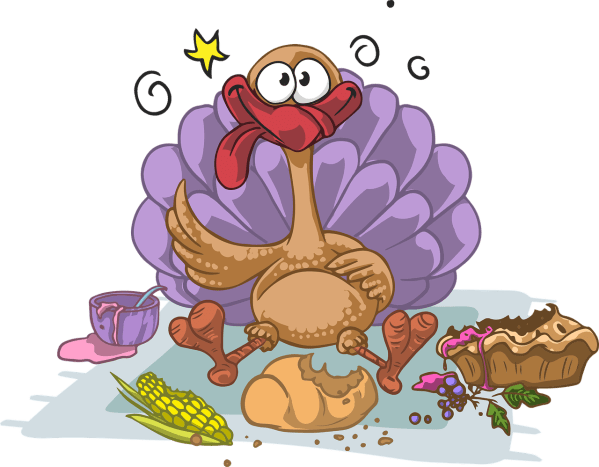
For Pete’s sake, that farmer read Harry Potter to your poultry from the the end of June onward. And he played it Vivaldi before bedtime. And he regularly fed it a posh protein diet of sautéed shredded lizard sprinkled with dried grasshopper powder, delicately placed atop a bed of tender shaved young bulbs. On special occasions, old Tom got a soup pureed with snails, slugs, and worms, swirled with a small dusting of sand and gravel for grit to aid with his proper digestion.

Yeah, you really can’t go back on someone’s efforts like that.

So, a lot may have changed from last year’s big food festival, and this year’s attendance level might have been reduced to only those you regularly sneeze on and don’t apologize to. But the one thing that has remained a steady and dependable guest at all of our tables is the necessary presence of gratitude.

We are reminded of it everywhere. We may be feeling rather down in the dumps about not scarfing down half of Aunt Marge’s Rum Chiffon Pie this year, but all we need do is read the headlines to remind ourselves about how many Aunt Marge’s are no longer around to make such a treat.

It’s an effortless endeavor to see that we are not alone in our suffering or sadness, and there are countless others who may be experiencing greater loss than we are.

It reminds me a little bit of growing up in Wisconsin. One was not allowed to indulge in the wholly justifiable complaining about how cold one was. Because it was not a personal experience. Everyone was cold. Chin up. Shut up. Get up. And get on with it.

But back to the gratitude.

Typically, I am the type of person who nearly falls on my knees in appreciation for anyone who’s kind enough to even hold open a door for me, let alone ease some significant burden. And I’m annoyingly delighted to see every sunrise or sunset, every flower bloom, or bird in flight. I get an absolute thrill even hearing my dog belch as I’m confidently assured he loved the meal I prepared for him so much that he snarfed it down too quickly and ate a bucket of indigestible air.

Yeah, uber grateful person.

So, it came as a bit of a head-scratcher when I recently heard an interview with A.J. Jacobs, an author I adore, as he spoke about his latest book, Thanks a Thousand.

Knowing how seriously he plunged into his research when writing something new—like The Year of Living Biblically: One Man’s Humble Quest to Follow the Bible as Literally as Possible, where he took it upon himself to obey the divine suggestions to “Love thy neighbor,” “Be fruitful and multiply,” and of course, “Stone adulterers,” I had no doubt his newest book would be as intricately studied.

Mr. Jacobs takes the elemental concept of exploring how gratitude can enrich our lives and produce countless experiences where we are more thoughtful and grounded by using his morning cup of coffee as the chosen object of his determined efforts to thank everyone who was a part of making it materialize before him.

Seems rather effortless really, but in truth … it is impossible.

From the clerk who rang up your bag of beans, one can move to the roaster, the trucker, the airline, the packagers, the bean harvester, the farmer, the mechanic who fixed the tractor the farmer needed to use to plant the beans. The manufacturer of the tractor, the countless companies that created the parts for that manufacturer, the construction workers who built those plants, the people who made lunch for those construction workers. I think you get my point. The list is exhaustive.

Jacobs speaks to and visits miners and biologists, goatherds and smugglers, and that travel required trucks and airplanes, boats and motorcycles. He realizes the myriad materials that went into the making of that sip—the rubber, wood, steel, and bat guano. His assessment is that it required thousands of human beings collaborating across dozens of countries.

To make one cup of coffee.

In an era when we feel so disconnected from one another, A.J. Jacobs illuminates the miracle of human cooperation. Togetherness. Relationships. Synergy. Support.

It is not unlike the super-human efforts that have gone into the research and development of one of many vaccines our planet is desperately and impatiently waiting upon. We have discovered that it takes the whole world to help the whole world.

And as the world and all its many inhabitants do what they can to heal our planet and our people, let’s take a moment to realize just how connected we really, truly are and need to be.

This year we may be apart. But it is so that next year and for countless years following we can be together, closer than we’ve ever been before, because gratitude became the cream in our coffee.

~Shelley

For the time being, the blog is closed to comments, but if you enjoyed it, maybe pass it on to someone else. Email it, Facebook it, or print it out and make new wallpaper for the bathroom. If it moves you, show it some love and share. Cheers!

Don’t forget to check out what’s cookin’ in the Scullery and what we all gossiped about down in the pub. Or check out last month’s post and catch up.

The Meticulously Precise and Non-Magical Way to make Whiskey

I’m nearly finished writing another book.

This one won’t be published for the public though. It’s a technical manual.

I’d never done a technical manual before; therefore, this genre has been entirely new to me.

I was at one point reminded, Technically speaking, technical manuals do not fall into a “genre,” Shelley.

Disappointing news.

I was also at one point informed that my other skills of fiction writing were, although appreciated, inapplicable with this work.

“What do you mean?” I’d asked, halfway through the job.

Please do not allow the machinery to have any “dialogue.”

Hugely disappointing news.

In my mind, everything is conversing with anything beside it. Refrigerators hum, clocks tic, boats roar, trees creek, tea kettles whistle, grills hiss, frying pans spit, drains gurgle—I could go on.

There is conversation with their purpose, with their function, and it is our choice to tune in to hear it if we choose to do so—or maybe it’s just a special type of non-worrisome derangement those of us who practice anthropomorphizing inanimate objects experience every day.

So, okay, the mash tuns, the fermenters, the stills, and bottling equipment will not be engaged with any discourse. Fine.

Also, no need to “set the scene.”

Wait. What? No “Once upon a time”? No “In a galaxy far, far away”?

No.

No “Imagine if you can, a farm field in Virginia filled with rows of waving grain. Corn so tall, so yellow, so sweet. Wheat so soft, so feathery, so—”

No. Also, just list the manufacturer of each piece of equipment. No need to give colorful backstory that creates a uh … biography for them.

Damn.

But the still is an old copper Armagnac pot which surely, if you’d allow me to research, has the most fascinating history, connecting it to a village in Gascony, and likely to some illicit brandy making where people’s lives were at risk for defying the king’s orders and skirting around the excise men, right?

No. Louis XVI died in 1793. The still was made in 2006. Write that down.

No excise men?

*insert cold stare here

Fine. Hard facts only. It has been an arduous road to travel. It has been serial numbers, maintenance schedules, standard operating procedures, operator responsibilities, quality controls, ingredient specification sheets, safety protocol, system malfunction detection. It has been measurements, sampling data, testing methods, recording methodology, and out of the realm of tolerance identification.

No language describing the invention of any equipment, the trials and tribulations of the inventor, the recognition, the accolades, the race between rivals to patent first, to reach the market, to make a name and reap rewards.

No timeline of history, the tales of great machinery malfunction and mishaps that caused strife, or injury, or daresay … death.

Nope. Just operator files.

It’s ‘if blank, do blank.’ Or ‘when this, then this.’ It’s ‘measure now, record here.’

There’s no beginning, middle, or end.

It is not a story, not a narrative, no plot.

None of the machinery barely scrapes by, screeches to a halt, or belches out for attention.

The manual is meant to be informative. Concise. Crystal clear. It is meant to provide a “just in case” scenario for an event like a catastrophic pandemic wiping out all previous operators’ ability to fight through throngs of apocalyptic zombies to appear at the facility, allowing any stranger to eventually walk in off the street, discover the book and easily, effectively, and effortlessly pick up where we left off.

No, Shelley. It is meant to use as a teaching guide for new employees.

Yeah, that too, but my take could be plausible (I mumble quietly).

So, I study each piece of equipment. I learn its function. I define its specifications. I describe its purpose. It is thirsty work as I crawl around, beneath, above, and inside many of them. I watch them perform. I study their mechanisms. I research their optimal modes.

And I learn … they are still magical.

I learn it from listening to the operators as they describe their years of experience working with each station.

The grain will stubbornly clump and ball if you don’t chase it with the paddle in the cooker. It likes to hide right in that corner.

If you don’t clamp down the hose securely, the impellor pump turns into a raging snake that’ll spit hot mash on every square inch of the production room floor.

You see that steam rising from the strip still’s parrot spout? We call that the dragon’s breath.

I did find a story. The story of waking up the yeast before releasing it into its comforting, warm bath, of performing the tightly timed choreography between pieces of machinery as they demanded immediate attention to avoid calamity, of discovering that the general consensus for many of the processes was that you just had to feel it, smell it, taste it, gauge it. The machinery had its tells, and a good operator was sensitive to them and could anticipate results because of the accumulated years of a bonding relationship.

Making whiskey requires procedural care, yes. It’s a recipe. It’s a step by step adventure that when timed perfectly churns out a salable product.

But to me, and to others, the machinery is responsible for the alchemy, the head-spinning potions, the conjuration that leads grains to glass, this honeyed, headying elixir.

But the manual will not reveal that magic. The manual will not even hint at it. The manual conceals the story.

Except it’s there. We just don’t capture it within the pages that keep the secret safe. It is for others to read between the lines, to unearth the buried story within it.

If they find it after the zombie apocalypse.

~Shelley

For the time being, the blog is closed to comments, but if you enjoyed it, maybe pass it on to someone else. Email it, Facebook it, or print it out and make new wallpaper for the bathroom. If it moves you, show it some love and share. Cheers!

Don’t forget to check out what’s cookin’ in the Scullery and what we all gossiped about down in the pub. Or check out last month’s post and catch up.


Explaining the Birds & the Bees, But Mostly the Bugs

But before we begin …

A thousand squealing thank yous to Robin Gott — sorcerer of stage, screen, and scribbles — who has so kindly taken a few minutes off from work to sit in his dressing room and whip out a handful of his amazing cartoons to accompany this post. And for so much more of Robin, visit robingott.com

~~~~~~~~~~~~~~~~~~~~

I think we can all agree that we will never, ever truly be alone.

And for some that is a giant sigh of relief, as being alone is akin to losing your entire family and all your friends—even if they only existed on screen in the form of the cast of Downton Abbey.

But for others, no matter how hard we may try, we discover that we will shuffle on this mortal coil in the company of countless others who clearly have never been invited along.

They make quick assessment of who you are, but mostly where you live, and decide to take up residence—contributing nothing to the upkeep and maintenance, and only adding to your woes.

Bugs.

As I’m pottering about my new abode, discovering nooks and cramming things in crannies, I also discover a great variety of crammed in arthropods—either walking, flying, or in some cases, swimming, depending upon the nook or cranny.

It has been a cycle of either open up cupboard, glance toward ceiling, or focus in on floor followed by squeal, squeak, or shriek.

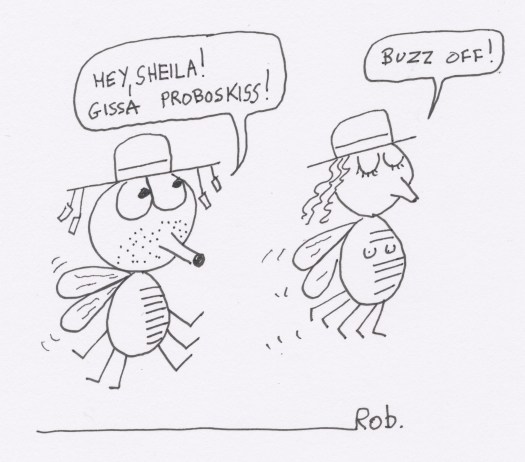
Now don’t get me wrong. I think bugs are interesting. Fascinating, even. Because who doesn’t want to know how a frustrated Australian seaweed fly finally gets some action from all the disinterested Sheilas around him?

Or how a green spoon worm, happily sitting at the bottom of the sea, can accidentally inhale her husband when she simply suffered from an itch on her nose?

Well, I certainly did.

I’ve read Olivia Judson’s Dr. Tatiana’s Sex Advice to All Creation. I took copious notes about virgin births and about paralyzing would-be lovers so that your children can eat him alive. I scoured the sketches of detachable penises, and made sure I understood how one could go deaf from too much mite sex.

But seeing it in real life form, knowing that all that was happening right beneath or above my nose was something else altogether.

Hello, Pest Control.

The jolly folks on the other end of the line proved almost too happy to hear from me.

Infestation? Blight? Chiggery scourge and epidemic? How delightful! We’ll be right over.

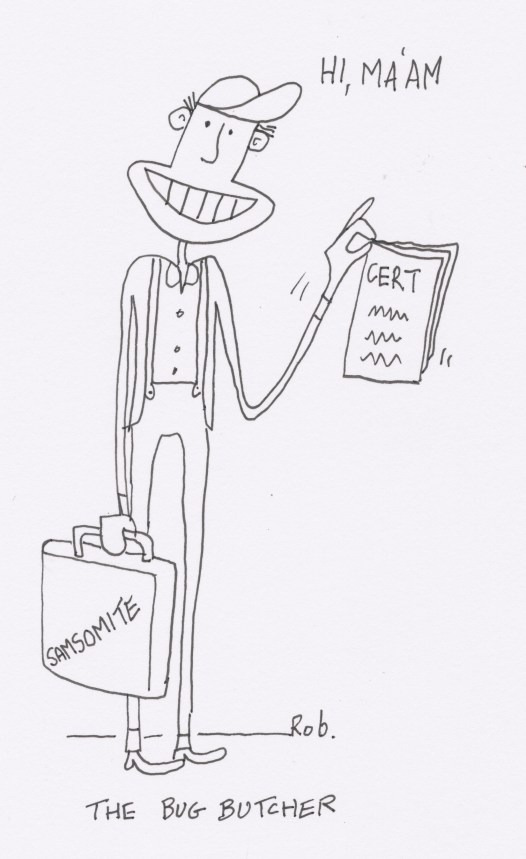
Mere moments later, I greeted a six foot three, thin as a pine sapling fellow with a beaming face exuding pure celestial rapture, and instead of shaking my hand, he held up a framed 8 x 10 diploma.

Blessings on you and yours, ma’am. My name is Jebediah, and I just got my certs.

Well, uh … I stumbled, glancing up into the scalding hot sun where his head was haloed, Praise … be?

He beamed sunshine. Yes, ma’am. And then stood, turning to admire his freshly-inked degree.

It’s not been 24 hours yet since the family gatherin’ with coffee and a slice of pie to celebrate my good fortune, but I assure you—

He peered down at me gravely.

—I am fully in charge of my faculties despite sneakin’ that sip of Mama’s cookin’ sherry she hides behind the flour tin in the pantry. Ooowee!

He made to swipe at his brow, and I realized the pest company had sent over a reincarnation of Mayberry’s Gomer Pyle.

I suddenly wondered if this meet and greet should come to a quick end, as a few steps farther into the house he would be received by my own set of not-quite-choir-boy-bottles. Well over one hundred of all the Bens and Glens from Scotland, neatly lining an entire wall of shelving.

Come on in, Jebediah, I said hesitantly. Let’s see if we can’t cleanse this little dwelling of its demons.

Six steps into the house he did a three-sixty spin, his wide-eyed, slack jawed visage finding my uneasy one.

Ma’am? I saw all the wood from the outside as I was drivin’ up, but I had no idea there’d be all this wood on the inside too.

I looked at him, my head cocked with incredulity. I live in a log cabin, Jebediah.

He nodded soberly and whispered, This was not on the paperwork.

Might want to make a note of it for next time then, I suppose, but I’ll leave you to it for now. I’ll be in my little office if you need me. I pointed down the hallway.

For the next ninety minutes I heard precious little and finally decided to hunt down the biblical bug butcher.

Jebediah? I called out, and then spotted him crouched on the floor in a corner, his hand cradling an iridescent blue-winged dead wasp.

He glanced up at me, his eyebrows crinkling as he sighed. Real butes these guys are, ain’t they? This here is Chalybion californicum—what you all commonly call the Blue Mud Dauber.

Then he held out his other hand with another bug that looked exactly like the first—including the whole dead part. This here should not be confused with his cousin, the Chlorion aerarium—the Steel-Blue Cricket Hunter—as although the same size, one has a longer pedicel, and the other is much more hairy.

Also, he went on, these fellers are worthy specimens, as some of them will rid the environment of crickets and others of the vicious black widow.

I studied the young man for a full thirty seconds as he sighed long and sorrowfully once again, his head bent low over the bugs he was in charge of destroying.

Jebediah? Are you sure this is the right job for you?

He looked up at me and then swept an arm in a circle over his head. You live in a tree, ma’am.

I sniffed. Well … a dead one, really.

He nodded. Exactly. It’s the natural habitat for nearly all of these creatures. It seems … he paused, … it seems a little unnerving that there has been so much death here today. I did not expect such a high body count on my first day of work.

I walked to my bookshelf and then returned to Jebediah on the floor, holding out Dr. Tatiana’s sexpert advice for all bugs.

Here. Read this. Chances are you’ve been far too immersed in the end of the life cycle for all your many legged friends.

Jebediah read the title slowly and out loud, and then looked up at me dumbstruck. A slow smile crossed his face as he tucked the small book into his back pocket and headed for the door.

Word of warning, Jebediah, I added, you might want to keep this behind the flour tin in the pantry too.

~Shelley

For the time being, the blog is closed to comments, but if you enjoyed it, maybe pass it on to someone else. Email it, Facebook it, or print it out and make new wallpaper for the bathroom. If it moves you, show it some love and share. Cheers!

Don’t forget to check out what’s cookin’ in the Scullery and what we all gossiped about down in the pub. Or check out last month’s post and catch up.


You Say Tomato, I Say, “Hey There, Bloody Mary”

Someone last week announced that I was particular.

But what I thought I’d heard was that I was peculiar.

Both are true.

At the time I assumed it was a simple observance—one like Oh, you have blue eyes or Your shirt is misbuttoned, or even Huh, I guess some people really do like lutefisk.

But in retrospect I think the statement was more like Huh, I guess some people really do like lutefisk—slathered with Limburger cheese sauce and perched atop a mound of kimchi.

Of course even I know where to draw the line because, Good Lord, no one in their right mind would serve dried cod in lye next to deeply salted and fermented red vegetables. The colors are just way off.

Photo by Pixabay on Pexels.com

But I should probably embrace one adjective more so than the other, except after giving it some deep-thought consideration while cleaning out the cat litter (an event that comes just behind sock-folding as far as pensive places for contemplation), I realized that both descriptions justify not simply tolerance, but support.

Maybe even celebration.

Merriam Webster (my three favorite people in the world—yes, three cuz there were two Merriam brothers) states that the word “particular” means: notably unusual, nice in taste, hard to please.

Obviously, that last one was added by mistake and surely the next edition will correct their error, but for the sake of full transparency, I’ve included it above.

The three then go one to define “peculiar” as: special, curious, odd.

Again, I feel as if I could be accused of cherry-picking here, but clearly this is not the case. Undoubtedly, as there are 58,876 words that begin with the letter P, and this day surely brought immeasurable stress and opportunity for the occasional blunder, I shall forgive the lexicographers for that last erroneous entry and dismiss it out of hand altogether.

I am neither hard to please, nor odd.

Except if doing a headcount of humans in my home. Then yes, odd in number I would be.

And I feel extraordinarily pleased to be the odd human at home as there is precious little time wasted instructing anyone but the cats as to the proper way to replace a toilet paper roll. Although they still quibble, with countless power point slideshows, as to the ease of reach for the “under” argument, I, as purchaser of said paper, have final say.

The dog has no opinion and believes it all tastes the same no matter the direction – over or under.

Regardless of one’s paper product preference, I still feel there is much to lionize when one comes across anything or anyone deemed “notably unusual” or “curious,” as these are two terms we have, in the past, sadly assigned negative connotation to.

Reviewing my grade school report cards, I note a handful of examples that reinforce this impression.

Shelley has a lot to say and may benefit from raising her hand less often is not what your Average Joe parent wishes to read on a quarterly bulletin summarizing academic progress.

Nor is If you continue to ask questions during CCD classes, you are risking an interpretation from The Almighty as one of little faith. Our catechism classes are spaces meant for quiet absorption.

My recollection was that neither myself nor any of my classmates were precocious enough at ten to question the four pillars of Christianity but simply wished to understand the definition of “catechism,” and therefore repeatedly drew straws to see which of us would get whacked with a ruler that afternoon.

I mean really, why were we here? This time slot was interfering with our ongoing science project of seeing what 3000 tons of freight train with a rail speed of 60 mph can do to a penny.

I’d say that kind of curiosity deserved to be commended.

To be fair, I feel I should attempt to put in a sympathetic word or two for the case of being determined “hard to please” or “odd.”

In some lights, one might benefit from a touch of hard to please-ness, such as when one has been convinced one’s mechanic has sufficiently fixed the brakes.

An attitude of As long as they’re going to halt the car eventually is likely one that will not serve you well for long. Best to adopt a posture of fastidiousness regardless of the inflated garage shop bill.

And when exploring the depth and breadth of the term “odd,” one must acknowledge that although, yes, it can denote something bizarre or mismatched, it can also highlight that last brownie in the pan which could not be divvied up equally among friends going home after tea, or that one Weimaraner puppy with crossed blue eyes, a paw in a cast, and one undescended testicle.

Q: Why the hell would you want this runty K-Mart blue light special, lady?

A: Why the hell would I not?

Clearly, this is not a case of being hard to please, rather seeing years’ worth of creative writing material.

It’s true—in essence, all of this is simply determined “in the eye of the beholder,” right? You can be picky or specific. You can be creepy or eccentric. It often comes down to how the term is delivered and how it is received.

For the sake of one’s self-esteem, I vote a regular bath among the tissue-thin pages of one’s dictionary where you can steep yourself within myriad meanings of every descriptor ever tacked upon your personhood.

Photo by Pixabay on Pexels.com

You will come out learned, enlightened, and smelling like a rose.

Which, for most people, is slightly better than smelling like lutefisk.

~Shelley

For the time being, the blog is closed to comments, but if you enjoyed it, maybe pass it on to someone else. Email it, Facebook it, or print it out and make new wallpaper for the bathroom. If it moves you, show it some love and share. Cheers!

Don’t forget to check out what’s cookin’ in the Scullery and what we all gossiped about down in the pub. Or check out last month’s post and catch up.
The Magical Tale of a Tail

The world is full of random flukes, right?

We’ve all experienced a flush of good timing, poetic justice, or quirky happenstance. Something we look back on and say, yeah, that was weird, but seriously, how cool.

As a writer of fiction, I know I can drizzle a bit of curious coincidence into my stories, but I treat it as though it was a ghost pepper hot sauce—a little goes a long, long way. And too much will kill my reader’s appetite for any more of my story.

I mention all of the above because my life would never be considered believable fiction.

My editor would toss it back and say it was filled with way too many unexplainable flukes. Events that appeared for no reason, simply to push the narrative arc along. It’s too farfetched, too fortuitous, too implausible.

And yet … this is the contents of my life.

I write about magic in some of my books. In one it is simply sprinkled about, in several others it is the main focus, widespread and thoroughly researched. As authors we are encouraged to write what we know. But I wouldn’t say I know magic per se, I’d instead phrase it as I experience magic—or what some would define as magic—nearly every day.

And I don’t mean magic in the sense of ‘wand-casting-turn-you-into-a-toad’ type magic, nor would I lessen it to the side of the spectrum which might be confused with abundant gratitude. As in the warm rush of excitement at seeing a rainbow, or a water funnel, or a squirrel escape unharmed from the opposite side of your moving vehicle as it dashed out in front of you.

No. My magic is more the serendipitous kind and mostly the unexplainable. Unexplainable, as far as science is concerned. And I do believe science will one day have an explanation for my wonky situations. That chapter just hasn’t been written yet.

I don’t have rational answers for why, when visiting religious sites, or landscapes of great historic relevance, I am overcome with a physical dis-ease so great it can send me to my knees. Someone theorized that perhaps the pseudo-science stating the correlation between ley lines and magnetic fields might be an influence—and my body simply has an abundance of iron that interferes.

*shrug*

I have no reasonable explanation as to why I am forever running into self-proclaimed witches, soothsayers, mystics, and wizards. This week alone the tally is already up to three.

Surely, you think I jest.

I certainly would.

And it’s not like I belong to any covens, Wiccan moots, or regularly visit Renaissance festivals. These individuals just find me. Or, as I have heard explained to me numerous times, I find them. But I take issue with this declaration, as the last one I “found” was literally fifteen minutes ago—someone who marched up to my front door to say hello as I’ve been working on this article.

*sigh*

I know. It’s supremely absurd.

I feel like erasing this entire confessional essay, except that I’m writing to tell you about one of my most beloved repeating serendipitous occurrences: meeting my favorite people.

(The reveal is coming up, so hang tight.)

I was recently away at a massive book festival in Tucson, Arizona. Over one hundred and thirty thousand people attend this three day event each year, and I was lucky enough to be invited to participate.

A bazillion flights, ubers, panels, and tacos later, I lug my bags across the threshold of my home, my luggage filled with the contact info of countless authors, publishing reps, moderators, and book sellers.

I toss it all up on the kitchen counter and glance out the porch door where movement catches my eye. A wretched face glances up at me, curled up upon my swinging rocker. Two large chocolate colored eyes effortlessly convey the message of I’m cold, I’m hungry, I’m lost.

Unlike the countless other things up on the mountain where I live, this animal has no desire to fight me back for territory taken, and only wishes for a quick solution to his mounting problems.

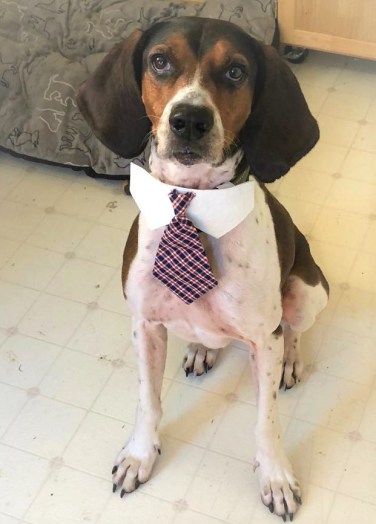
I rush out to greet the sweet and gangly-legged hound and usher him into the warmth where aid is in abundance. “Sammy,” as his tags indicate, is one of the most grateful tail wagers I’ve yet to lay eyes on.

He tells me, in a way that only animals can, how the water has never been so thirst-quenching, the food has never been so filling, and yes, please scratch right there until I tell you to stop. I adore animals and their gratitude for simple needs met. I wish more people were so.

I quickly make contact with Sammy’s owner—a doppelganger of me, had I been on the receiving end of the phone call: thrilled, desperate, relieved. She is on her way.

Sammy and I find the warmest, sunniest room in the house to await her arrival, and many attempts at my poor human-to-dog speak message of, “I promise, she’s rushing here to get you,” prove unsuccessful. His eyes still say, Make my two-leg appear, please.

And minutes later when she does, I can see in her eyes the same urgency as was in Sammy’s, and my “chatty Cathy” habit is getting in the way of reunification.

Paula is clearly a perfect match for her companion—warm, gentle, intelligent, personable. It’s almost as if she was a …

“What do you do for a living?” I ask her.

“I’m a school librarian.”

I drop all pretense of politeness and inhibition. I hug her.

“You are my favorite kind of people!” I look at her hard. “Did you somehow know that I run a campaign to erect monuments to all librarians? Because I write that on the jacket flap of all my books!”

She shakes her head. She did not know. And eyes the door.

I thrust three of my books into her hands. “For your school, if you want them.”

We will be friends. I’m sure of it. I will make it happen. And I will try to tone down that unnerving affection.

But it comes naturally when you’ve been surrounded by all this wonky magic your whole life. I may look askance at all the other lunacy that regularly shows up, but I will never question fate or the three siblings in charge of it.

And if Clotho, Lachesis, or Atropos—the three Sisters of Fate—should toss a librarian onto my front door’s welcome mat, I will treat her the same way I would any lost and loved puppy: with open arms and great goodwill.

Also a big spoonful of peanut butter.

~Shelley

Sammy was lost in the forest for two long winter days. And because of his perseverance and suffering, I suggest he receives a spot at Paula’s feet within the mold of her bronze cast—once her school raises enough money from bake sales. Come on, Western Albemarle High School. Get baking!

For the time being, the blog is closed to comments, but if you enjoyed it, maybe pass it on to someone else. Email it, Facebook it, or print it out and make new wallpaper for the bathroom. If it moves you, show it some love and share. Cheers!

Don’t forget to check out what’s cookin’ in the Scullery and what we all gossiped about down in the pub. Or check out last month’s post and catch up.