The Meticulously Precise and Non-Magical Way to make Whiskey

I’m nearly finished writing another book.

This one won’t be published for the public though. It’s a technical manual.

I’d never done a technical manual before; therefore, this genre has been entirely new to me.

I was at one point reminded, Technically speaking, technical manuals do not fall into a “genre,” Shelley.

Disappointing news.

I was also at one point informed that my other skills of fiction writing were, although appreciated, inapplicable with this work.

“What do you mean?” I’d asked, halfway through the job.

Please do not allow the machinery to have any “dialogue.”

Hugely disappointing news.

In my mind, everything is conversing with anything beside it. Refrigerators hum, clocks tic, boats roar, trees creek, tea kettles whistle, grills hiss, frying pans spit, drains gurgle—I could go on.

There is conversation with their purpose, with their function, and it is our choice to tune in to hear it if we choose to do so—or maybe it’s just a special type of non-worrisome derangement those of us who practice anthropomorphizing inanimate objects experience every day.

So, okay, the mash tuns, the fermenters, the stills, and bottling equipment will not be engaged with any discourse. Fine.

Also, no need to “set the scene.”

Wait. What? No “Once upon a time”? No “In a galaxy far, far away”?

No.

No “Imagine if you can, a farm field in Virginia filled with rows of waving grain. Corn so tall, so yellow, so sweet. Wheat so soft, so feathery, so—”

No. Also, just list the manufacturer of each piece of equipment. No need to give colorful backstory that creates a uh … biography for them.

Damn.

But the still is an old copper Armagnac pot which surely, if you’d allow me to research, has the most fascinating history, connecting it to a village in Gascony, and likely to some illicit brandy making where people’s lives were at risk for defying the king’s orders and skirting around the excise men, right?

No. Louis XVI died in 1793. The still was made in 2006. Write that down.

No excise men?

*insert cold stare here

Fine. Hard facts only. It has been an arduous road to travel. It has been serial numbers, maintenance schedules, standard operating procedures, operator responsibilities, quality controls, ingredient specification sheets, safety protocol, system malfunction detection. It has been measurements, sampling data, testing methods, recording methodology, and out of the realm of tolerance identification.

No language describing the invention of any equipment, the trials and tribulations of the inventor, the recognition, the accolades, the race between rivals to patent first, to reach the market, to make a name and reap rewards.

No timeline of history, the tales of great machinery malfunction and mishaps that caused strife, or injury, or daresay … death.

Nope. Just operator files.

It’s ‘if blank, do blank.’ Or ‘when this, then this.’ It’s ‘measure now, record here.’

There’s no beginning, middle, or end.

It is not a story, not a narrative, no plot.

None of the machinery barely scrapes by, screeches to a halt, or belches out for attention.

The manual is meant to be informative. Concise. Crystal clear. It is meant to provide a “just in case” scenario for an event like a catastrophic pandemic wiping out all previous operators’ ability to fight through throngs of apocalyptic zombies to appear at the facility, allowing any stranger to eventually walk in off the street, discover the book and easily, effectively, and effortlessly pick up where we left off.

No, Shelley. It is meant to use as a teaching guide for new employees.

Yeah, that too, but my take could be plausible (I mumble quietly).

So, I study each piece of equipment. I learn its function. I define its specifications. I describe its purpose. It is thirsty work as I crawl around, beneath, above, and inside many of them. I watch them perform. I study their mechanisms. I research their optimal modes.

And I learn … they are still magical.

I learn it from listening to the operators as they describe their years of experience working with each station.

The grain will stubbornly clump and ball if you don’t chase it with the paddle in the cooker. It likes to hide right in that corner.

If you don’t clamp down the hose securely, the impellor pump turns into a raging snake that’ll spit hot mash on every square inch of the production room floor.

You see that steam rising from the strip still’s parrot spout? We call that the dragon’s breath.

I did find a story. The story of waking up the yeast before releasing it into its comforting, warm bath, of performing the tightly timed choreography between pieces of machinery as they demanded immediate attention to avoid calamity, of discovering that the general consensus for many of the processes was that you just had to feel it, smell it, taste it, gauge it. The machinery had its tells, and a good operator was sensitive to them and could anticipate results because of the accumulated years of a bonding relationship.

Making whiskey requires procedural care, yes. It’s a recipe. It’s a step by step adventure that when timed perfectly churns out a salable product.

But to me, and to others, the machinery is responsible for the alchemy, the head-spinning potions, the conjuration that leads grains to glass, this honeyed, headying elixir.

But the manual will not reveal that magic. The manual will not even hint at it. The manual conceals the story.

Except it’s there. We just don’t capture it within the pages that keep the secret safe. It is for others to read between the lines, to unearth the buried story within it.

If they find it after the zombie apocalypse.

~Shelley

For the time being, the blog is closed to comments, but if you enjoyed it, maybe pass it on to someone else. Email it, Facebook it, or print it out and make new wallpaper for the bathroom. If it moves you, show it some love and share. Cheers!

Don’t forget to check out what’s cookin’ in the Scullery and what we all gossiped about down in the pub. Or check out last month’s post and catch up.
 

A Problem Shared is a Problem Halved (or not Felled if You’re Quick)

Currently, I’m in the middle of a fight with three people.

Well, they’re not actually people, they’re animals, but they are just as stubborn, unreasonable, and small-minded as some of my closest friends, so it’s easy to confuse the two groups.

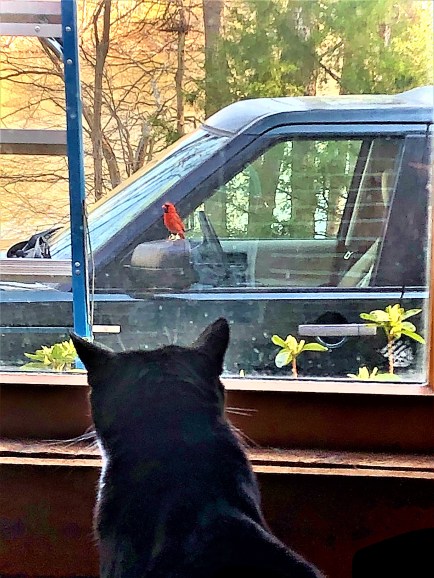
There is a cardinal, who for weeks has been fighting with fisticuffs, or whatever feathered version there is of that, with nearly every window I have on my house.

And on my car.

And with my head if I’m outside and happen to have extra shiny hair that day.


Obviously, one must protect one’s nestlings from intruders—even if you mistake them for your own reflection. And I, obviously, must protect a smaller-brained organism from leaving his nestlings fatherless.

But my efforts are thwarted by the cardinal’s span of territory to patrol. I cannot blackout every window to diminish the glare, as I have limited supplies and a biological need for vitamin D.

He will have to take his chances with the likelihood of beak repair.

There is also a squirrel. One who suffers from great impatience.

The rule in my childhood neighborhood, adhered to by anyone with one season of vegetable growing experience was thus: plant 1/3rd for the deer, 1/3rd for the birds, and 1/3rd for your family.

For years this directive was sage and followed by all participating creatures.

This year, I cannot get the seeds in the ground without a squirrel—one I now recognize because of the prison art tattoo on his back—digging them up the second I’ve stepped away.

First, I tried netting the box. He must have opposable thumbs. He easily unnetted the netting.

Then I tried heavy-duty tree trunk wiring. He must have tools. Unwired, and again I am seedless.

Then I just put out half a pound of already grown green beans and a sign that said YOU WIN.

(*insert squirrel snickering here)

Lastly, there is a beaver.

He is industrious. He is relentless. And he has expensive taste.

He has already struck down and carried off three massive bayberry bushes and is now working on a beautiful thick oak that will take him years to gnaw through. Gauging his angle of approach, it will likely land directly on my house.

It’s okay. I’ve got time.

But to deter him from this great specimen of timber—which may or may not survive his insatiable appetite for cellulose and lignum—I have begun laying piles of thick branches and small logs at the base of the tree. A gift. An impediment. A message that suggests If you carry on with this task, you will soon become a part of my winter wardrobe.

Nevertheless, he persists.

My next step would be to enmesh that tree with the heavy-duty tree trunk wiring, but it’s still currently in use with my next squirrel-thwarting endeavor which involves a small makeshift catapult.

I know these minor skirmishes sounds like small potatoes as we’re all muscling our way through day after day of the pandemic which forces us to revisit and ration our daily wants and needs.

But might there be a silver lining out there for many of us? The substantial amount of people who have yet to experience the oh-so-real terror of scarcity?

Is it such a bad idea—despite the fact that it has been forced upon us—to reevaluate what the word need truly means? Or to press each of us into a state of deliberative ingenuity?

I’m not suggesting we all slap on a coonskin hat and become some version of Daniel Boone, but would it be so awful to think like an Italian nonna when facing the dwindling supplies on one’s pantry shelves and you’ve got thirteen hungry bellies to fill?

I think most of us would benefit from a few hours of bootstrap thinking.

Certainly, when I look at the microcosm of The Hunger Games event I’m involved in with Mother Nature and her brood, I can see that there’s more than one way to skin a cat—or a beaver, if you will.

I see them effortfully striving, every day, for the same things: food, shelter, and the protection of one’s progeny.

That’s the focus. And I don’t blame them.

That said, being the individual with slightly more gray matter, I find it’s possible for me to not only endeavor to achieve those same things, but maybe help a few of them in their pursuit as well.

Now is the time for inventiveness, resourcefulness, and innovation. Along with that comes the eye-opening bonus of gratitude.

We may never view the necessities—the essentials of life in quite the same light. Whether you’re handing out bags of successfully grown green beans to neighbors, or you’re delivering face masks made from the hairy hide of a befallen beaver, you’ve seized the chance to be a section of a solution and not part of a problem.

Most important, this is a critical time for self-reflection. The point is none of us have to be bird-brained about any of it.

~Shelley

For the time being, the blog is closed to comments, but if you enjoyed it, maybe pass it on to someone else. Email it, Facebook it, or print it out and make new wallpaper for the bathroom. If it moves you, show it some love and share. Cheers!

Don’t forget to check out what’s cookin’ in the Scullery and what we all gossiped about down in the pub. Or check out last month’s post and catch up.

On the Cutting Edge of Shear Madness

There is a venerable phrase many of us have heard countless times in our lives:

Doveryai, no proveryai.

Or if your Russian is a little bit rusty, Trust, but verify.

It’s an old proverb American writer Suzanne Massie passed on to Ronald Reagan before he began traveling to Russia to discuss U.S. and Soviet relations during his presidency.

It became for him somewhat of a trademark phrase.

It became a lodestar for many of us, a crutch for a few, but sage advice for all.

A week ago, my hound, Haggis, had none of the typical skepticism that normally washes across his face unless spotting a jar of peanut butter, his leash, or the hind leg of a freshly shot deer in my hands. But this was because he could no longer spot anything.

Literally. His hair had grown to a length where it could serve as an emergency ladder should he be close to a second story window and we had a fire.

So, when he finally heard the hair-raising snippets of my hair-cutting scissors, that skepticism shifted straight into suspicion and finally parked itself at defiance.

I had never cut his locks before, and he believed it was best if we left it that way.

Today, we find a great swath of our population experiencing a crisis of trust.

And why is that? The reasons are many. Understanding them is paramount and will likely shift the way we think, plan, behave, and move forward.

Together, this globe is redefining what life upon this planet is like. We are forced to assess our work, our relationships, our lifestyles, and the unforeseen shape they will morph into down the road.

Over the next several days I employ great determination during my time of internationally urged self-isolation to convince myself and my great hairy hound that I can accomplish the Herculean task of carving through his shrubby mane in the same way most of my fellow humans try to muddle their way through the maze of subterfuge, pretext, and great gobs of misinformation clouding our sight of the truth.

Daily, I place him in an unnatural position and beg him to be still as I scissor away for the space of an hour. I listen to the news: the practitioners, pundits, the press, and the president—each one with a decreasing sense of belief.

I feel Haggis tremble beneath the sound of sharp shears, and I put the scissors down and soothe him with all the ridiculous cooing tones meant to bring forth some ease. But I echo his same tiny twitch of skin when I’ve nipped him with the tip, or when they broadcast some new tally.

Every day certain numbers shoot up, and others slide down. We are warned by some and encouraged by others. Who do we trust? Who should we trust?

With boastful reassurance, I tell Haggis that he’s going to look fine—don’t gaze in the mirror, don’t question my actions, don’t think about it too hard. Trust me.

Each afternoon I hear about people who have heeded and those who’ve just balked. About those who have saved lives and those who have risked them. I wonder if, when this is all over, and I’m face to face with strangers, will I look at them with a fresh question: can I trust you?

And each afternoon I stand from my work, look at the dog, take a deep breath, and exhale with despair.

Good lord, what a mess. I’ve never done this before. And clearly it shows.

I fill him with flattery and maudlin praise, hoping he can’t see through my bluster and swash. But he feels my inexperience. And he knows that whatever my actions, I’ll not feel them as keenly as he does. He discovers at some point—day four or day five—that I’m frustrated with this routine, I’m wishing it over, and I’m unhappy with the results.

But he also knows that there’s no turning back, and this is where his lack of trust in my skills begins to crystallize into disregard.

I am somewhat offended as each day he pulls away from me, refusing to hand me a hoof or his chin.

You’re going to slow.

You’ve made a right mess.

Look here, now I bleed.

I hear him.

I should have left this up to the professionals. Although this is not a choice. We work with what we have, and a large team of experts does not appear at my door.

Each day I scooch the hound outside, toward the mile-long stretch of road between us and the mailbox. I keep my fingers crossed, hoping no one sees as we walk along. Haggis is only mid-way through this pruning, sporting a thick Mohawk down the length of his back, a mop-head, and four legs that are shaved only three-quarters down, making it appear that he is a belligerent teen prancing about in dog-friendly Uggs.

A neighbor stops his truck and rolls his window down slowly. He eyes the two of us with suspicion.

Has he got the virus?

No, I answer. He’s in the middle of a haircut.

Looks like he’s got the virus.

It does my ego and my confidence no favors to receive yet more criticism, and I mope the rest of the way home.

But tomorrow comes, and after convincing Haggis to climb atop the coffee table/barber’s chair once more, I ask myself a critical self-esteem building question:

What would Vidal Sassoon do?

It’s true—it’s not particularly hashtag worthy, but it seemed relatively uplifting for the moment.

And when one is on one’s own, navigating uncharted waters and expecting choppy results, one will search for signs of inspiration, direction, and security wherever one may find it.

(I’m lookin’ at you Dr. Fauci …)

We muddle through and trudge along. We rise to the occasion and make a small difference.

We find places to put our faith: in facts, in evidence, in one another.

And until we emerge on the other side, knackered, shaggy, and injured, we offer kindness if not confidence.

A spoonful of peanut butter can go a long, long way.

Surely the Russians knew that.

~Shelley

This slideshow requires JavaScript.

For the time being, the blog is closed to comments, but if you enjoyed it, maybe pass it on to someone else. Email it, Facebook it, or print it out and make new wallpaper for the bathroom. If it moves you, show it some love and share. Cheers!

Don’t forget to check out what’s cookin’ in the Scullery and what we all gossiped about down in the pub. Or check out last month’s post and catch up.

At Death’s Doorstep but Refusing to Knock

My computer has been damaged.

It happened several weeks ago. In a moment of lumpish movement, I reached for my mug of ginger lemon brew.

But I missed the handle.

Hit the mug.

Mug tumbled.

Liquid spilled.

Computer morphed into Margaret Hamilton in toxic emerald green paint, hissing burbling words of, Ohh! You cursed brat! I’m melting … how could a good little girl like you … what a world …

I looked at the flattened mass of steel, glass, silica sand, and bauxite and wondered how an object so small could oversee so much.

Of my life.

And how could an infusion of chamomile, ginger, and lemon—a trifecta of ingredients that would likely be the doppelganger action behind any yogi crossing himself—be the orchestrator of such tumultuous chaos?

I checked off the usual boxes of people-based panic.

  • Took immediate useless action to undo damage
  • Scoured the Great Book of Knowledge via smartphone to employ other useless actions to undo damage
  • Set up a small alter of candles, stones, and spice jars in place of unavailable idols to undo damage
  • Carved new idols from Irish Spring soap bars to replace spice jars in hope of undoing damage
  • Took a hot shower with useless idols

Days later, news from the twenty-year-old behind the We Fixit In Fifteen counter said it might make a nice new coaster for my mug and take a look at our newer models behind you.

Twenty-four hours later I order a new computer.

Twelve hours later I rest my hand atop my faithful old friend and remind him that all the great dogs die in the best movies and I promise not to forget you.

Five seconds later I see a blinking light on my old computer and am flooded with the same adrenaline as a SETI scientist having discovered evidence of extraterrestrial contact.

Immediately, I cancel the newly ordered computer—of course via smartphone, as who would be so cruel as to break up with your new obsession by letting your old obsession deliver the shattering message?

The old obsession should never be aware you were so quick to replace him. Especially if you’ve got a serious conversation to have about some accidental drowning and electrocution charges lodged against you.

But now … he is not the same.

There is flickering, sluggishness, unresponsiveness, and a fan with sound comparable to that of a Hoover on high churning all the time.

I am counting the minutes of life.

I am too nervous to unlock his tiny screws to reveal his backside—possibly caked with flecks of ginger, lemon peel, and sticky with agave syrup.

I will live with his new dysfunctions. I will admire his determined efforts to keep his optical drive optimal, his CPUs from functioning fractiously, his unrelenting maternal push of cool air on his overheated, sweet-caked motherboard.

Except, he’s really distracting.

It’s just like the heavily taxed HVAC unit outside which when both starting up and shutting down mimic a driver pulling up curbside beneath my window depressing the breaks on a massive antiquated school bus.

Or it’s like my pre-biblical flood-aged microwave which will only work if I slam the door shut and squeeze its sides together, chanting Judaic words of encouragement which are probably only the lyrics to an old Chanukah song.

And it’s like my nearly old enough to vote printer which jerks and coughs with every line it successfully prints and then spits out the finished product, shooting a barely-inked piece of paper straight across the room as if it finally hacked up some pestiferous phlegm.

The one thing these objects share is my fear of finding their faults.

The flaws in a system indicate weakness, deficiencies, and malfunction.

They panic you into late night visits to urgent care, house calls from specialists, and the poking and prodding from unqualified quacks who advise you to toss your not-quite-dead loved ones onto the wheelbarrow of the deceased.

And they are options that for me usually equate to an insanely expensive fix that lasts for three days, versus a ‘do nothing about it’ choice where they quietly die in two.

I’ll choose the latter.

Because there is something noble and magical about a piece of machinery anthropomorphizing into a half-marathon runner who crawls across the finish line as the balloons are being taken down and the banners are all rolled up.

I will cherish every second of my enfeebled laptop as it gushes out with audible vibrations akin to the phrase, I can’t feel my legs.

I will celebrate my tubercular printer with applause as it heaves out my text.

I will bear hug my nukebox and switch from Hebrew to Ladino when it’s beans and burrito night.

I will stand in a giant pink bubble—like Glinda, beaming an identical smile of unflappable tranquility, likely due to one too many mollies in her dressing room—as I ponder what it is like to be bereft of these items.

Okay, that last sentence is likely impossible for me. Presumably, I will continue to be needled by all their noisy and toilsome imperfections.

But at least now I will sip my tea an arm’s length away.

~Shelley

For the time being, the blog is closed to comments, but if you enjoyed it, maybe pass it on to someone else. Email it, Facebook it, or print it out and make new wallpaper for the bathroom. If it moves you, show it some love and share. Cheers!

Don’t forget to check out what’s cookin’ in the Scullery and what we all gossiped about down in the pub. Or check out last month’s post and catch up.

Black-Eyed Peas: Apparently Good Fortune Comes from Good Fiber

If ever I needed proof that I am only mid-way through the birthday year where I naively wished for a spate of fresh challenges, it has fallen into my lap like spilt New Year’s champagne.

Any thoughts that the clinking of bubble-filled liquid in crystal would somehow wipe the slate clean and bring me respite was about as viable as believing hugging a skunk would turn out favorably.

I’ve have witnessed those who’ve tried and made a wide berth of their error.

And if I believed my deceased female relatives—a band of cackling, clever ancestors to whom I sent this credulous ‘speak-to-the-dead’ request to—had left their watchful posts for one instant when the clock struck its first moment of 2020, I was sorely proven wrong.

They are nothing if not dogged, steadfast, and no doubt thoroughly enjoying themselves.

It has been half a year of watching me trip over my tongue, toes, and trifling talents and land ungainly in cow-pie patties so stench-ridden they even give pause to most dogs.

I have hosed off and gotten back in the proverbial saddle more times than a handful of stuntmen. And my message to them on this fresh first month of the year is thus:

Go choke on it.

As of now—simply two weeks into 2020—I have the new and unwanted experiences of

  • One dead deer
  • One damaged car (soon to be …)
  • One dead car
  • One dead residential water system
  • One restored residential water system minus one toilet
  • One dead computer
  • One restored computer (think snail with a limp type vitality)
  • One partial electrical failure
  • Two partial electrical failures
  • Three whole electrical failures
  • A request from the IRS to provide all receipts from when I was fourteen and started working part-time in a strawberry patch.
  • Lost productive work hours wishing for the traumatic fatality of the IRS


I’m sure with one refreshing glance upward you can pinpoint the theme present in abundance:

I’m in need of a drink.

And likely an exorcist.

I’m not entirely sure what kind of a kick these vengeful visitors are experiencing as they continue to shovel calamity upon calamity in my direction, but referring back to that whole “spot the motif” concept, my guess is they have some sort of monthly execution quota to fulfil, and I was an opportunistic target.

Or … it could be that thing I did in the grocery store on December 31st.

I walked through the produce section to pick up a few last-minute things for dinner. There, squeezed between three elderly turnips and a basketful of withering Brussels sprouts was a bag of black-eyed peas.

I picked them up and rolled my eyes—which must have made a loud sound—or it could have been that my eye-rolling was accompanied by some giant snort, because a tall sapling pretending to be a human scuffled over to see what was amiss.

Is there a problem, ma’am?

I glanced up at the young man’s employee name tag. Just bemused by the fact that a package of dried black-eyed peas is mixed in with the fresh produce, Leverette.

He studied the sad display. Well, because it’s New Year’s.

I scratched my head. But they’re dried.

He shrugged. Doesn’t make ‘em any less potent.

I must have rolled my eyes again because he continued. Surely you aren’t one of those scoffers, are you, ma’am? One of the reasons we place them here is for ease of access. A reminder of necessary tradition.

I picked up the sad sack of Brussels sprouts. I’m more into “necessary nutrition.”

Leverette’s eyes went wide, and he jabbed a pointy finger toward a faded insignia on my hoodie. NASA thinks they’re good enough. They’ve been test-growing them for years in fake space vehicles and Martian greenhouses.

I narrowed my eyes at him and then whipped out my phone. Standby, Leverette.

I texted my daughter.

Uh … sure, that sounds like a thing we’d do was her reply.

Dammit.

I threw my nose into the air and glanced back up to catch the supercilious expression Leverette now displayed. I’ll pass, I said, and gave him a wave. Then I mumbled something under my breath about going home to make a pot of four-leaf clover soup.

Apparently, the witches were watching.

And likely rubbing their hands together with glee.

Which I find extra annoying as it makes the scent of one of those old aunties materialize. And it is an aroma that was long ago burned into my brain as specifically identifiable to her. All musk, earth, and sandalwood steeped in the smoke of her long, thin Virginia slims.

Well, that’s what I guessed they were, but I was young, and for all I know she could have been smoking incense sticks.

But the scent is present, and I’m sure it’s her.

Or it could be the wires in the walls finally sparking and smoldering. Chances are that’s what’s next on the list.

As I sit in the dark and shine a flashlight on my taxes, I try to hearten my gloomy mood with the acceptance that it’s only another five months.

I then load up another spoonful of black-eyed peas and force myself to swallow it.

Because who couldn’t use a little extra fiber, right?

~Shelley

For the time being, the blog is closed to comments, but if you enjoyed it, maybe pass it on to someone else. Email it, Facebook it, or print it out and make new wallpaper for the bathroom. If it moves you, show it some love and share. Cheers!

Don’t forget to check out what’s cookin’ in the Scullery and what we all gossiped about down in the pub. Or check out last month’s post and catch up.